TRAC Monthly Report: September 2026
- Category: Monthly Reports
- Author: JM
- Published: 01 Oct 2026
- Last updated: 03 Oct 2026
Astrophotography (AP)
The Dumbbell Nebula (M27)
The Dumbbell Nebula is a huge cloud of gas and dust in space. It's one of the most famous planetary nebulae in our galaxy and is thought to be roughly 10,000-15,000 years old.
The nebula's bright central regions form two lobes, giving it a shape resembling a dumbbell.
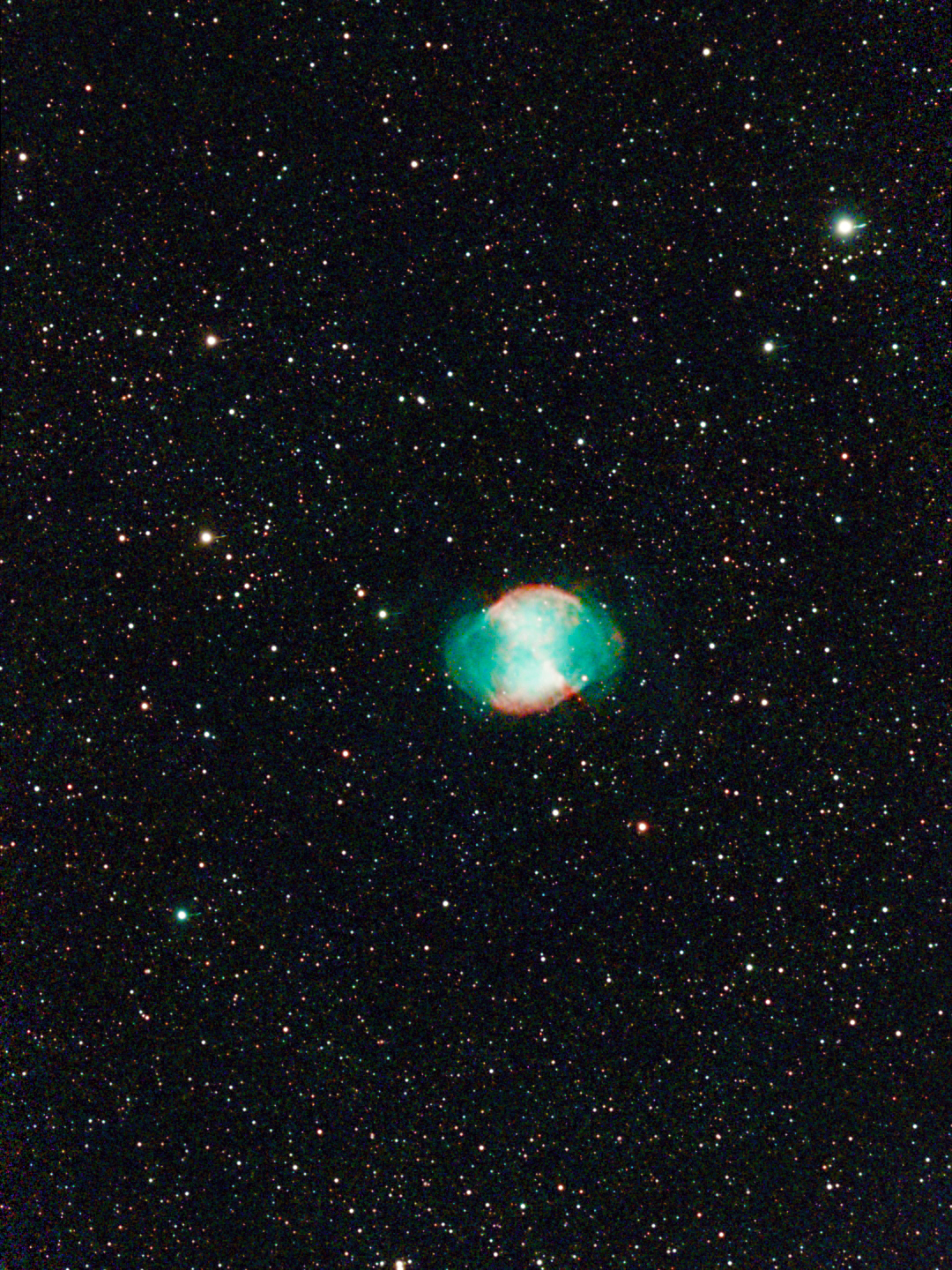
Image credit: JM (TRAC)
Above image: The Dumbbell Nebula, one of the most recognisable deep-sky objects. Equipment: Seestar S50. F-stop: f/5. Exposure: 193 x 10 sec. Taken at 00:06 on 09 Sep 2026.
Wild Duck Cluster (M11)
The Wild Duck Cluster is a beautiful open star cluster in the constellation Scutum.
The stars form a V-shaped pattern that some observers imagine resembles a flock of flying ducks. Quack, quack!
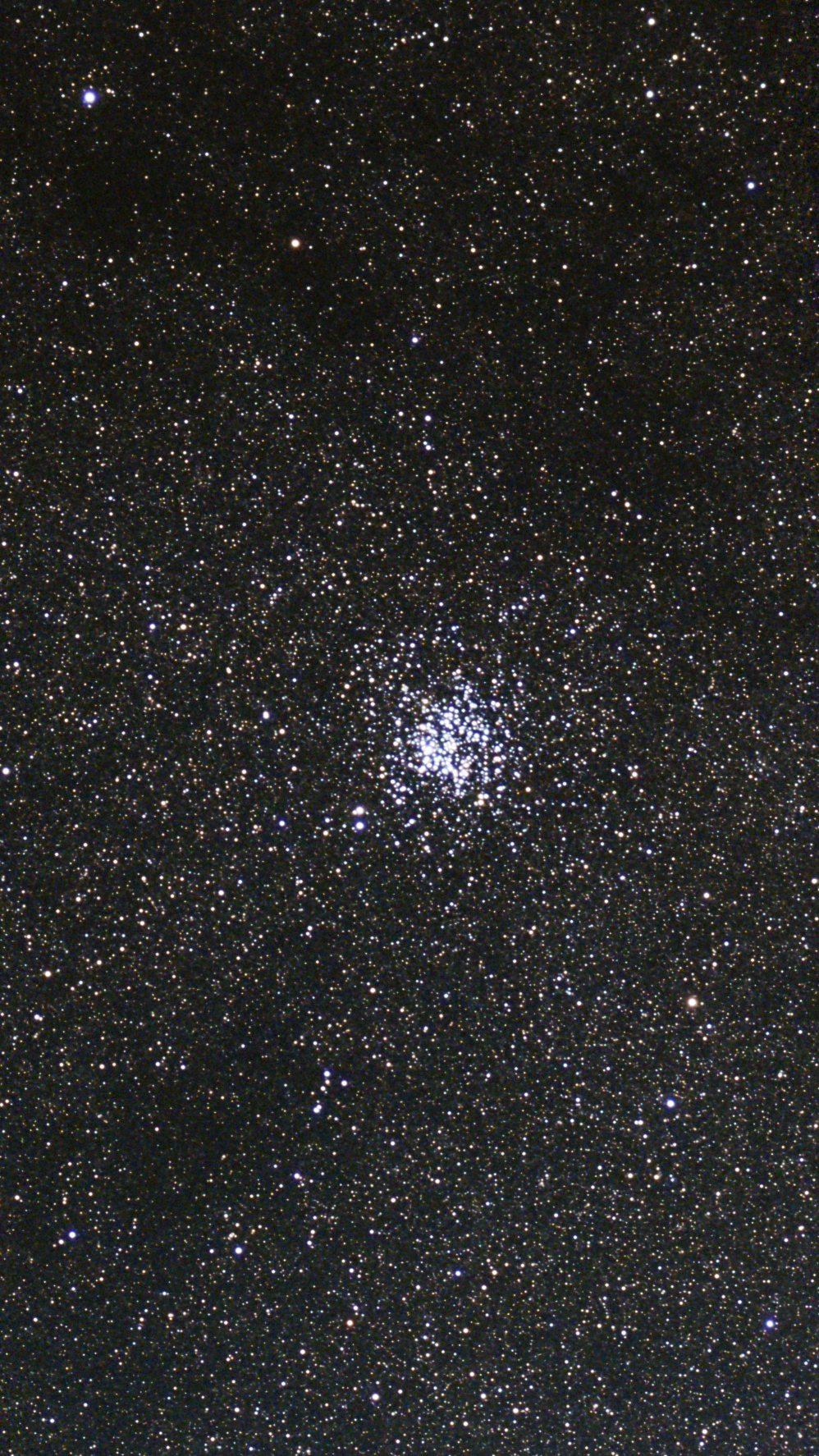
Image credit: JM (TRAC)
Above image: Thousands of stars are believed to belong to this cluster. Equipment: Seestar S50. F-stop: f/5. Exposure: 108 x 10 sec. Taken at 22:55 on 09 Sep 2026.
Albireo (Double Star)
Albireo is a famous double star in the constellation Cygnus, the Swan.
It's one of the best double stars to look at through a small telescope because of the contrast between the golden-orange colour of Albireo A and the blue-white of Albireo B.
The Seestar photo turned out better than the photo we took in July using the telescope and phone adapter.
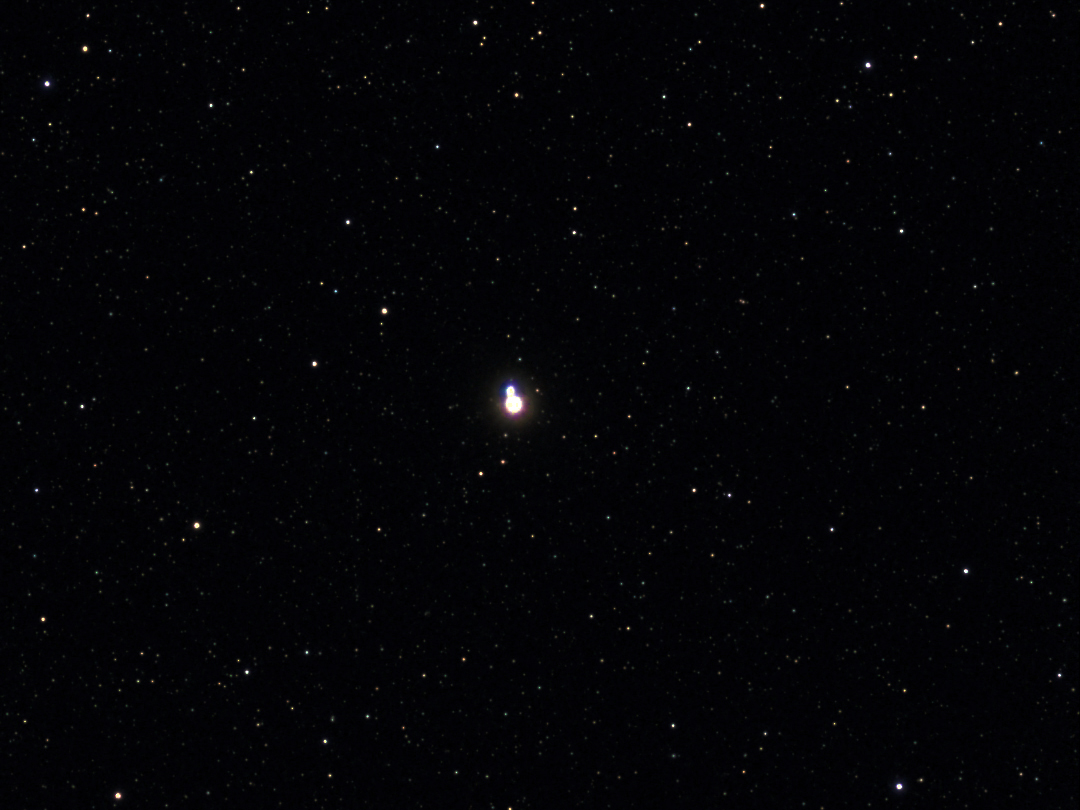
Image credit: JM (TRAC)
Above image: The two stars are separated by only 35 arcseconds. Equipment: Seestar S50. F-stop: f/5. Exposure: 19 x 10 sec. Taken at 00:07 on 07 Sep 2026.
Lunar Observations
Moon at 1st Quarter (20 Sep 2026)
We headed out to test our new Celestron Inspire 90 mm telescope. Our target was the Moon at its first quarter phase.
The terminator was very close to Copernicus crater. At this time in the lunar cycle, the low Sun angle creates long shadows from the rim of the crater rim, making it really stand out.
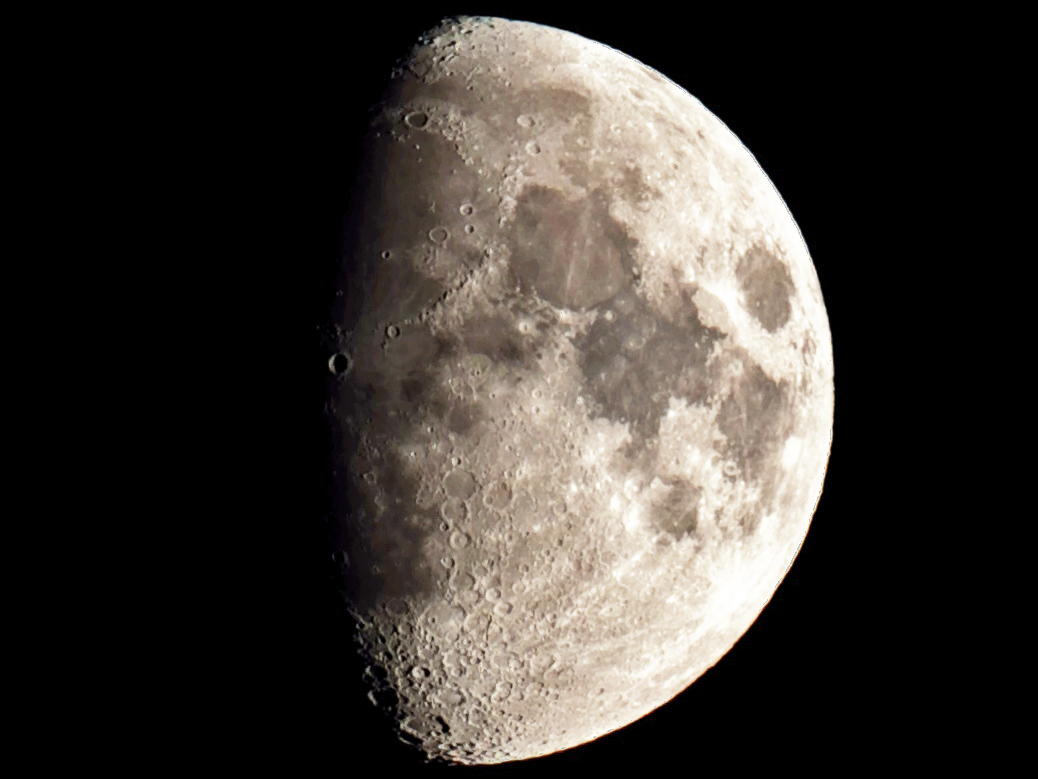
Image credit: KK (TRAC)
Above image: Krum K captured this photo of the Moon at the point where the Sun was rising over the large crater Copernicus. Equipment: Seestar S50. F-stop: f/5. Exposure: 1/186 sec. Focal length: 250 mm. Taken at 19:24 on 20 Sep 2026.
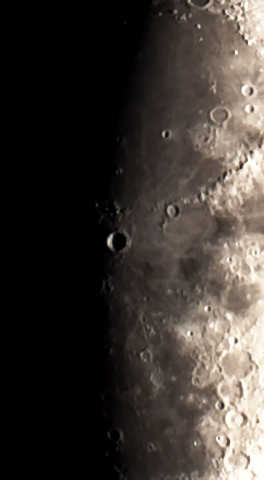
Image credit: KK (TRAC)
Above image: A closer look at the light and shadow around Copernicus Crater in Krum's photo. Equipment: Seestar S50. F-stop: f/5. Exposure: 1/100 sec. Focal length: 250 mm. Taken at 19:30 on 20 Sep 2026.

Image credit: KK + JM (TRAC)
Above image: The new scope produced a reasonably decent image when paired with a phone. Equipment: Celestron Inspire 90 mm refractor + Samsung phone. F-stop: f/1.8. Exposure: 1/50 sec. ISO: 100. Focal length: 600 mm. Taken at 19:50 on 20 Sep 2026.

Image credit: KK + JM (TRAC)
Above image: Detail can be seen at a higher magnification, though the quality is not impressive when compared to our club's other telescope. Equipment: Celestron Inspire 90 mm refractor + Samsung phone. F-stop: f/1.8. Exposure: 1/111 sec. ISO: 100. Focal length: 600 mm. Taken at 19:55 on 20 Sep 2026.
Observe the Moon Night (26 Sep 2026)
September Moongazing in the UK
It was great to see so many people at our Observe the Moon Night event on 26 September. We hope you had a fun time exploring the Moon through the telescopes and enjoyed the evening with us.
Well done to all the children who completed the "Moon Explorer Challenge" under poor weather conditions.
Thanks for bearing with the clouds – we hope they didn't spoil your evening too much and that you still managed to get some good views of the Moon.
Stay tuned for upcoming astronomy events this winter!
Seestar S50 Moon Photo
Krum K was in charge of setting up our Seestar S50 smart telescope and keeping it aligned with the Moon all evening. His patience once again paid off, and he captured the below image of September's Full Moon, known historically as a Harvest Moon.

Image credit: KK (TRAC)
Above image: Krum K took this detailed photo of the Harvest Moon during TRAC's Observe the Moon Night event. Equipment: Seestar S50. F-stop: f/5. Exposure: 1/463 sec. Focal length: 250 mm. Taken at 21:03 on 26 Sep 2026.
Stars of the Evening: Our Volunteers
Thank you to everyone who helped with our Moon Night event! It wouldn't have been possible without your help and expertise.
Special thanks to Krum K for operating the Seestar smart telescope throughout the evening and showing visitors a live view of the Moon; to David M for manning telescopes and sharing his astronomy knowledge with visitors; to Matey K for efficiently setting up our equipment, keeping everything running smoothly, and answering technical questions; and to Kacy D for offering visitors views of the Moon through binoculars while they waited in the queue.

Image credit: DM (TRAC)
Above image: Telescopes and tables. Astronomy Club members show members of the public an up-close view of our nearest celestial neighbour – the Moon. Taken at 20:14 on 26 Sep 2026.
Planets
Saturn
Saturn appeared as a bright star in the eastern sky after 20:00. Eventually, after 21:00, we managed to catch a glimpse of the planet through a brief gap in the clouds during our Moon Night event.
At around 1.3 billion kilometres from Earth, Saturn appears quite small in the telescope eyepiece. Even so, seeing its distinctive rings through a telescope is always an amazing sight and something that's well worth waiting for!
Saturn (Seestar S50 Test)
While the Seestar S50 isn’t designed for photographing small objects such as planets, it was still able to capture Saturn’s rings and pick up the distinctive orange colour of Titan.
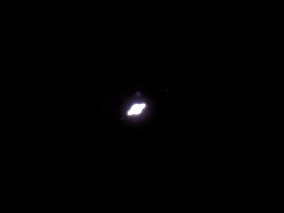
Image credit: JM (TRAC)
Above image: Saturn with its largest moon, Titan, visible above the ringed planet. Equipment: Seestar S50. F-stop: f/1.7. Exposure: 1/10 sec. Taken at 00:18 on 07 Sep 2026.
Summary
New Equipment
It was fun to test out a few new telescopes this month. We tested the Celestron 60 mm, 130 mm reflector, and Inpsire 90 mm scopes in the daytime.
We calibrated the finderscopes by aiming the telescopes at the telegraph pole at the end of the street, then we looked at pigeons resting on television aerials to test the alignment. This was Krum's idea. He loves pigeons.
Looking Ahead
October should be a good time to press ahead with our DSO astrophotography.
I'm also delighted to welcome our newest member, Kacy, to the astronomy club! With the nights beginning to draw in, September is the perfect time to get involved with astronomy.
James M
TRAC Team Leader
01 Oct 2026 – Rainham, Kent

TRAC is an amateur astronomy group based in Rainham (Kent) in the United Kingdom.
On clear nights, you'll find us outside, observing stars, planets, moons, galaxies, satellites, meteors, and comets.
This monthly report is intended to keep club members informed of our observational activities, track progress towards the club's long-term goals, celebrate successes, and record memorable moments.
Unless stated otherwise, magnitude values refer to apparent magnitude and have usually been rounded to one decimal place; photos of deep-sky objects credited to TRAC were taken using a Seestar S50 smart telescope; our observations were made from Rainham, Kent; and times and dates are in the UK's local time zone (GMT or BST, depending on the time of year).
We welcome any questions, feedback, or suggestions you may have. Please let us know if anything is unclear or if you notice an error, inaccuracy, or typo. Contact us via email.
© 2026 Taverners Road Astronomy Club