TRAC Action Plan: November 2026
- Category: Action Plans
- Author: JM
- Published: 01 Nov 2026
- Last updated: 01 Nov 2026
November 2026 Calendar
- Sun, 01 Nov Last Quarter Moon (20:28)
- Mon, 02 Nov Moon near Mars (00:30)
- Tue, 03 Nov Moon near Jupiter and Regulus (01:00)
- Sat, 07 Nov Moon near Venus and Spica (07:00)
- Mon, 09 Nov New Moon (07:00)
- Mon, 16 Nov Mars near Jupiter (00:00)
- Tue, 17 Nov First Quarter Moon (11:48)
- Sat, 18 Nov Voyager 1 (one light day)
- Fri, 20 Nov Mercury Greatest Elongation (07:00)
- Tue, 24 Nov Full Moon (Moonrise: 15:20)
- Thu, 26 Nov Uranus at Opposition
- Sat, 28 Nov Moon occults Praesepe (22:00)
- Mon, 30 Nov Moon near Jupiter, Mars, and Regulus (00:00)
Stargazing
Autumn/Winter Constellations
Constellations to look out for this month:
- Cygnus
- Taurus
- Orion
- Pegasus
- Cepheus
- Aquila
- Andromeda
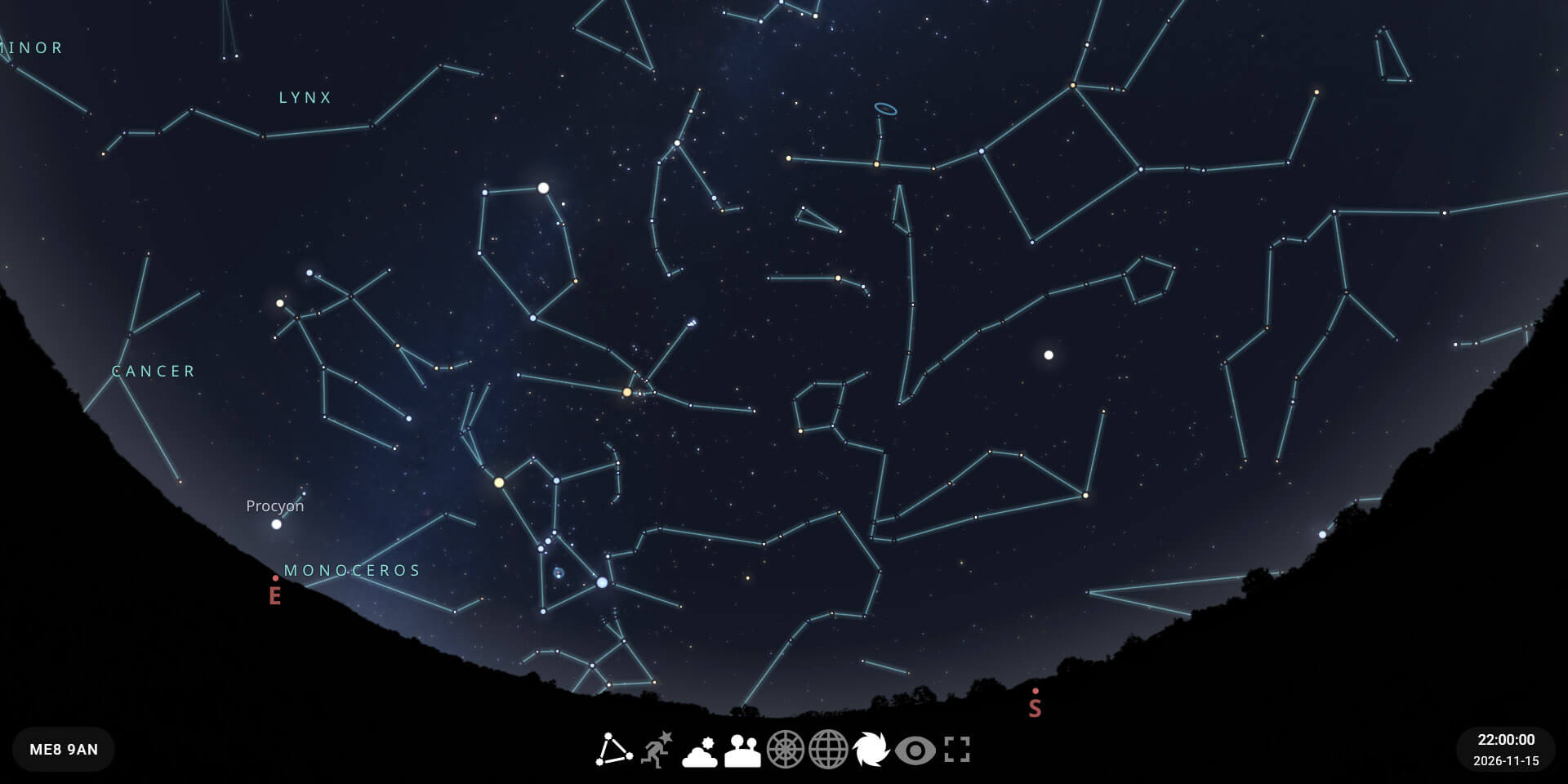
Image credit: Stellarium
Above image: A view of the constellations visible in the night sky looking south-east on 15 Nov 2026.
Astrophotography
TRAC's number one mission for 2026 is to photograph as many deep-sky objects (DSOs) as we can.
In November and December, we'll focus on star clusters and galaxies as our deep-sky targets.
Star Clusters
Star clusters are large groups of stars that formed from the same giant cloud of gas and dust. The stars in the cluster are held together by gravity.
Open clusters and globular clusters are both groups of stars held together by gravity, but they differ in their size, age, shape, and how closely their stars are packed together.
You can see most of the star clusters listed below from Rainham with a pair of binoculars.
Open Clusters
Open clusters contain tens to thousands of stars, which are spread out relatively loosely across space. Their stars are often young and blue.
Possible targets:
- The Pleiades (M45)
- Double Cluster (NGC 869/884)
- M34 (Spiral Cluster in Perseus)
- NGC 457 (Owl Cluster)
- NGC 663 (Caldwell 10)
Globular Clusters
Globular clusters are enormous, tightly packed, roughly spherical groups containing hundreds of thousands or sometimes even millions of stars.
Possible targets:
- M15 (Great Pegasus Cluster)
- M2 (NGC 7089)
Galaxies
Andromeda Galaxy (M31)
We didn't get a chance to capture a detailed image of M31 (mag. +3.4) last month, but we'll try to do so over the first two weeks of November if conditions are favourable.
Silver Sliver Galaxy (NGC 891)
A beautiful edge-on spiral with a dark dust lane. It gets very high in the UK sky in autumn, and its narrow shape fits the S50 field of view well.
Phantom Galaxy (M74)
Messier 74 is a large spiral galaxy in the equatorial constellation Pisces. It's about 32 million light-years away from Earth.
Planets
Mercury
- Reaches inferior conjunction on 04 Nov 2026.
- Reappears in the morning sky and is best seen at 7 AM towards the end of the month.
- Magnitude: +0.0
Venus
- A morning planet, close to bright star Spica (+1.0).
- 07 Nov - 7 AM: Venus will be 1.3 degrees W of Spica and 2.2 degrees E of a 4% lit waning crescent Moon.
- Magnitude: -4.1
Mars
- Visible by 01:00 at the end of the month.
- Mars is gradually getting closer to Jupiter.
- Mars and Jupiter will be in conjunction between 16 and 18 Nov.
- Magnitude: +0.9
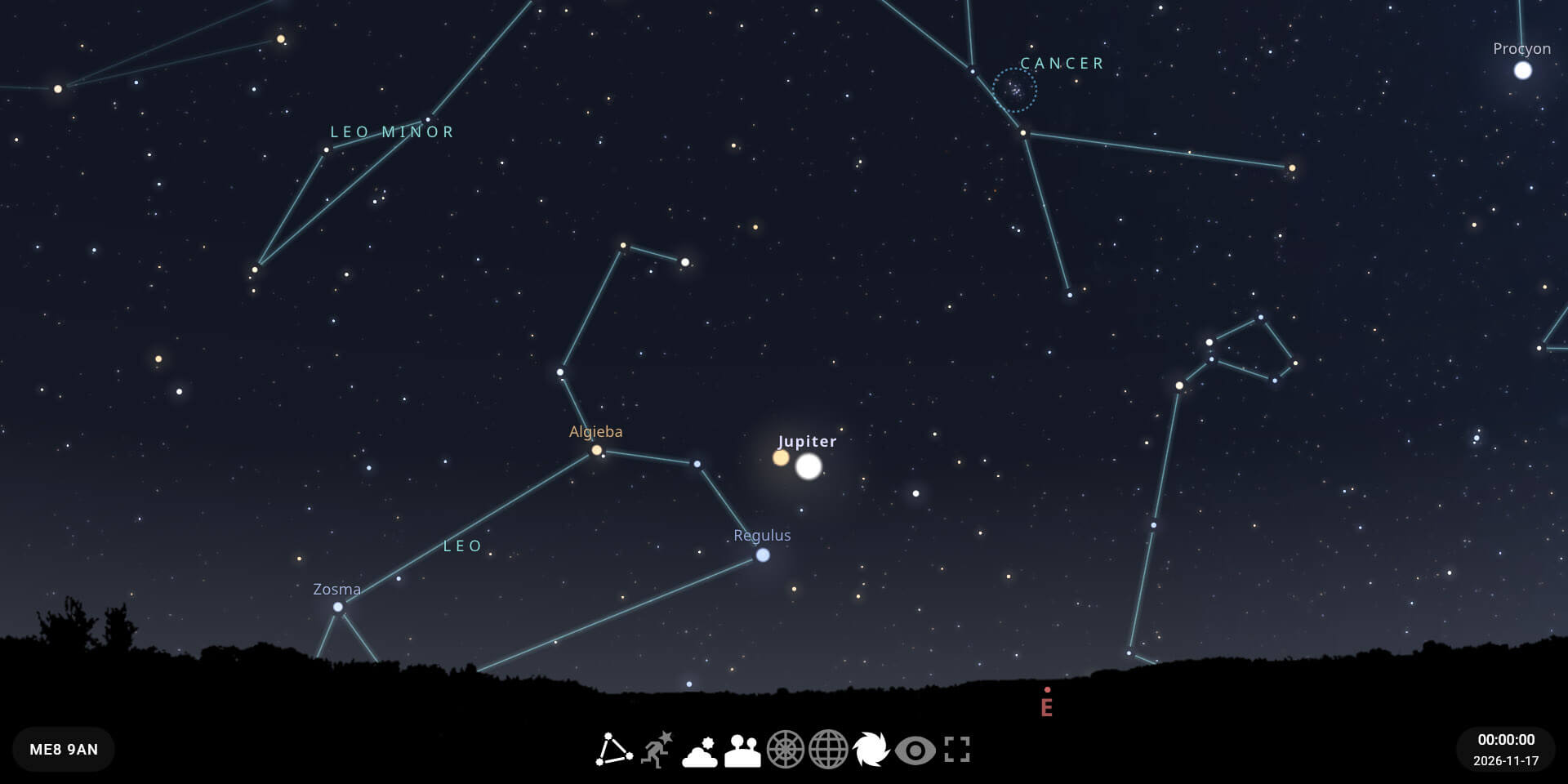
Image credit: Stellarium
Above image: Mars will lie close to Jupiter between 16 Nov and 18 Nov 2026.
Jupiter
- Visible by 23:00 at the end of the month.
- 30 Nov 2026 - Midnight: The Moon, Mars, Regulus, and Jupiter will all lie within a 7-degree circle.
- Magnitude: -2.1
Saturn
- High under dark skies all month long.
- The gap between the planet and its rings should now be noticeable to us.
- Magnitude: +0.6
Uranus
- Easy to find all month in Taurus, close to the Pleiades.
- Reaches opposition on 25 Nov 2026.
- We're looking for the planet's slight green-blue tint.
- Magnitude: +5.6
Neptune
- Visible high in the sky all month in Pisces
- Reached opposition on 26 Sep 2026.
- Our aim is to see its blue colour and largest moon, Triton (mag. +13.4).
- Magnitude: +7.8
Minor Planets
If you're interested in spotting a minor planet in the asteroid belt between Mars and Jupiter, look out for Pallas (2) and Vesta (4), both of which can be observed with binoculars this month.
As we saw in October, the Seestar S50 is capable of capturing a photo of Pluto. See if you can get a clearer image of this distant magnitude +15.5 minor planet!
Lunar Observations
November 2026 Lunar Calendar
- Last Quarter Sun 01
- New Moon Mon 09
- First Quarter Tue 17
- Full Moon Tue 24
November 2026 Full Moon
- Date: 24 Nov 2026
- Moonrise: 15:20
- Traditional Name: "Beaver Moon"
Lunar Conjunctions
| Date | Time | Event |
|---|---|---|
| 02 Nov 2026 | After 00:30 | Moon near Mars |
| 03 Nov 2026 | After 01:00 | Moon near Jupiter and Regulus |
| 07 Nov 2026 | Before 07:00 | Moon near Venus and Spica |
| 30 Nov 2026 | After Midnight | Moon near Jupiter, Mars, and Regulus |
Lunar Occultations
Moon Occults Praesepe (M44)
28 Nov 2026: The Moon will begin occulting Praesepe (the Beehive Cluster) at around 22:00, with the event continuing into the early hours of the 29th.
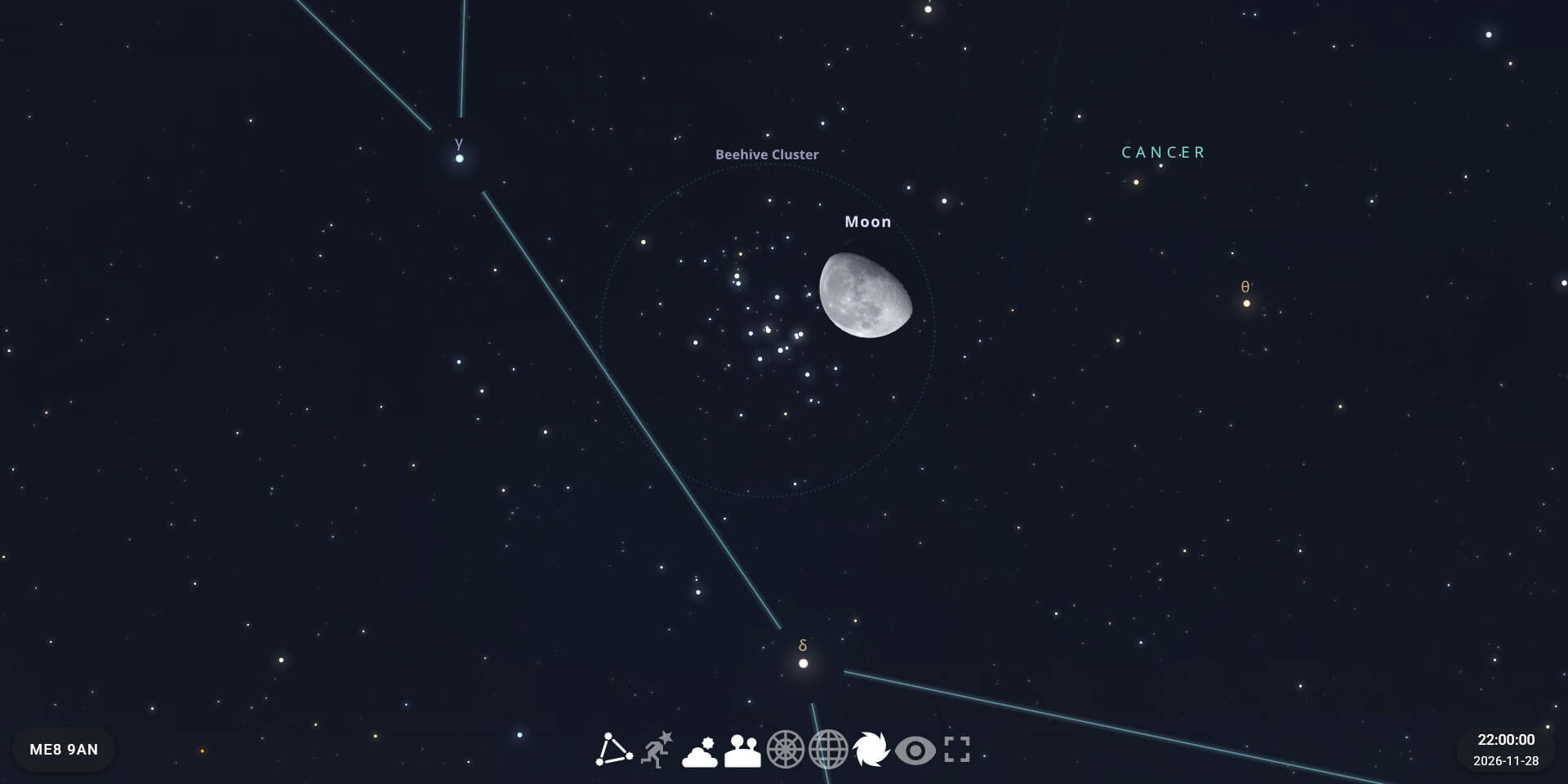
Image credit: Stellarium
Above image: The Moon begins moving in front of the Beehive star cluster at 22:00 on 28 Nov 2026.
Meteor Showers
There are no major meteor showers this month.
Summary
Top Priorities for November 2026
In descending order of importance:
- Mars–Jupiter Conjunction (17 Nov)
- DSO Astrophotography
- Uranus and Neptune (if there's enough time)
- Moon Occults Praesepe (28 Nov)
Voyager 1
NASA launched the Voyager 1 space probe on 05 Sep 1977 – 49 years ago! It passed Jupiter in 1979 and Saturn in 1980. It's now 26 billion km (16 billion miles) from Earth.
Voyager 1 is the most distant human-made object from Earth and is predicted to reach a distance of one light day from Earth on 18 Nov 2026.
See You Out There
The main highlight in November will be the close conjunction of two bright, naked-eye planets, Mars and Jupiter, on 16–18 November.
Be sure to make the most of all the clear nights we get this month!
James M
TRAC Team Leader
01 Nov 2026 – Rainham, Kent

TRAC is an amateur astronomy group based in Rainham (Kent) in the United Kingdom.
On clear nights, you'll find us outside, observing stars, planets, moons, galaxies, satellites, meteors, and comets.
This action plan is specifically tailored for our location (Rainham, Kent), schedules, optical equipment, level of experience, personal interests, and local sky conditions.
Unless stated otherwise, magnitude values refer to apparent magnitude and have usually been rounded to one decimal place; photos of deep-sky objects credited to TRAC were taken using a Seestar S50 smart telescope; our observations were made from Rainham, Kent; and times and dates are in the UK's local time zone (GMT or BST, depending on the time of year).
We welcome any questions, feedback, or suggestions you may have. Please let us know if anything is unclear or if you notice an error, inaccuracy, or typo. Contact us via email.
© 2026 Taverners Road Astronomy Club