TRAC Action Plan: May 2026
- Category: Action Plans
- Author: JM
- Published: 30 Apr 2026
- Last updated: 27 May 2026
May 2026 Calendar
- Fri, 01 May Full Moon
- Mon, 04 May Moon close to Antares (Early AM)
- Wed, 06 May Eta Aquarids Meteor Shower peaks
- Sat, 09 May Last Quarter Moon
- Sat, 16 May New Moon
- Mon, 18 May Moon close to Venus (21:45)
- Tue, 19 May Moon between Venus and Jupiter (21:45)
- Wed, 20 May Moon close to Jupiter (21:45)
- Sat, 23 May First Quarter Moon
- Sat, 23 May Lunar V and Lunar X Clair-Obscur Effects (22:00)
- Sat, 30 May Moon close to Antares (After 22:30)
- Sun, 31 May Full Moon (Blue Moon!)
Stargazing
Spring/Summer Constellations
Constellations to look out for this month:
- Leo
- Boötes
- Corona Borealis
- Hercules
- Gemini
- Corvus
- Libra
- Leo Minor
- Coma Berenices
- Crater
- Virgo
Star of the month: Arcturus. The brightest star in the constellation Boötes, the Herdsman. Arcturus shines at mag. +0.2 and sits at the southern tip of the kite shape in Boötes.
The bright globular cluster M13 in Hercules is also worth looking for with the telescope and perhaps photographing with the Seestar if there's enough time.
Astrophotography
TRAC's number one mission for 2026 is to photograph as many deep-sky objects as possible.
As always, we need a clear, moonless night to achieve the best results possible with the Seestar S50.
We'll aim to take photos of several prominent galaxies in the constellations of Virgo and Ursa Major:
Virgo contains hundreds of interesting objects. We'll focus on the ones we didn't photograph in April.
Virgo Galaxies
Virgo is home to our nearest giant galaxy cluster, which contains over 2,000 galaxies. Our Milky Way galaxy is part of the Virgo Supercluster.
Markarian's Chain (mag. +8.9 and higher)
This iconic arc-shaped grouping of galaxies within the Virgo Cluster is made up of 8-10 prominent galaxies. These include M84, M86, NGC 4435, and NGC 4438.
The Sombrero Galaxy (mag. +8.0)
M104 (NGC 4594), also known as the "Sombrero Galaxy", is a peculiar galaxy of uncertain classification, located on the border between Virgo and Corvus.
Messier 49 (mag. +9.4)
M49 (NGC 4472) is a huge elliptical galaxy about 60 million light-years away in the Virgo Cluster of galaxies. The Seestar might be able to detect many of the fainter galaxies which lie in the vicinity of M49.
Swelling Spiral Galaxy (mag. +10.2)
M61 (NGC 4303), also known as the "Swelling Spiral Galaxy", is an intermediate barred spiral galaxy in the Virgo Cluster. It's roughly 55 million light-years from Earth.
Messier 87 (mag. +9.6)
M87 (NGC 4486), also known as Virgo A, is a giant elliptical galaxy about 55 million light-years away. M87 is the largest galaxy in the Virgo cluster and contains several trillion stars.
Ursa Major Galaxies
Galaxies overhead in Ursa Major can be seen from the garden all evening. Let's aim to photograph these two:
The Cigar Galaxy (mag. +8.4)
M82 (NGC 3034), also known as the "Cigar Galaxy", is a starburst galaxy about 12 million light-years away.
Vacuum Cleaner Galaxy (mag. +9.8)
M109 (NGC 3992), also known as the "Vacuum Cleaner Galaxy", is a barred spiral galaxy roughly 60 million light-years away. It's the brightest member of the Ursa Major Galaxy Group of roughly 80 galaxies.
Online reports mention that M109 is difficult to view from light-polluted skies. The Seestar S50 will need to rise to the challenge.
Planets
Mercury
- Mercury starts the month as a morning planet and ends the month as an evening planet.
- Superior conjunction occurs on 14 May 2026.
- It will be low in the sky after sunset towards the end of May, but it won't be easy to see because it won't be very bright against the twilight sky.
- Magnitude: -1.0
Venus
- The best time to view Venus is early in the evening when it appears in the west at twilight.
- 18 May 2026: Venus will be positioned next to a 6%-lit crescent Moon (23:00).
- 20 May 2026: Venus will be close to M35 (23:00)
- Magnitude: -4.0
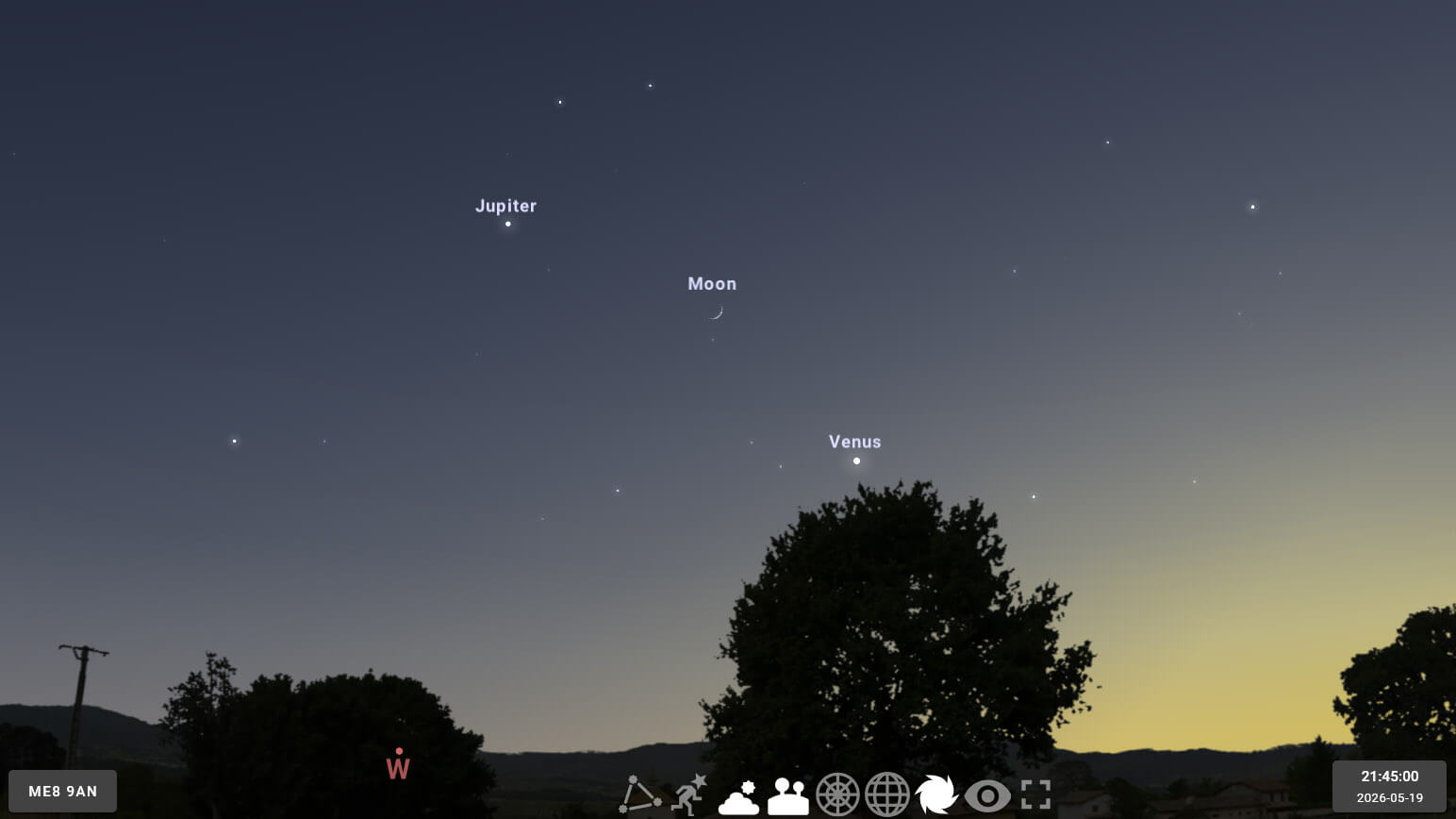
Image credit: Stellarium
Above image: A simulated view showing the crescent Moon between Venus and Jupiter in the twilight sky on 19 May 2026.
Mars
- Mars will still be low down in the morning sky.
- We'll wait until August or September to view Mars.
- Magnitude: +1.2
Jupiter
- Jupiter sets at 01:00 at the start of May.
- May will be the final good month to see Jupiter.
- Watch out for Venus and Jupiter approaching each other.
- Magnitude: -2.0
Jupiter Event Timings:
Saturn
- Saturn is a morning planet, but it's too close to the Sun to be seen easily.
- Magnitude: +0.9
Uranus
- Uranus is too close to the Sun to be seen.
- Magnitude: +5.8
Neptune
- Neptune is not visible this month.
Lunar Observations
May 2026 Lunar Calendar
- Full Moon Fri 01
- Last Quarter Sat 09
- New Moon Sat 16
- First Quarter Sat 23
- Full Moon Sun 31
May 2026 Full Moons
- 01 May 2026: The first Full Moon of May 2026 will rise at 20:40.
- May's Full Moon is called a "Flower Moon".
- It will be located in the constellation of Libra.
- 31 May 2026: The second Full Moon of May 2026 will rise at 22:00.
- When we get two full moons in the same calendar month, the second one is often referred to as a "Blue Moon".
Lunar Conjunctions
- 04 May 2026: Full Moon close to Antares (after midnight).
- 18 May 2026: 6%-lit crescent Moon next to Venus in the west after sunset (22:00).
- 19 May 2026: 13%-lit Moon between Venus and Jupiter (22:00).
- 20 May 2026: 22%-lit Moon close to Jupiter (22:00).
- 30 May 2026: Full Moon close to Antares (22:00).
Meteor Showers
The Eta Aquarids
- Active Dates: 19 Apr - 28 May
- Peak Night: 06 May 2026 (AM)
- Peak Rate: Up to 50 meteors per hour
- Radiant: Aquarius
- This shower is caused by Earth passing through debris from Halley's Comet.
- Very difficult to see due to the low altitude of the radiant.
The Eta Aquarids in 2026:
Spoilt this year by bright moonlight.
I'll be very impressed if anyone is able to see a meteor during this shower!
Summary
Top Priorities for May 2026
In descending order of importance:
See You Out There
Let's see how many Virgo galaxies we can capture in the middle of May.
Pay attention to the relative positions of Venus and Jupiter. The two planets will get closer together in the evening sky over the course of May before passing close by each other in June.
James M
TRAC Team Leader
30 Apr 2026 – Rainham, Kent

TRAC is an amateur astronomy group based in Rainham (Kent) in the United Kingdom.
On clear nights, you'll find us outside, observing stars, planets, moons, galaxies, satellites, meteors, and comets.
This action plan is specifically tailored for our location (Rainham, Kent), schedules, optical equipment, level of experience, personal interests, and local sky conditions.
Unless stated otherwise, magnitude values refer to apparent magnitude and have usually been rounded to one decimal place; photos of deep-sky objects credited to TRAC were taken using a Seestar S50 smart telescope; our observations were made from Rainham, Kent; and times and dates are in the UK's local time zone (GMT or BST, depending on the time of year).
We welcome any questions, feedback, or suggestions you may have. Please let us know if anything is unclear or if you notice an error, inaccuracy, or typo. Contact us via email.
© 2026 Taverners Road Astronomy Club