TRAC Action Plan: June 2026
- Category: Action Plans
- Author: JM
- Published: 31 May 2026
- Last updated: 31 May 2026
June 2026 Calendar
- Mon, 08 Jun Last Quarter Moon
- Tue, 09 Jun Venus close to Jupiter
- Mon, 15 Jun Mercury Greatest Elongation
- Mon, 15 Jun New Moon
- Tue, 16 Jun Moon close to Venus and Jupiter (22:00)
- Wed, 17 Jun Moon very close to Venus (22:00)
- Fri, 19 Jun Moon close to Regulus (Daytime - 14:00)
- Fri, 19 Jun Venus close to Beehive Cluster
- Sun, 21 Jun First Quarter Moon
- Sun, 21 Jun Summer Solstice (Sunset: 21:19)
- Tue, 23 Jun Moon close to Spica
- Sat, 27 Jun Moon close to Antares
- Tue, 30 Jun Full Moon
Stargazing
Summer Constellations
Constellations to look out for this month:
- Boötes
- Corona Borealis
- Hercules
- Cygnus
- Libra
- Lyra
- Coma Berenices
- Ophiuchus
- Virgo
- Cepheus
- Aquila
- Sagittarius
Star of the month: Vega. The brightest star in the constellation Lyra. Vega shines at mag. +0.1, making it one of the brightest stars in the night sky.
24 Comae Berenices: This double star shows one orange star and one blue star which sometimes looks slightly green.
Anyone outside at midnight can look out for Antares, the brightest star in Scorpius. It has a very deep orange-red colour. Look south.
Astrophotography
TRAC's number one mission for 2026 is to photograph as many deep-sky objects as possible.
It doesn't get dark during the summer months. We'll switch to daytime astrophotography – taking photos of the Sun in preparation for the August 2026 Partial Solar Eclipse.
Solar Photography
Sun Photos with a Seestar S50
Krum K and Matei M took a photo of the Sun using the Seestar S50 last month. We'll have another go when the Sun is lower in the sky just to see how that works out.
Sun Photos with a Nikon D80
We got some decent photos of the Moon using the Nikon D80, and now we'll test it out on the Sun. We'll compare the results to the photos we got last year using a phone with the Celestron phone adapter.
Sun Photos with a Svbony SV105
Another thing we can try is the SV105 Planetary Camera. When we used it to see the Moon, the results were not the best. But I think the Sun will be easier because we're only looking to pick up the sunspots. And it will be another way for us to view the solar eclipse in August.
Planets
Mercury
- June 2026 is a great time for us to try to spot the elusive planet Mercury.
- Greatest eastern elongation occurs on 15 Jun 2026 when the planet will be separated from the Sun by 24.5 degrees.
- It should be possible for us to see Mercury after sunset towards the middle of June, but it won't be easy to spot against the bright twilight sky.
- We'll attempt to observe the planet's pinkish hue and its phase, which will be about 40% in mid-June, the same as when we saw it in March 2024.
- Maybe we'll capture a photo showing its colour and phase.
- Magnitude: +0.4
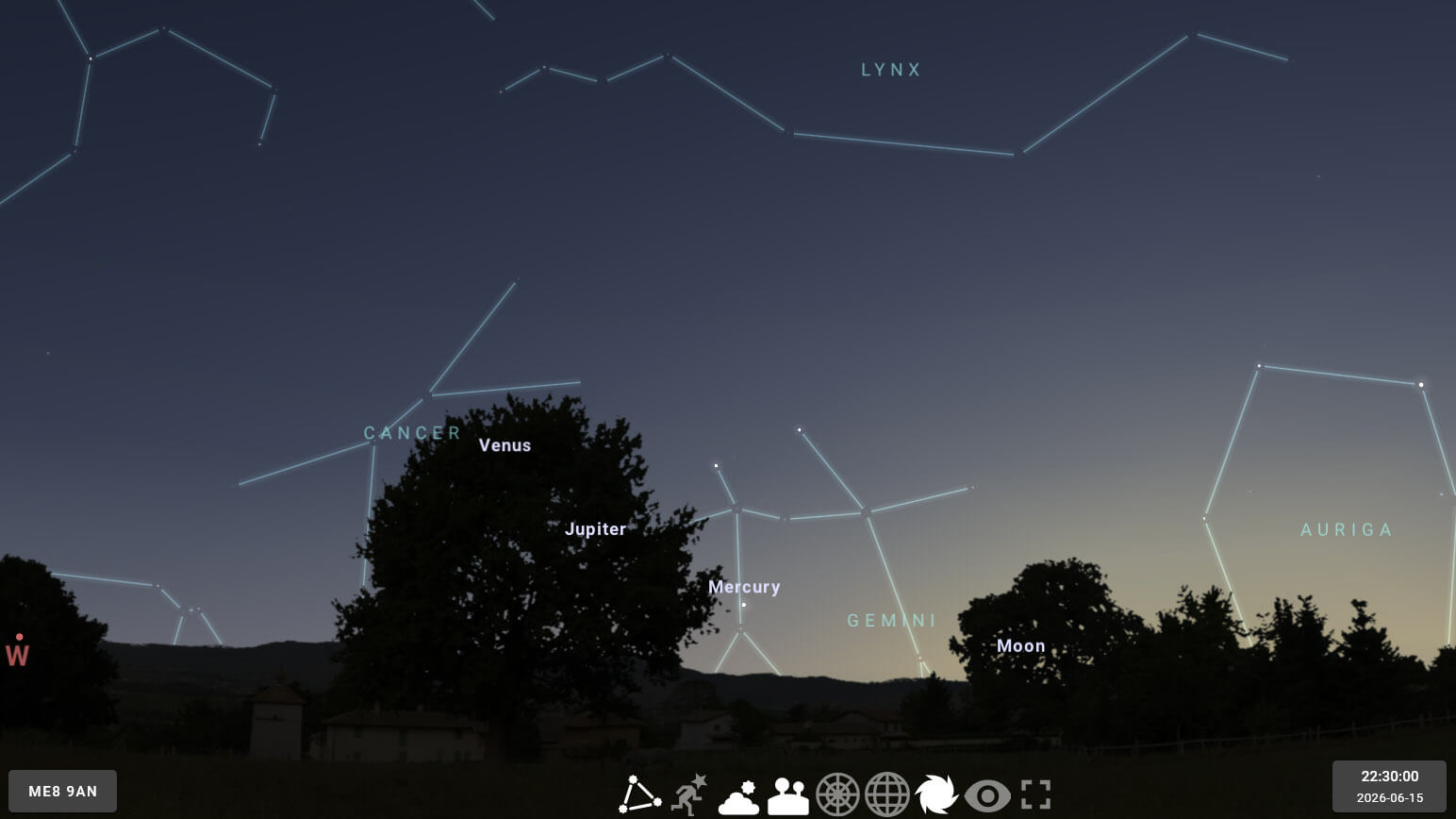
Image credit: Stellarium
Above image: A simulated view showing the position of Mercury on the date of its greatest eastern elongation.
Venus
- The best time to view Venus is early in the evening when it appears in the west at twilight.
- 09 Jun 2026: Venus will be positioned 1.6 degrees from Jupiter.
- 19 Jun 2026: Venus will be close to the Beehive Cluster (22:30).
- The Venus–Jupiter conjunction will make a nice photo, but it will be challenging due to the bright twilight sky as we approach the solstice.
- Magnitude: -4.0
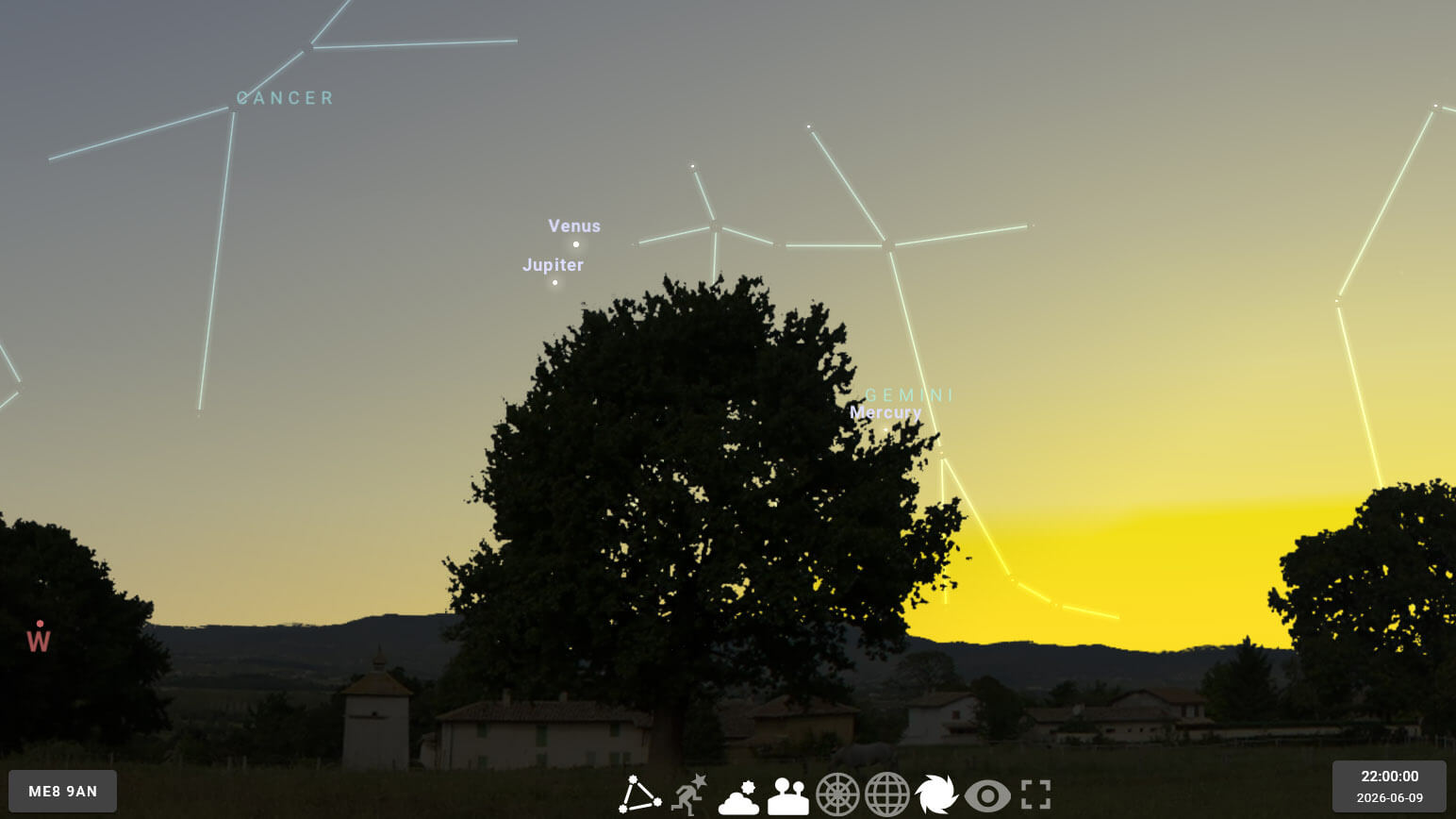
Image credit: Stellarium
Above image: A simulated view showing the Venus–Jupiter conjunction on 09 Jun 2026.
Mars
- Mars will still be low down in the morning sky.
- We'll wait until August or September to view Mars.
- Magnitude: +1.3
Jupiter
- Jupiter sets at 22:30 by the end of June.
- Look out for Jupiter, Venus, Mercury, and a thin crescent Moon on the evenings of the 16th and 17th.
- Watch out for Venus and Jupiter approaching each other leading up to their meeting on 09 Jun 2026.
- Magnitude: -1.9
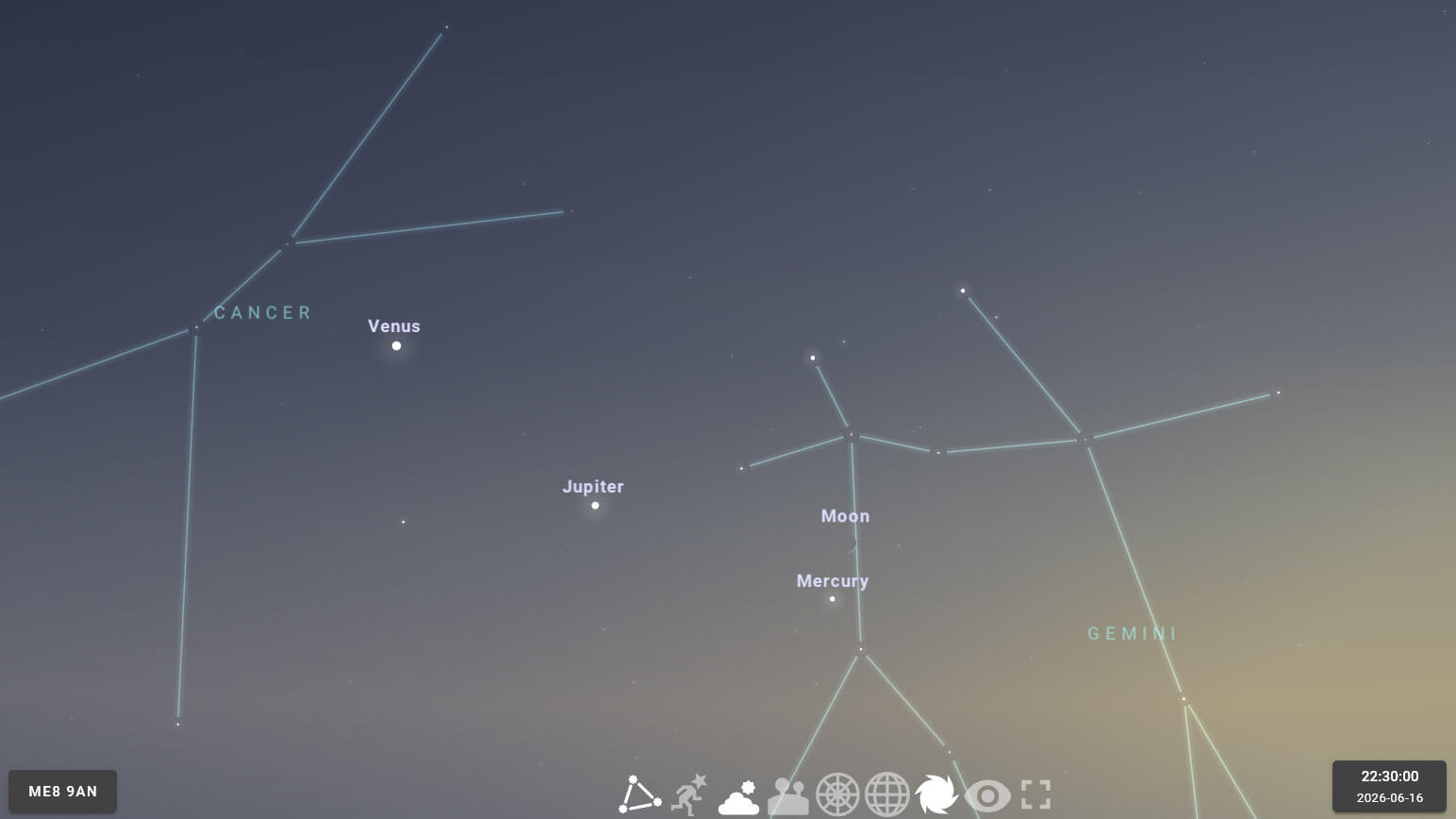
Image credit: Stellarium
Above image: A simulated view showing Mercury, Venus, Jupiter, and the crescent Moon in the western sky at twilight on 16 Jun 2026.
Jupiter Event Timings:
Saturn
- Saturn is a morning planet, but it's only visible shortly before sunset.
- Magnitude: +0.8
Uranus
- Uranus is too close to the Sun to be seen.
- Magnitude: +5.8
Neptune
- Neptune is not visible this month.
Lunar Observations
June 2026 Lunar Calendar
- Last Quarter Mon 08
- New Moon Mon 15
- First Quarter Sun 21
- Full Moon Tue 30
June 2026 Full Moon
- 29 Jun 2026: The Full Moon will rise at 21:38.
- June's Full Moon is called a "Strawberry Moon".
- It will be located in the constellation of Sagittarius.
- This Full Moon will be low and slightly smaller than average.
Lunar Conjunctions
- 16 Jun 2026: Moon close to Venus and Jupiter (22:00).
- 17 Jun 2026: Moon close to Venus (22:00).
- 19 Jun 2026: Moon close to Regulus (mag. +1.4) (Daytime - 14:00).
- 23 Jun 2026: Moon close to Spica (22:00).
- 27 Jun 2026: Moon close to Antares.
Solar Observations
Solar Eclipse Planning
We have a spectacular partial solar eclipse coming up in August 2026. Around 90% of the Sun will be covered by the Moon.
It will be the best solar eclipse visible from Kent for many years. We need to make sure we're ready for it. Preparations start this month!
In previous years, we've had issues with aligning the telescope with the Sun without looking straight at the Sun, something which must be completely avoided. We've also got more camera equipment to use, and it will take practice to get the best results possible.
Here's what we need to do in June and July:
- Review, research, and double-check all safety aspects and procedures related to solar observing.
- Make solar filters from cardboard and the Baader solar film to fit the 70 mm spotting scope and the 80 mm Celestron PowerSeeker scope.
- Is it worth making one for the Celestron Newtonian telescope?
- Test all of these scopes at viewing the Sun. Decide which eyepieces to use with each scope.
- Time how long it takes to set up everything.
- Complete all of the astrophotography activities listed above and assess their suitability for the eclipse event.
- Observe the Sun from the park one evening when the Sun will be at the same altitude as it will be during the peak of the eclipse.
- Make a solar filter for the 10x50 binoculars and the 15x70 binoculars. Is this a good idea?
- Do we need to make more pinhole cameras? Probably, yes.
- It would be a good idea to buy a solar finder? It's a device used to align the telescope with the sun safely and easily.
- Check we have enough Baader Solar Film.
- Design a logo, flyer, poster, and web page for the event.
No doubt we'll add some more to this list as we go. There are always unexpected difficulties when attempting any complex activity for the first time.
Meteor Showers
There are no major meteor showers this month.
Summary
Top Priorities for June 2026
In descending order of importance:
Summer Solstice (21 Jun 2026)
The Summer Solstice occurs on Sunday, 21 Jun 2025. The Sun reaches its highest point in the sky during the day. This is the day with the longest period of daylight and the shortest nighttime.
Perhaps we will be able to view the setting Sun from the quay down by the river if the weather's good.
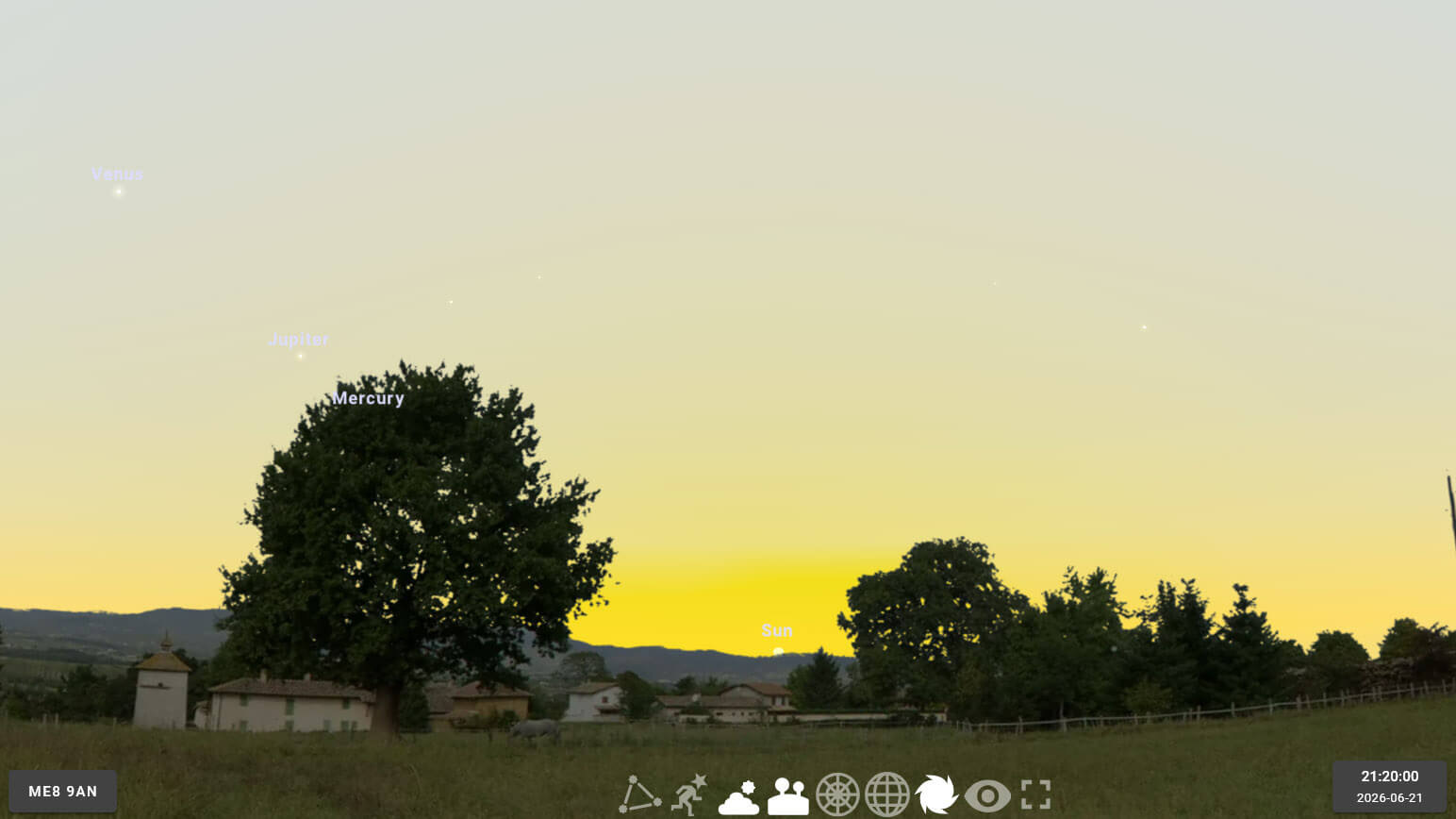
Image credit: Stellarium
Above image: A simulated view showing the time and position of the setting Sun on the Summer Soltice 2026.
See You Out There
Let's see if we can spot three planets (Mercury, Venus, and Jupiter) close together after sunset. Pay attention to the positions of Venus and Jupiter in the twilight sky from the beginning of the month.
June is the ideal month to turn our attention to the Sun in preparation for the spectacular partial solar eclipse coming up in August 2026.
James M
TRAC Team Leader
31 May 2026 – Rainham, Kent

TRAC is an amateur astronomy group based in Rainham (Kent) in the United Kingdom.
On clear nights, you'll find us outside, observing stars, planets, moons, galaxies, satellites, meteors, and comets.
This action plan is specifically tailored for our location (Rainham, Kent), schedules, optical equipment, level of experience, personal interests, and local sky conditions.
Unless stated otherwise, magnitude values refer to apparent magnitude and have usually been rounded to one decimal place; photos of deep-sky objects credited to TRAC were taken using a Seestar S50 smart telescope; our observations were made from Rainham, Kent; and times and dates are in the UK's local time zone (GMT or BST, depending on the time of year).
We welcome any questions, feedback, or suggestions you may have. Please let us know if anything is unclear or if you notice an error, inaccuracy, or typo. Contact us via email.
© 2026 Taverners Road Astronomy Club