TRAC Monthly Report: August 2026
- Category: Monthly Reports
- Author: JM
- Published: 01 Sep 2026
- Last updated: 10 Sep 2026
Astrophotography (AP)
Tracking Sunspots (Seestar S50)
We took photos of the Sun using the Seestar S50 on several consecutive evenings when large sunspots were visible at latitudes close to the Sun's equator.
You can see how the sunspots evolve and move across the Sun's upper atmosphere. The Sun's rotational period can be estimated by measuring the distance they've moved.
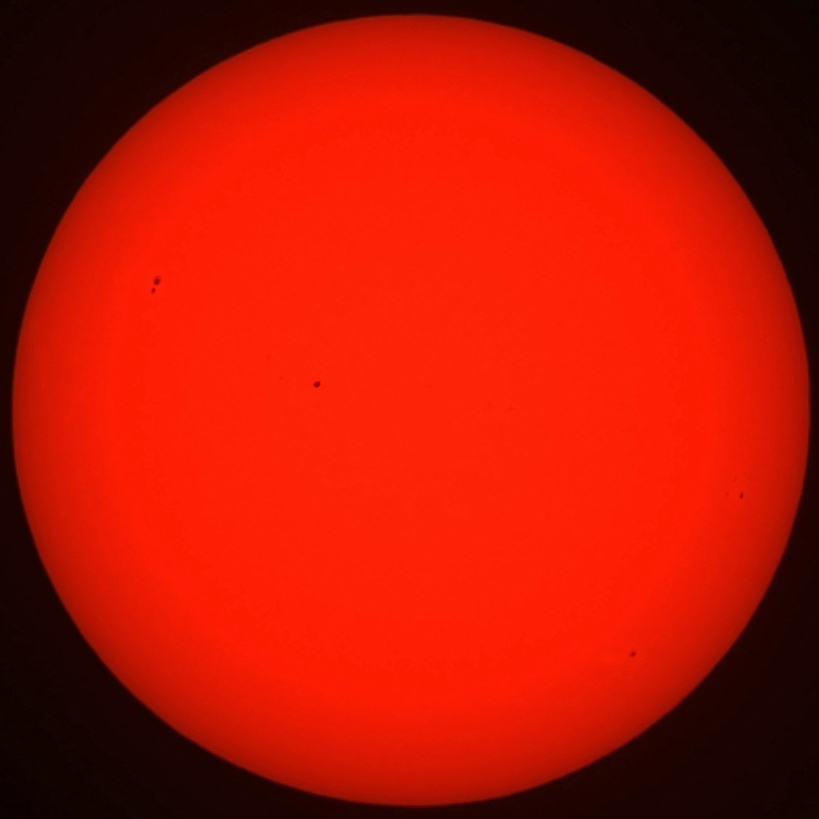
Image credit: JM (TRAC)
Above image: A view of the Sun exactly 24 hours after the peak of the August 2026 partial solar eclipse. Taken at 19:14 on 13 Aug 2026.
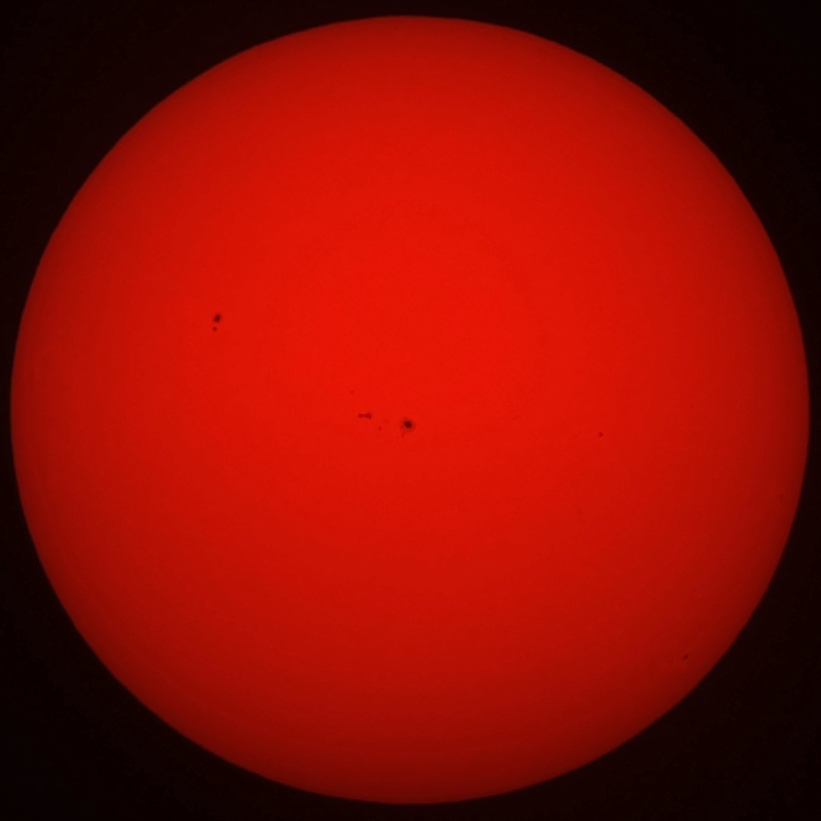
Image credit: JM (TRAC)
Above image: The sunspots had moved roughly 1/11 of the way across the Sun's disc by the same time the following evening. Taken at 19:26 on 14 Aug 2026.
Sun Rotation Period
Using printouts of the two photos of the Sun above, we were able to calculate a rough estimate of the rotational period of the Sun at its equator.
The diameter of the Sun's disc was measured as 190 mm, and the sunspots had drifted 17 mm over the 24-hour interval. These figures yield an estimated rotational period of 22.35 days.
The true figure is approximately 24.47 days. Our estimate was only around 9% off the true value, which is not at all bad for such a basic method.
Next time, we'll try this when the Sun is high overhead, around noon, on a day when there are a few large sunspots across the centre of the Sun. Perhaps this will produce an even more accurate result.
Summer Night Sky Photos
Matey K took his astrophotography to the next level over summer 2026. He returned from his annual trip to Bulgaria with detailed night sky images and videos.
He mounted his Google Pixel 10 phone on a travel tripod and took 16-second exposures when conditions were optimal. He decided to focus on our own galaxy, the Milky Way, and our closest major galaxy, Andromeda.
A selection of Matey's photos are included below.
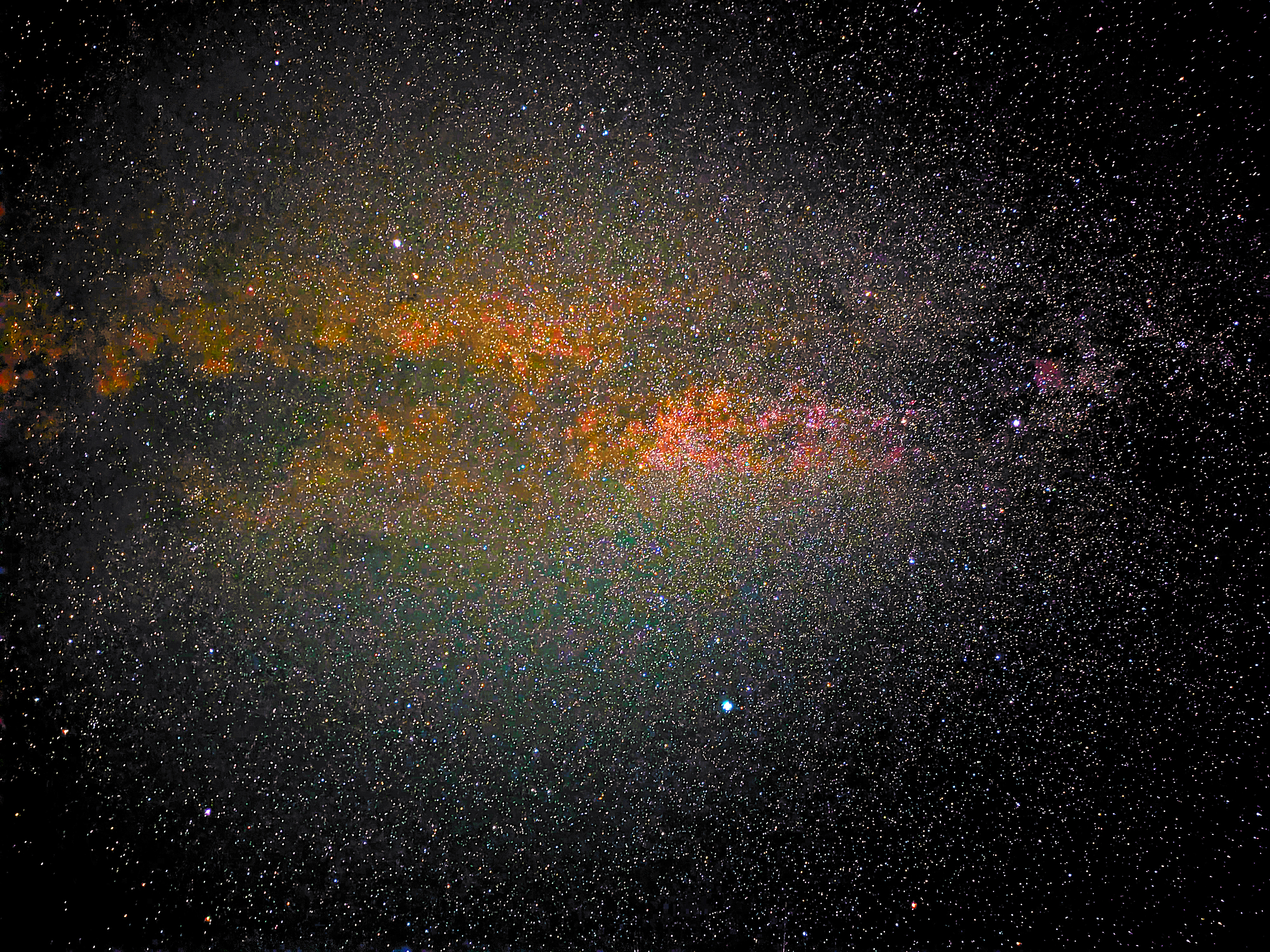
Image credit: MK (TRAC)
Above image: The Milky Way stretching across the Summer Triangle. The bright blue star (lower middle) is Vega, the bright star (top left) is Altair, and the bright star (middle right) is Deneb. Equipment: Google Pixel 10. F-stop: f/1.7. Exposure: 16 sec. Taken at 00:34 on 07 Aug 2026.
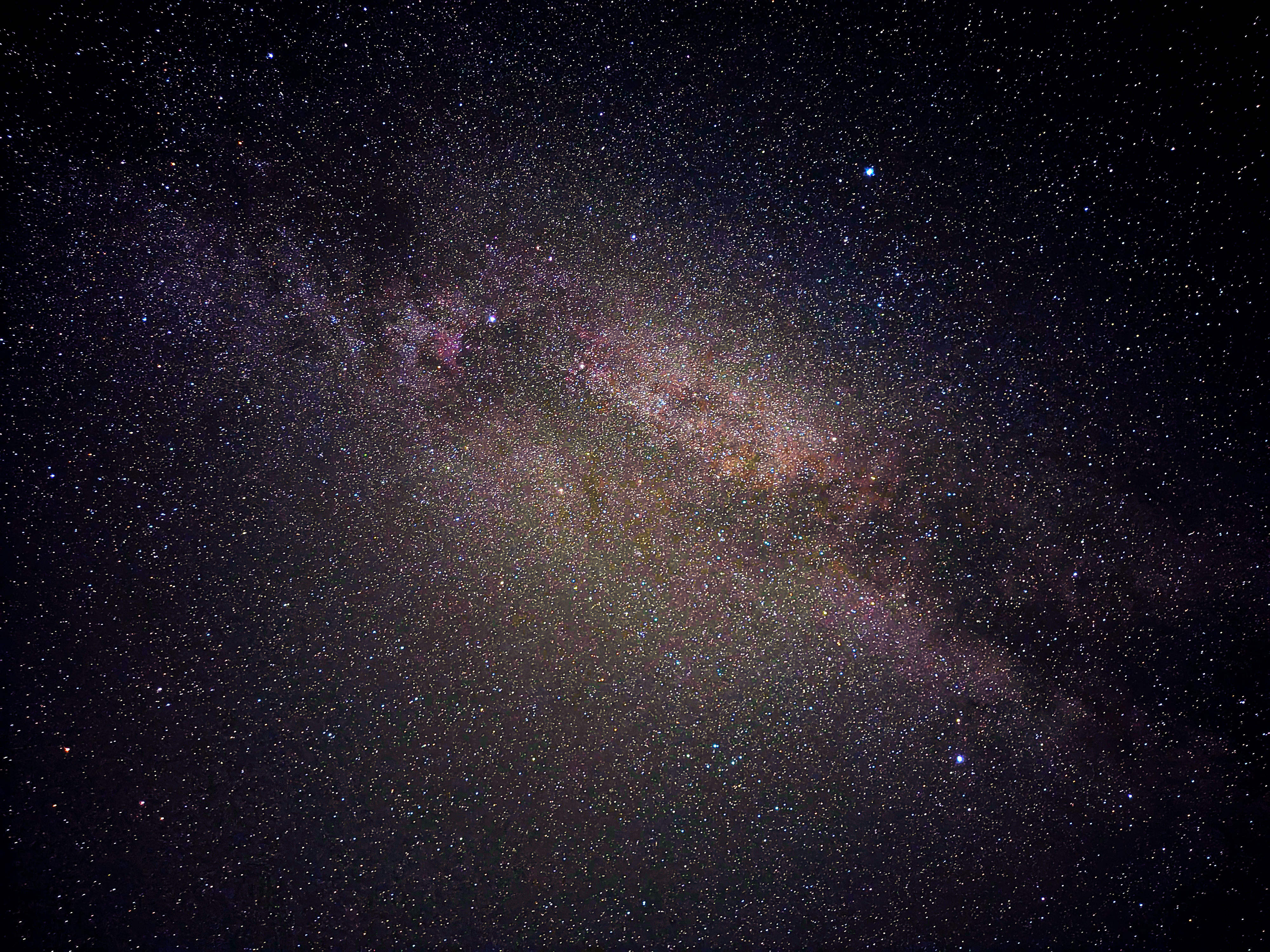
Image credit: MK (TRAC)
Above image: Wow! The light from billions of stars shine as we look towards galactic core of The Milky Way. Equipment: Google Pixel 10. F-stop: f/1.7. Exposure: 16 sec. Taken at 23:18 on 14 Aug 2026.
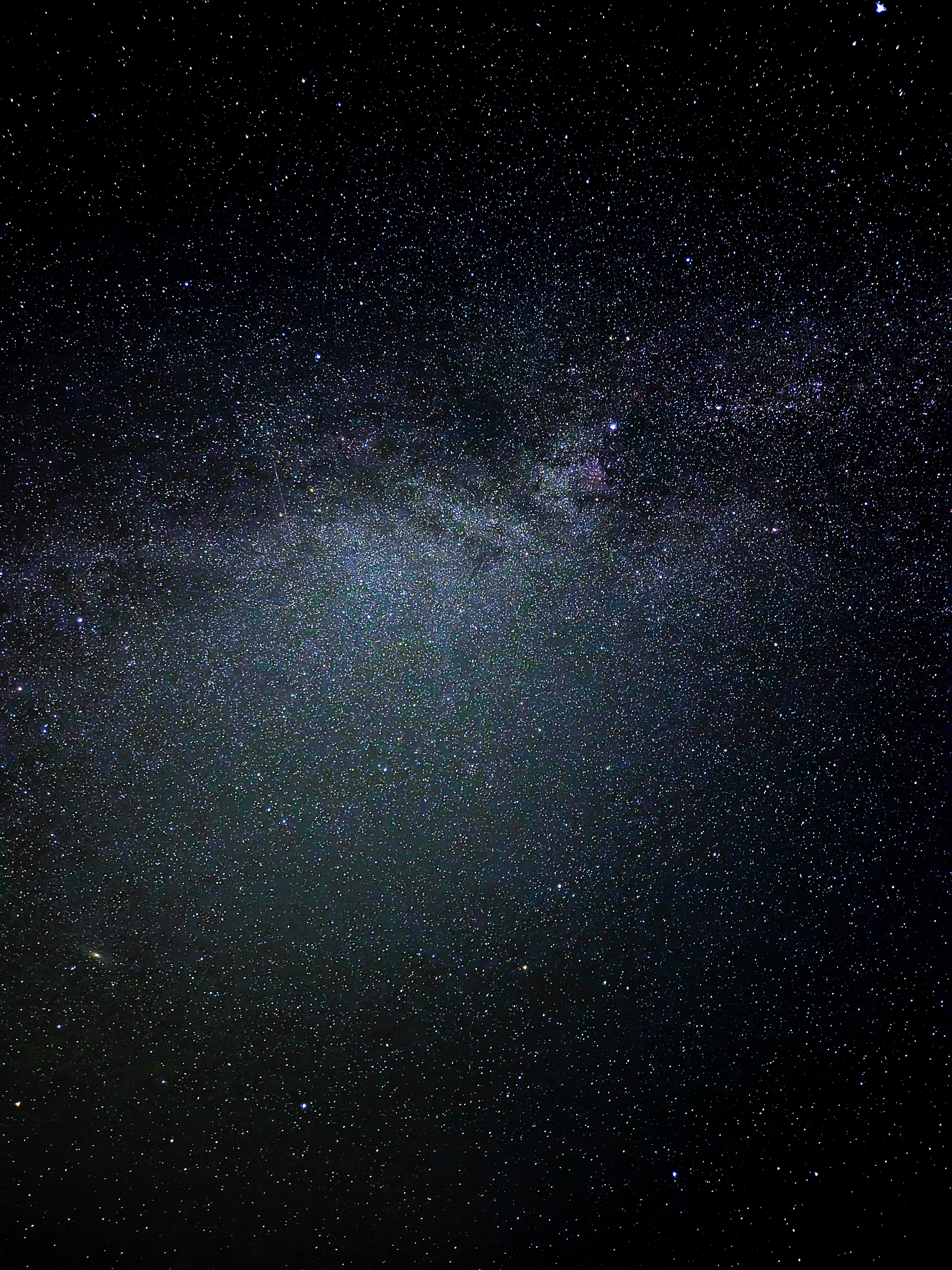
Image credit: MK (TRAC)
Above image: The Milky Way seen from Hungary. The orange star to the lower left is Mirach, with the Andromedga Galaxy above. Equipment: Google Pixel 10. F-stop: f/1.7. Exposure: 16 sec. Taken at 23:36 on 05 Aug 2026.
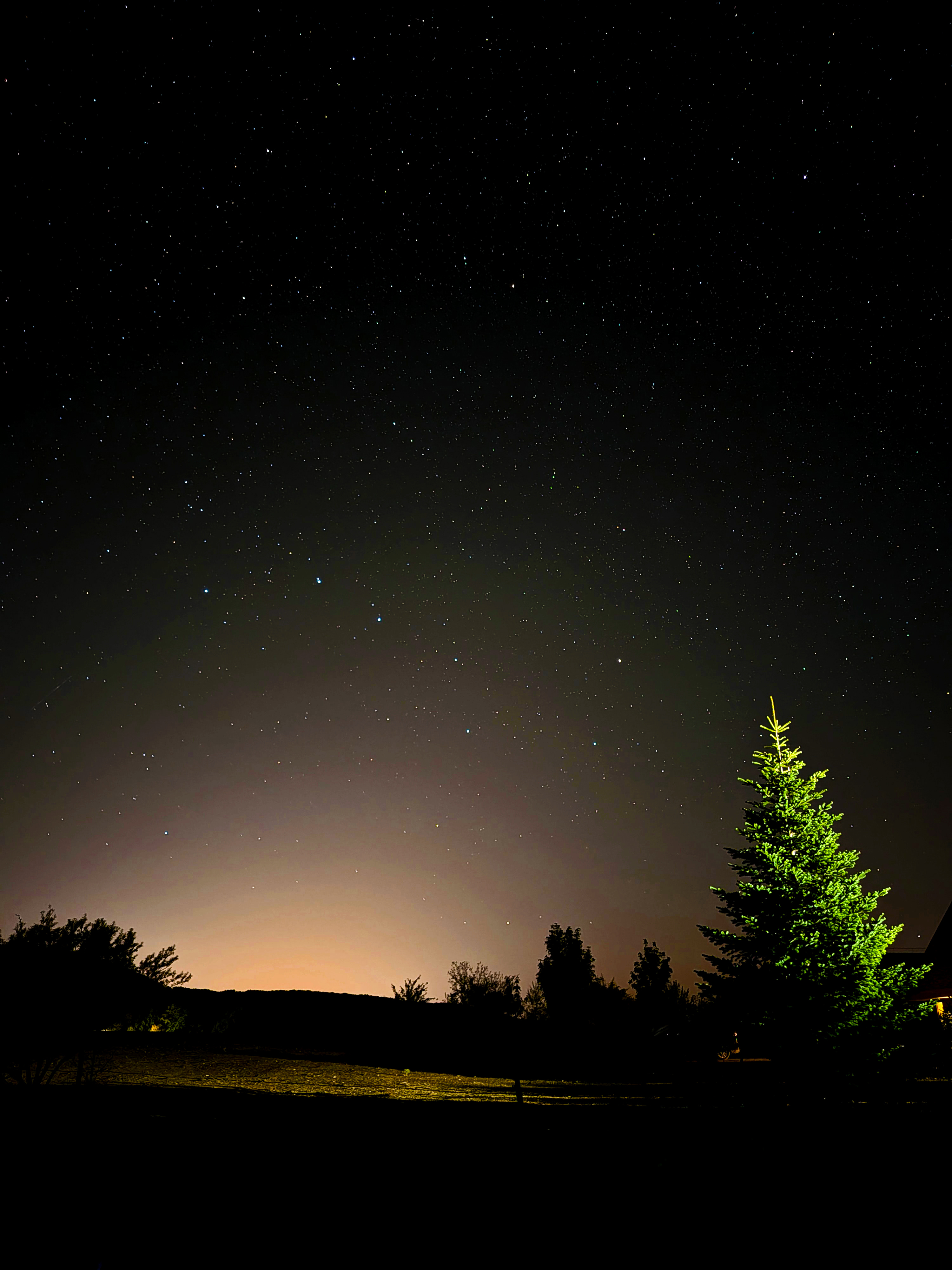
Image credit: MK (TRAC)
Above image: Looking north towards Polaris. Equipment: Google Pixel 10. F-stop: f/1.7. Exposure: 16 sec. Taken at 00:08 on 15 Aug 2026.

Image credit: MK (TRAC)
Above image: Moon shining below the Milky Way with the Andromeda Galaxy visible to the upper right. Equipment: Google Pixel 10. F-stop: f/1.7. Exposure: 16 sec. Taken at 00:21 on 12 Aug 2026.

Image credit: MK (TRAC)
Above image: The bright orange star to the left of the image is Arcturus in Boötes, with the crescent shape of Corona Borealis above it. Equipment: Google Pixel 10. F-stop: f/1.7. Exposure: 16 sec. Taken at 23:13 on 14 Aug 2026.
Solar Observations
Partial Solar Eclipse (12 Aug 2026)
We witnessed an incredible partial solar eclipse from Ryetop Park on the evening of 12 Aug 2026. It was the most impressive solar eclipse visible from the UK since 1999, and an event of this kind will not be seen again until 2090.
The park provided an excellent vantage point, and we were fortunate to enjoy perfectly clear skies throughout the entire eclipse.

Image credit: CL (TRAC)
Above image: A photo of the Moon passing in front of the Sun around 15 minutes before the peak of the partial solar eclipse in August 2026. Equipment: Google Pixel 9a. Exposure: 1/25 sec. F-stop: f/1.7. Taken at 18:59 on 12 Aug 2026.
It was great to see so many children among the visitors. Our telescopes, safely fitted with solar filters, gave them the chance to enjoy a close-up view of the Sun and watch the progress of the eclipse.
For many, this was an exciting chance to see the eclipse in much greater detail and experience astronomy through a telescope for the first time, making it a memorable evening for young and old alike.
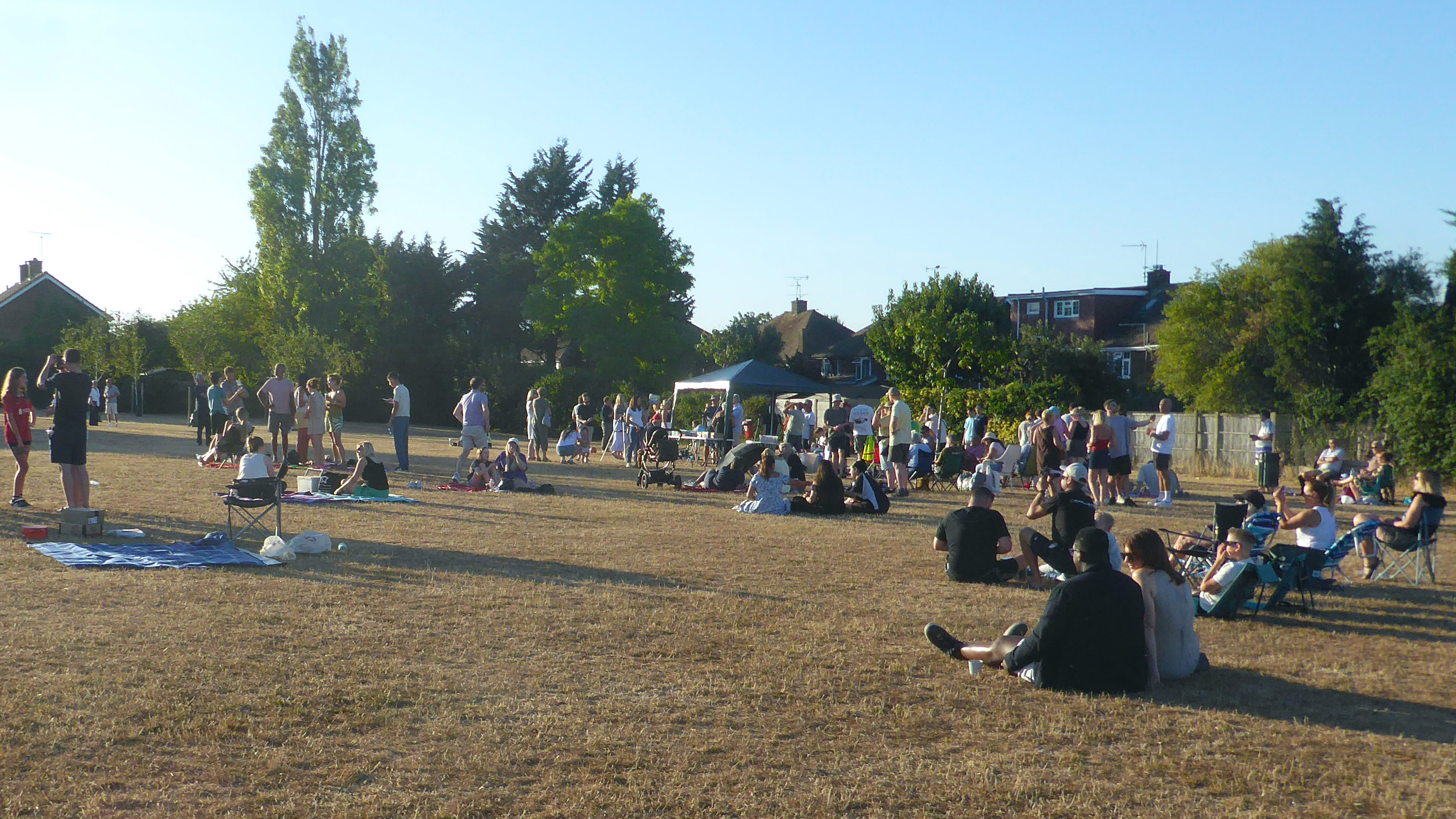
Image credit: AM (TRAC)
Above image: The scene in Ryetop Park at 7 PM on the evening of 12 August 2026. Around 150 people gathered to watch the best partial solar eclipse visible from Rainham since 1999 and one that will not be surpassed for many decades to come. Taken at 18:58 on 12 Aug 2026.
Video credit: DM (TRAC)
Above video: The crowd enjoys the eclipse with elcipse glasses, pinhole cameras, and at high magnification through telescopes. Recorded at 18:58 on 12 Aug 2026.
Eclipse Photos
Did you watch the eclipse from Ryetop Park? If you took any photographs of the eclipse, we'd love to see them! Please send your photos to us by email, and we'll add them to this page.
We didn't get a chance to take many photos, so any you can send are greatly appreciated!
Children's Certificate
Parents can download a printable Certificate of Achievement for children who watched the partial solar eclipse from the park with us on 12 August 2026.
Eclipse Event: Acknowledgements
A huge thank you to all TRAC team members and volunteers who helped make our eclipse event run smoothly.
Special thanks to Lorraine, David, and Deborah for their logistical support, operating telescopes, and managing the sale of eclipse glasses; to Steve for stepping in at short notice to man a telescope; to Andrei and Charlie for security and photography services; to Jackie for helping with the gazebo; and to the staff at Kent Best Buy and Homely Gifts for displaying our posters.
I'm very grateful to everyone who contributed their time and effort to make the event such a success.
Future Eclipses
We won't have to wait long for another solar eclipse! A partial solar eclipse will be visible from Kent next year on Monday, 02 August 2027.
Lunar Observations
Partial Lunar Eclipse (28 Aug 2026)
Congratulations to everyone who saw the lunar eclipse early on the morning of Friday, 18 August 2026. It was a remarkable astronomical event, and the magnitude and exceptional clarity of the eclipse made it a particularly special sight to observe.
We were exceptionally lucky with the weather conditions; visibility was perfect. It was certainly worth setting the alarm for 4 AM to witness such a rare event.

Image credit: KK (TRAC)
Above image: Krum K captured this photo of the Moon at the peak of the lunar eclipse when roughly 96% of the Moon was shrouded in the Earth's shadow. Equipment: Seestar S50. F-stop: f/5. Exposure: 1/12 sec. Focal length: 250 mm. Taken at 05:16 on 28 Aug 2026.

Image credit: JM/DM (TRAC)
Above image: The Lunar Eclipse seen at ~45x magnification through a telescope. Equipment: Samsung Galaxy smartphone through a Celestron NexStar 127 SLT Maksutov-Cassegrain telescope. F-stop: f/1.8. Exposure: 1/13 sec. ISO: 3200. Focal length: 1500 mm. Taken at 04:57 on 28 Aug 2026.

Image credit: KK (TRAC)
Above image: Krum K aligned the Seestar S50 with the Moon just before it sunk behind the houses. Equipment: Seestar S50. F-stop: f/5. Exposure: 1/20 sec. Focal length: 250 mm. Taken at 05:22 on 28 Aug 2026.
Krum's photo was selected by the team at Sky at Night Magazine to feature in their article covering the August 2026 lunar eclipse. This is a fantastic achievement and a wonderful recognition of his perseverance.

Image credit: JM (TRAC)
Above image: Telescopes and cameras pointing south-west as the sun began to rise. Taken at 05:41 on 28 Aug 2026.
The next three total lunar eclipses occur on 31 Dec 2028, 26 Jun 2029, and 20 Dec 2029. We'll be ready for them.
Planets
Venus
TRAC members who regularly go walking at dusk have noticed Venus gradually losing altitude around sunset over the past six weeks.
Saturn
Saturn was seen as a bright star in the east after 22:00. The planet was high in the southern sky on the morning of the lunar eclipse, but we were so busy observing the Moon that we ignored it. Sorry Saturn!
Summary
The Perseids
The so-called best meteor shower of the year is always a disappointment to residents of the Medway Towns; the sky is simply not dark enough.
From Rainham, I saw two small meteors around the date of the peak. Zero meteors were spotted from Gillingham. From Bulgaria, Matey K saw around 30 meteors from his rural location.
Yellow Lightning
More yellow lightning was seen north-east of Rainham on 19 Aug 2026. The storm was far enough away that the sound of the thunder dissipated before it reached us.
Video credit: JM (TRAC)
Above video: Yellow lightning seen towards the Isle of Grain. Recorded at 19:03 on 19 Aug 2026.
New Equipment
Another small refractor arrived on 21 Aug 2026. We set up the Celestron Astromaster 60 mm telescope and tested it during the daytime. The image quality was impressive for such a small scope, and it proved useful when we viewed the lunar eclipse.
We'll probably acquire several more telescopes in September!
Looking Ahead
At the start of September, we'll be gearing up for our "Observe the Moon Night 2026" on Saturday, 19 September 2026. We'll practise setting up and operating the new telescopes and plan what we'll do on the night of the event.
James M
TRAC Team Leader
01 Sep 2026 – Rainham, Kent

TRAC is an amateur astronomy group based in Rainham (Kent) in the United Kingdom.
On clear nights, you'll find us outside, observing stars, planets, moons, galaxies, satellites, meteors, and comets.
This monthly report is intended to keep club members informed of our observational activities, track progress towards the club's long-term goals, celebrate successes, and record memorable moments.
Unless stated otherwise, magnitude values refer to apparent magnitude and have usually been rounded to one decimal place; photos of deep-sky objects credited to TRAC were taken using a Seestar S50 smart telescope; our observations were made from Rainham, Kent; and times and dates are in the UK's local time zone (GMT or BST, depending on the time of year).
We welcome any questions, feedback, or suggestions you may have. Please let us know if anything is unclear or if you notice an error, inaccuracy, or typo. Contact us via email.
© 2026 Taverners Road Astronomy Club