TRAC Action Plan: July 2026
- Category: Action Plans
- Author: JM
- Published: 30 Jun 2026
- Last updated: 30 Jun 2026
July 2026 Calendar
- Mon, 06 Jul Earth reaches Aphelion
- Tue, 07 Jul Last Quarter Moon
- Wed, 08 Jul Moon close to Saturn (01:00)
- Thu, 09 Jul Venus close to Regulus
- Sat, 11 Jul Moon close to Pleiades & Mars (02:00)
- Tue, 14 Jul New Moon
- Thu, 16 Jul Moon close to Regulus (22:00)
- Fri, 17 Jul Moon close to Venus (22:00)
- Tue, 21 Jul First Quarter Moon
- Wed, 22 Jul Comet 10P/Tempel close to Epsilon Capricorni
- Fri, 24 Jul Moon close to Antares (22:00)
- Fri, 24 Jul 3 Juno reaches opposition
- Wed, 29 Jul Full Moon
Stargazing
Summer Constellations
Constellations to look out for this month:
- Boötes
- Corona Borealis
- Hercules
- Cygnus
- Libra
- Lyra
- Coma Berenices
- Ophiuchus
- Virgo
- Cepheus
- Aquila
- Sagittarius
- Scorpius
Look south after 22:00 to see Antares, the brightest star in Scorpius. It has a very deep orange-red colour. It's sometimes even mistaken for the planet Mars.
Double Stars & Binary Stars
Some stars that appear as a single point of light are actually two or more stars located very close together. Using high magnification, astronomers can view both stars using telescopes. This process is called 'splitting' or 'resolving' a double star.
Using our 5-inch telescope, we should be able to resolve binary and double stars with separations as small as roughly one arcsecond.
Double stars bound by gravity are known as binary stars. They orbit around each other.
An 'optical' binary is a pair of stars that appear close together in the sky from our viewpoint on Earth, but in reality, they are not gravitationally bound and do not orbit each other.
We'll observe these two double star systems:
Albireo (Cygnus)
- Famous for its contrasting colours: golden yellow and azure blue.
- The golden component is mag. +3.1, while the blue member is mag. +5.1.
- It's probably an 'optical' binary star as opposed to a 'true' binary, but this remains unconfirmed as of 2026.
The Double Double (Lyra)
- Epsilon Lyrae (mag. +5.5) is located next to Vega.
- It looks like two yellow stars in binoculars.
- The double can be resolved as four stars using a small telescope.
- Requires a very high magnification.
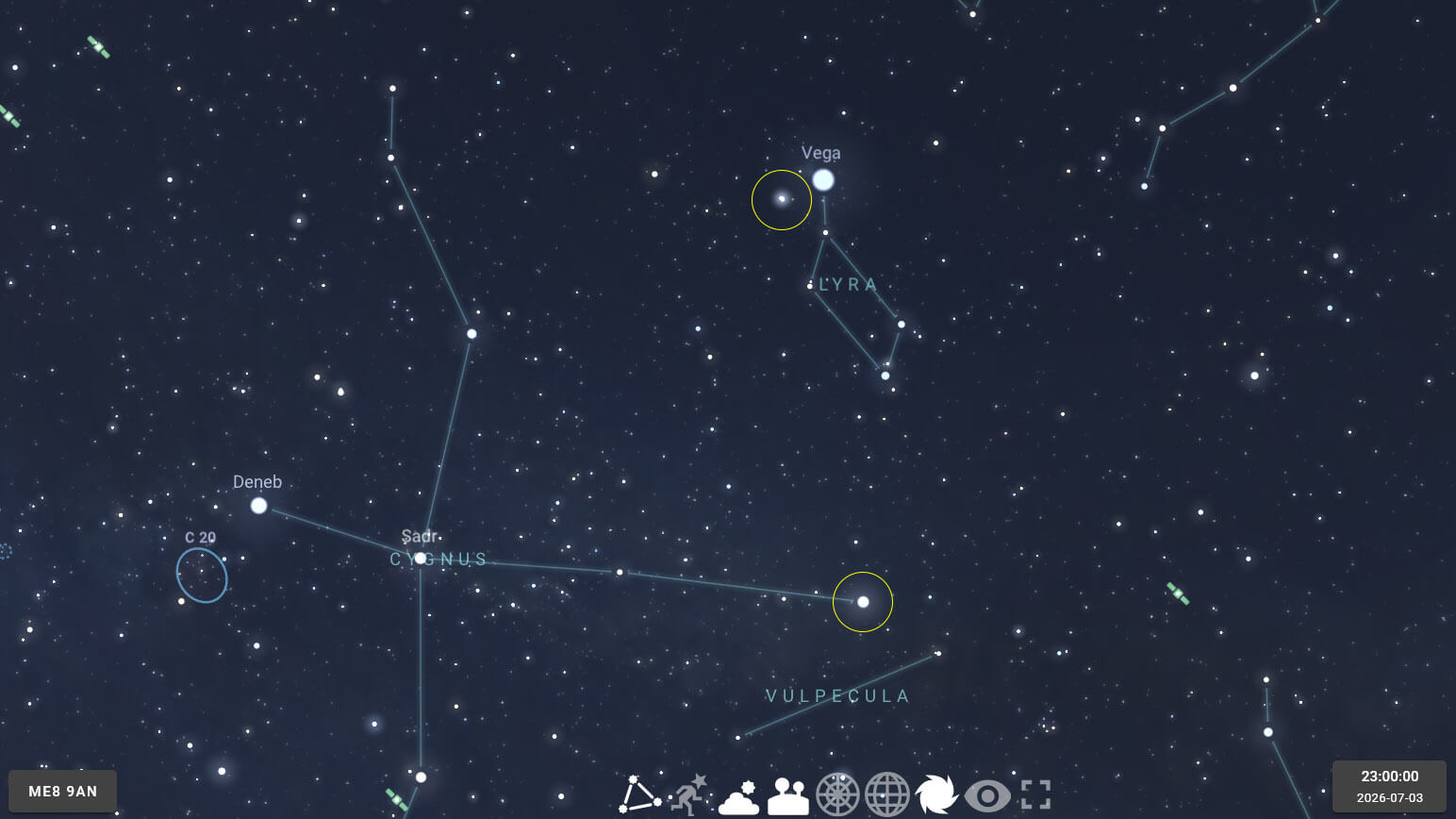
Image credit: Stellarium
Above image: The locations of Albrieo in Cygnus and Epsilon Lyrae in Lyra.
There are many more binary stars to see at other times of the year. We've already seen one naked-eye double. Can you remember where to find it?
Astrophotography
TRAC's number one mission for 2026 is to photograph as many deep-sky objects as possible.
It doesn't get dark during the summer months. We'll switch to daytime astrophotography – taking photos of the Sun in preparation for the August 2026 Partial Solar Eclipse.
Solar Photography
Sun Photos with a Seestar S50
We'll test the Seestar when the Sun is lower in the sky in the evening – like it will be during the solar eclipse.
Sun Photos with a Phone Camera
In June, we tried using the Nikon D80 to photograph the Sun, but we might get on better with our phone cameras. We'll compare the results and decide what's best to use to photograph the eclipse in August.
Sun Photos with a Svbony SV105
We still need to try the SV105 Planetary Camera. Will it fit the whole disc of the Sun in its field of view? Are we able to polar align the EQ mount in the daytime so that it will track the Sun as it sets?
Comet 10P/Tempel
On 22 Jul 2026, Comet 10P/Tempel will pass close to the +4.4 magnitude star Epsilon Capricorni, providing a useful reference point for locating the comet in the night sky.
The comet will be roughly magnitude +7, so bright enough to see with binoculars.
Also known as "Tempel 2", the comet has a diameter of about 10 km and completes one orbit around the Sun every 5.36 years.
Our aim is to observe the comet with binoculars and capture an image using the Seestar. This will be our first comet sighting of 2026 and our first opportunity to test the Seestar on a comet.
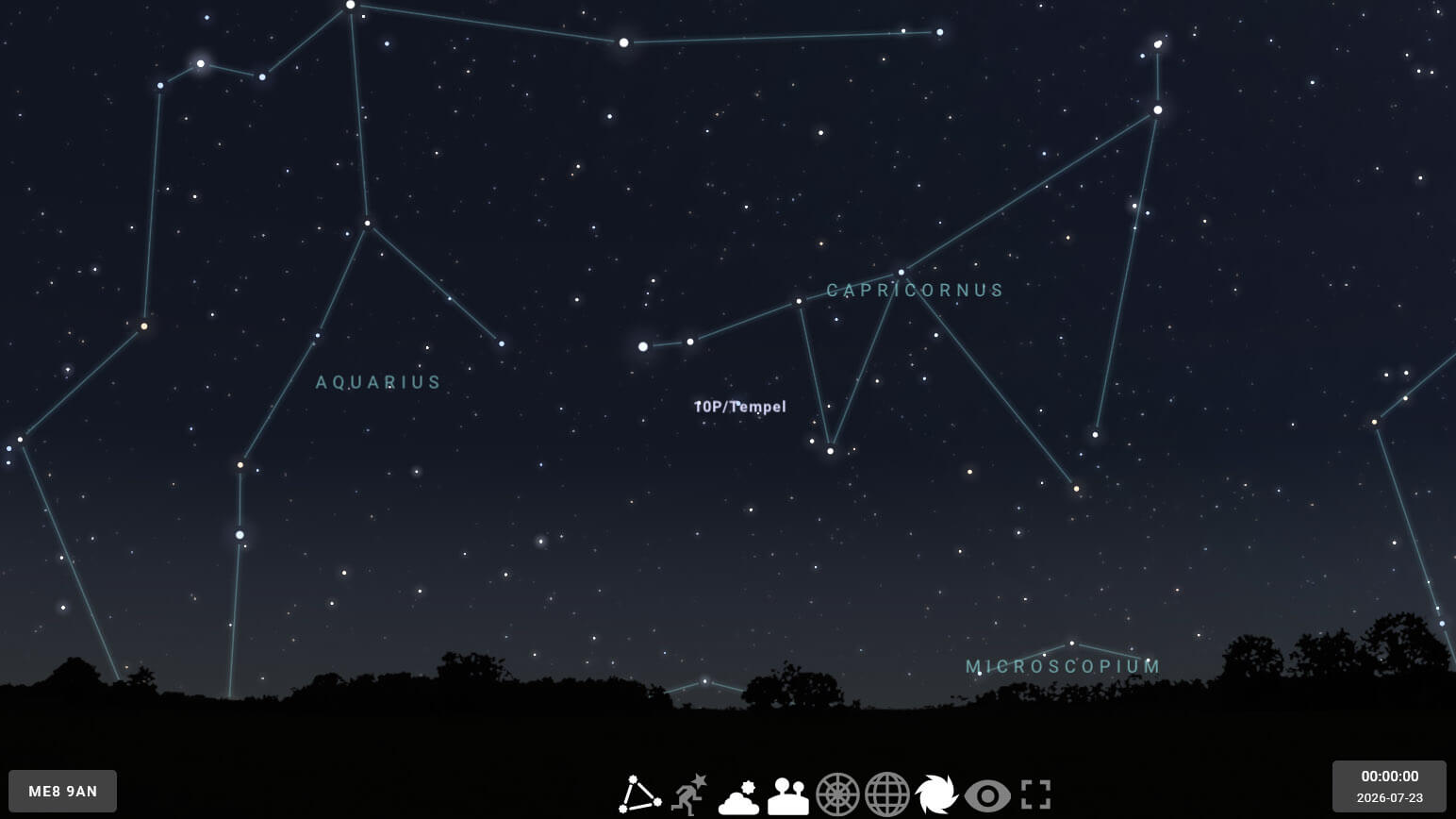
Image credit: Stellarium
Above image: A simulated view showing the position of Comet 10P on 22 Jul 2026.
Planets
Mercury
- Since its greatest eastern elongation on 15 Jun 2026, Mercury has been moving closer to the Sun from our perspective.
- Mercury goes through inferior conjunction on 12 Jul 2026, so it's between Earth and the Sun.
- Then it re-emerges in the morning sky and is visible at 05:00 by the end of July.
- Magnitude: +0.4
Venus
- The best time to view Venus is early in the evening when it appears in the west at twilight.
- 09 Jul 2026: Venus will be positioned close to Regulus (22:00).
- Venus is now losing altitude after sunset.
- Magnitude: -4.3
Mars
- Mars is a morning planet, visible after 03:00.
- We'll wait until August or September to view Mars.
- Magnitude: +1.3
Jupiter
- Jupiter is too close to the Sun to see this month.
- It moves directly behind the Sun on 29 Jul 2026.
Saturn
- Saturn is a morning planet, visible after 02:30.
- We'll wait until August to see Saturn.
- Magnitude: +0.6
Uranus
- Uranus is only visible in the early hours.
- Magnitude: +5.8
Neptune
- Neptune is positioned west of Saturn.
- We'll wait until it's visible in the evening later this year.
- Magnitude: +7.8
Lunar Observations
July 2026 Lunar Calendar
- Last Quarter Tue 07
- New Moon Tue 14
- First Quarter Tue 21
- Full Moon Wed 29
July 2026 Full Moon
- 29 Jul 2026: The Full Moon will rise at 21:04.
- July's Full Moon is called a "Buck Moon".
- It will be located in the constellation of Capricornus.
Lunar Conjunctions
- 08 Jul 2026: Moon close to Saturn (01:00).
- 11 Jul 2026: Moon close to Pleiades & Mars (02:00).
- 16 Jul 2026: Moon close to Regulus (After 22:00).
- 17 Jul 2026: Moon close to Venus (After 22:00).
- 24 Jul 2026: Moon close to Antares (After 22:00).
Solar Observations
Solar Eclipse Planning
We have a spectacular partial solar eclipse coming up in August 2026. Around 90% of the Sun will be covered by the Moon.
It will be the best solar eclipse visible from Kent for many years. We need to make sure we're ready for it. Our preparations already started in June!
Review our June 2026 Action Plan to check what we need to do.
Meteor Showers
There are no major meteor showers this month.
Summary
Top Priorities for July 2026
In descending order of importance:
Aphelion (06 Jul 2026)
Aphelion is when the Earth is furthest from the Sun in its elliptical orbit.
Earth will reach aphelion at 18:30 on 06 Jul 2026. We'll be 152 million km from the Sun – 5 million km further away than on 03 Jan 2026 at perihelion, when the Earth is closest to the Sun.
Juno Opposition (24 Jul 2026)
Juno reaches opposition on July 24 at magnitude +9.1 in Aquila. We'll wait until August to try to locate it because it's going to be a tricky target for us.
See You Out There
The main goal this month is to make sure we're fully prepared for the spectacular partial solar eclipse coming up in August 2026. Anything else we get done is a bonus.
James M
TRAC Team Leader
30 Jun 2026 – Rainham, Kent

TRAC is an amateur astronomy group based in Rainham (Kent) in the United Kingdom.
On clear nights, you'll find us outside, observing stars, planets, moons, galaxies, satellites, meteors, and comets.
This action plan is specifically tailored for our location (Rainham, Kent), schedules, optical equipment, level of experience, personal interests, and local sky conditions.
Unless stated otherwise, magnitude values refer to apparent magnitude and have usually been rounded to one decimal place; photos of deep-sky objects credited to TRAC were taken using a Seestar S50 smart telescope; our observations were made from Rainham, Kent; and times and dates are in the UK's local time zone (GMT or BST, depending on the time of year).
We welcome any questions, feedback, or suggestions you may have. Please let us know if anything is unclear or if you notice an error, inaccuracy, or typo. Contact us via email.
© 2026 Taverners Road Astronomy Club