TRAC Action Plan: March 2026
- Category: Action Plans
- Author: JM
- Published: 01 Mar 2026
- Last updated: 20 Mar 2026
March 2026 Calendar
- Tue, 03 Mar Full Moon
- Sat, 07 Mar Venus close to Saturn (18:30)
- Sun, 08 Mar Venus close to Saturn (18:30)
- Wed, 11 Mar Last Quarter Moon
- Thu, 19 Mar New Moon
- Fri, 20 Mar Spring Equinox
- Fri, 20 Mar Moon close to Venus (19:00)
- Wed, 25 Mar First Quarter Moon
- Thu, 26 Mar Moon close to Jupiter
- Sun, 29 Mar Moon Occults Regulus (19:00)
Stargazing
Winter/Spring Constellations
Constellations to look out for this month include:
- Cancer
- Leo
- Auriga
- Hydra
- Gemini
- Lepus
- Leo Minor
The main winter constellations will also still be visible to the west – but not for much longer.
In Leo, we'll take a closer look at Algeiba, a close pair (double star). It is meant to be possible for us to split the two yellow stars (mag. +2.2 and +3.5) with our 127 mm telescope. Let's see if we can do it!
Astrophotography
TRAC's number one Mission for 2026 is to photograph as many deep-sky objects as possible.
As always, we need a night with a clear, moonless sky to give us the best chance of getting the best results possible with the Seestar S50.
DSO Targets: Galaxies in Leo
In March, we'll focus on two galaxy groups found in the constellation of Leo, the Lion.
The galaxies in each group are close to each other, so the aim is to fit multiple galaxies in a single frame.
The Leo Triplet (Galaxy Group):
- NGC 3623 (M65): Spiral galaxy, mag. +10.3
- NGC 3627 (M66): Spiral galaxy, mag. +8.9
- NGC 3628: The "Hamburger Galaxy", mag. +9.4
M96 Group / Leo I Group:
- NGC 3351 (M95): Barred spiral, mag. +9.7
- NGC 3368 (M96): Spiral galaxy, mag. +9.2
- NGC 3379 (M105): Large elliptical galaxy, mag. +9.8
Many other galaxies are found in Leo, but they are much fainter, so likely won't be picked up well by the Seestar S50. If we can capture the galaxies listed above, we'll consider it a great success!
Bonus galaxies: If we have time, we'll photograph NGC 2903, an isolated barred spiral galaxy in Leo. Another possible target is the Leo Cluster, which is made up of over 70 major galaxies.
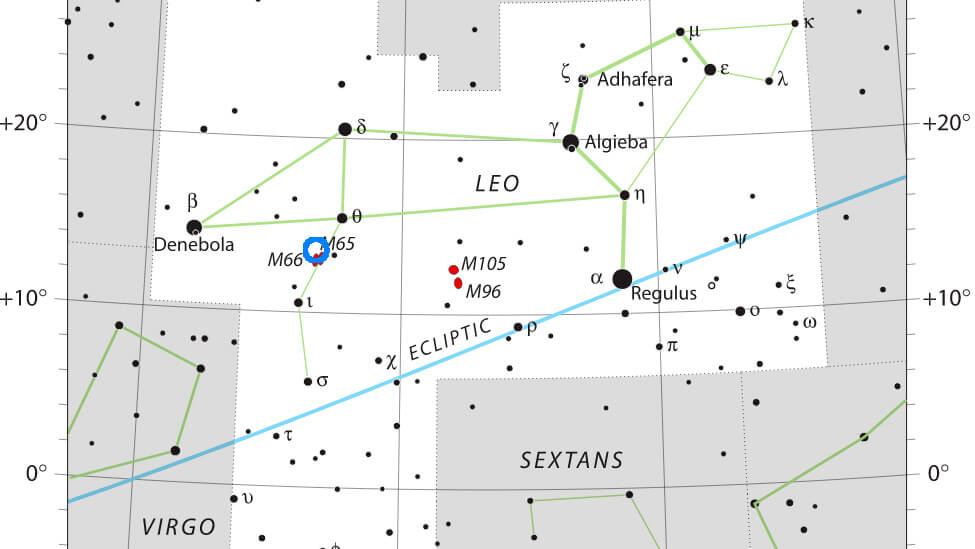
Image credit: IAU and Sky&Telescope
Above image: A star chart showing the location of the galaxy groups in Leo.
Comet C/2024 E1 (Wierzchoś)
A comet is visible low in the sky this month. The Seestar S50 is suited for faint comet photography, but Comet C/2024 E1 will not be an easy target.
- It was discovered on 03 Mar 2024 by Polish astronomer Kacper Wierzchoś.
- It reached perihelion (closest to the Sun) on 20 Jan 2026 (mag. +6.5).
- The comet will be fairly low in the southwestern sky at around 19:30.
- Its current apparent magnitude is +8.0 so it might be visible in binoculars, but our main aim will be to photograph it with the Seestar.
The start of March will be the last realistic window for detection from northern latitudes. After this period it will continue to fade. Unfortunately, the Full Moon is on the third, so we'll have to wait a few days for it to move out of the way.
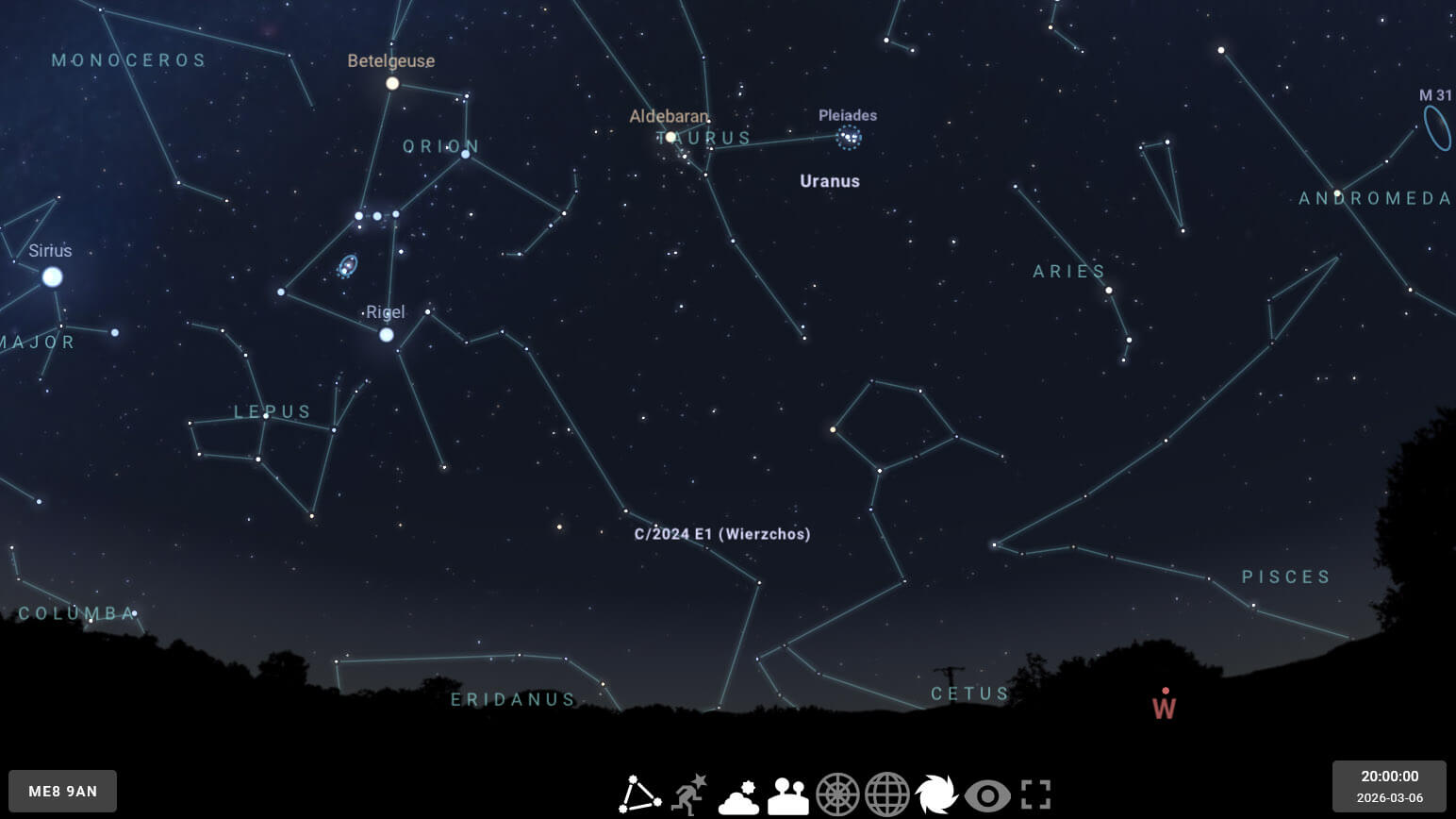
Image credit: Stellarium
Above image: A simulated view of Comet E1's position on 06 Mar 2026.
Planets
Mercury
- Mercury will be low down and not very easy to see.
- It will be exactly between the Sun and Earth on 07 Mar.
- Magnitude: +2.5
Venus
- Venus is now moving further from the Sun after sunset.
- 01 March: Venus alongside Mercury at dusk, but Mercury will be challenging to spot due to its brightness and low altitude.
- 07/08 March: Venus in between Saturn and Neptune.
- 20 March: Venus 6° south of a thin waxing Crescent Moon (19:00).
- Magnitude: -3.8
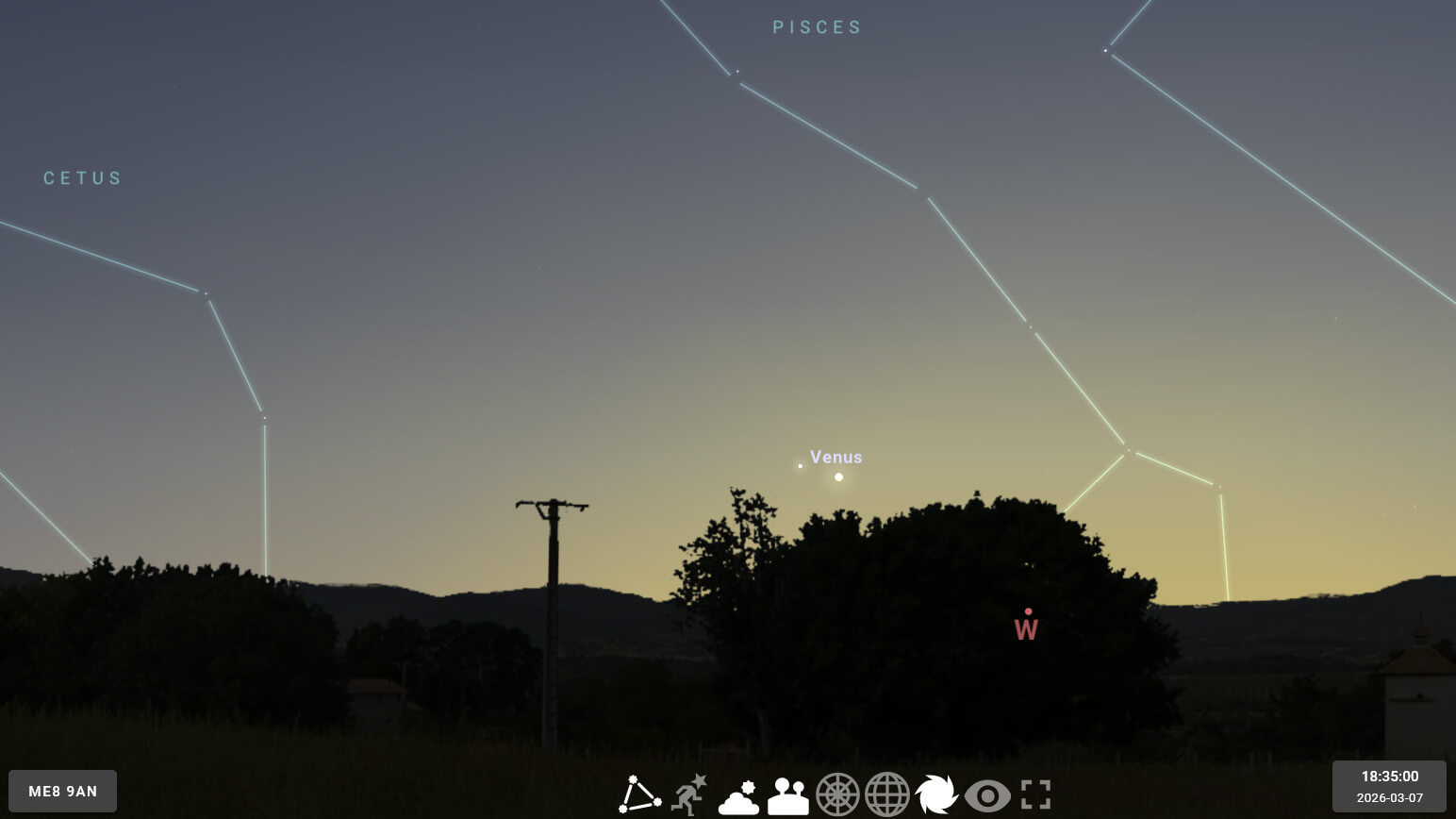
Image credit: Stellarium
Above image: A simulated view showing Mercury and Saturn close together after sunset on 07 Mar 2026.
Mars
- Mars is not visible this month.
Jupiter
- Jupiter will dominate the evening sky all month again.
- See it all night long in Gemini.
- TRAC's main goal with Jupiter is to see the GRS.
- Magnitude: -2.4
Jupiter Event Timings:
Special Galilean Moon Events:
- 09 Mar 2026: Callisto eclipsed by Jupiter's shadow (20:16 - 00:32)
- 17 Mar 2026: Callisto transit (19:40 - 23:35)
- 08 Mar 2026: Ganymede occulted by Jupiter (19:10 - 22:20)
Saturn
- Saturn is visible in the west after sunset.
- It has been getting closer to the Sun and will align with it by the end of the month, so it will disappear from view.
- Magnitude: +1.0
Uranus
- Uranus will disappear from our skies by the end of the month.
- 20 March: Uranus will be located close to two stars of a similar magnitude to itself. The three objects will form a small triangle. We'll look out for this with binoculars.
- Magnitude: +5.7
Neptune
- Neptune is not visible this month.
Lunar Observations
March 2026 Lunar Calendar
- Full Moon Tue 03
- Last Quarter Wed 11
- New Moon Thu 19
- First Quarter Wed 25
March 2026 Full Moon
- 03 March 2026: The Full Moon will rise at 16:40.
- It will be located in the constellation Leo.
Lunar Conjunctions
- 20 March 2026: Thin crescent Moon close to Venus low in the west after sunset (19:00).
- 26 March 2026: 62%-lit Moon close to Jupiter and Castor and Pollux in Gemini (visible all night).
Lunar Occultations
29 March 2026: The Moon occults Regulus, the brightest star in Leo. The occultation begins in daylight at 19:00, and the star will reemerge at approximately 20:15.
It might be possible to see Regulus' faint companion star through binoculars. Regulus B (mag. +8.1) will emerge first, followed by Regulus (mag. +1.4) six minutes later.
Meteor Showers
There are no major meteor showers this month.
Summary
Top Priorities for March 2026
In descending order of importance:
Planetary Parade
The UK media are reporting that it will be possible to see six planets around the beginning of March 2026. Theoretically, this is possible; in reality, it's going to be difficult, if not impossible.
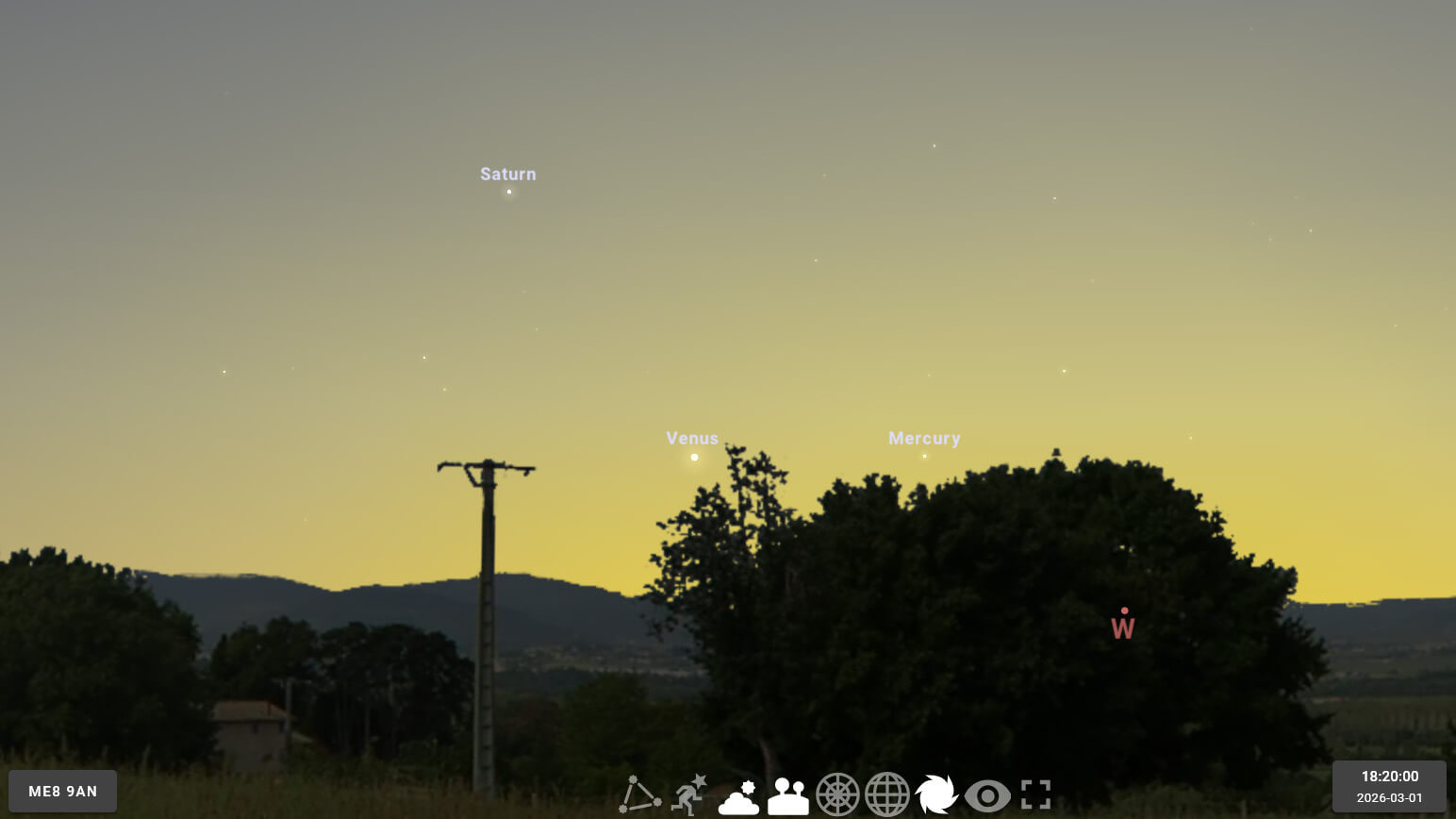
Image credit: Stellarium
Above image: A simulated view of the positions of Mercury, Venus, and Saturn low in the western sky on 01 Mar 2026.
Apart from the terrible weather, there are a few reasons why this planetary parade will be difficult for most people to see:
- Neptune is very faint and loses altitude with Saturn early in the evening.
- Venus and Mercury are both very low after sunset.
- Uranus can be spotted using binoculars, but only if you know exactly where to look.
Tips to see as many planets as possible:
- Go to a large open space with a good view of the western horizon.
- Use binoculars (but only after the Sun has set).
- Use Stellarium or other software/apps to locate Uranus.
Q: When's the best day to see the planets?
A: Whenever the weather's clear (if ever)!
Spring Equinox
20 March 2025: The northern hemisphere's Vernal Equinox (March Equinox) takes place. At this time of year, the amount of nighttime we get decreases at the fastest rate.
More info: Solstices and equinoxes explained
NASA Artemis II
NASA had a couple of setbacks in February. First, they encountered a hydrogen fuel leak, and then there was a problem with the rocket's helium supply.
Check back to our January 2026 Action Plan for more details, but bear in mind that the launch did not go ahead as planned.
NASA now says the earliest launch date for Artemis II is 01 Apr 2026.
More info: https://www.nasa.gov/mission/artemis-ii/
See You Out There
Let's see how many planets we can see at the start of the month and how many galaxies in Leo we can photograph in March 2026.
James M
TRAC Team Leader
01 Mar 2026 – Rainham, Kent

TRAC is an amateur astronomy group based in Rainham (Kent) in the United Kingdom.
On clear nights, you'll find us outside, observing stars, planets, moons, galaxies, satellites, meteors, and comets.
This action plan is specifically tailored for our location (Rainham, Kent), schedules, optical equipment, level of experience, personal interests, and local sky conditions.
Unless stated otherwise, magnitude values refer to apparent magnitude and have usually been rounded to one decimal place; photos of deep-sky objects credited to TRAC were taken using a Seestar S50 smart telescope; our observations were made from Rainham, Kent; and times and dates are in the UK's local time zone (GMT or BST, depending on the time of year).
We welcome any questions, feedback, or suggestions you may have. Please let us know if anything is unclear or if you notice an error, inaccuracy, or typo. Contact us via email.
© 2026 Taverners Road Astronomy Club