TRAC Action Plan: August 2026
- Category: Action Plans
- Author: JM
- Published: 01 Aug 2026
- Last updated: 03 Aug 2026
August 2026 Calendar
- Mon, 03 AugMoon near Saturn
- Thu, 06 Aug Last Quarter Moon
- Fri, 07 Aug Moon near Pleiades
- Sun, 09 Aug Moon near Mars (02:00)
- Wed, 12 Aug New Moon - Partial Solar Eclipse
- Sun, 16 Aug Moon near Venus
- Thu, 20 Aug Moon near Antares
- Thu, 20 Aug First Quarter Moon
- Sat, 22 Aug Jewelled Handle - Clair-Obscur Effect
- Wed, 26 Aug Pluto (mag. +14.4) Opposition
- Fri, 28 Aug Full Moon - Partial Lunar Eclipse
Stargazing
Summer Constellations
Constellations to look out for this month:
- Cygnus
- Libra
- Lyra
- Ophiuchus
- Pegasus
- Cepheus
- Aquila
- Andromeda
- Scorpius
Double Stars & Binary Stars
In July, we saw the best double star in the night sky, "Albireo" in Cygnus. This month we'll aim to take a photo of "The Double Double" in Lyra. It's a quadruple star system, meaning that we should be able to see four stars close together with the telescope.
Check back to our July 2026 Action Plan for the full details.
Astrophotography
TRAC's number one mission for 2026 is to photograph as many deep-sky objects as possible.
It doesn't get dark during the summer months. We have switched to daytime astrophotography – taking photos of the Sun.
Our goal this month is to take photos of the solar eclipse and the lunar eclipse.
Comet 10P/Tempel
No attempts were made to see this comet in July. We might get another chance around 09 Aug at midnight.
Refer back to our July 2026 Action Plan for the full details of Comet 10P.
Planets
Mercury
- Best viewed at the start of the month if you're awake at 04:30.
- Mercury reaches its greatest western elongation on 02 Aug 2026 and superior conjunction on 27 Aug 2026.
- It's close to Jupiter on the morning of 15 Aug 2026 at 05:30 before the sun rises.
- Magnitude: +0.4
Venus
- Venus is bright at twilight but is now losing altitude after sunset.
- Magnitude: -4.5
Mars
- Mars is a morning planet, visible after 02:00.
- We'll wait until September to get a better view of Mars.
- Appears to the naked eye as an orange star.
- Magnitude: +1.3
Jupiter
- Jupiter has reemerged from behind the Sun and is visible in the morning sky by the end of the month.
- Magnitude: -1.8
Saturn
- Saturn is visible in the east after 23:30.
- The position of Saturn will improve over the coming months.
- Magnitude: +0.5
Uranus
- Uranus is only visible in the early hours.
- We'll focus on Uranus later this year.
- Magnitude: +5.8
Neptune
- Neptune is also best viewed at 03:00.
- We'll wait until it's visible in the evening later this year.
- Magnitude: +7.8
Dwarf Planets
Pluto
- Pluto reaches opposition on 26 Aug 2026.
- We'll attempt to view it on a night where the Moon is below the horizon.
- The Seestar should be able to photograph this distant minor planet.
- Magnitude: +14.4
Juno
- Juno reached opposition on 24 Jul 2026.
- We'll attempt to view it with the telescope and the Seestar.
- Extra effort is required since Juno is not near any bright stars currently.
- Magnitude: +9.3
Lunar Observations
August 2026 Lunar Calendar
- Last Quarter Thu 06
- New Moon Wed 12
- First Quarter Thu 20
- Full Moon Fri 28
August 2026 Full Moon
- Date: 28 Aug 2026 (05:18)
- Moonrise: 19:40 on 27 Aug and 19:55 on 28 Aug
- Traditional Name: "Sturgeon Moon"
- Constellation: Aquarius
Partial Lunar Eclipse
A partial lunar eclipse will take place on 28 Aug 2026, with the maximum eclipse occurring at 05:12. This is a magnitude 0.93 eclipse.
| Time | Description | Moon Altitude |
|---|---|---|
| 02:23 | Penumbral Eclipse Starts | 24 degrees |
| 03:33 | First Contact | 19 degrees |
| 05:12 | Maximum Eclipse | 8 degrees |
| 06:13 | Last Contact | 0 degrees |
The Earth will cast a reddish-coloured shadow across the Moon. The eclipse continues as the Moon sets at 06:13.
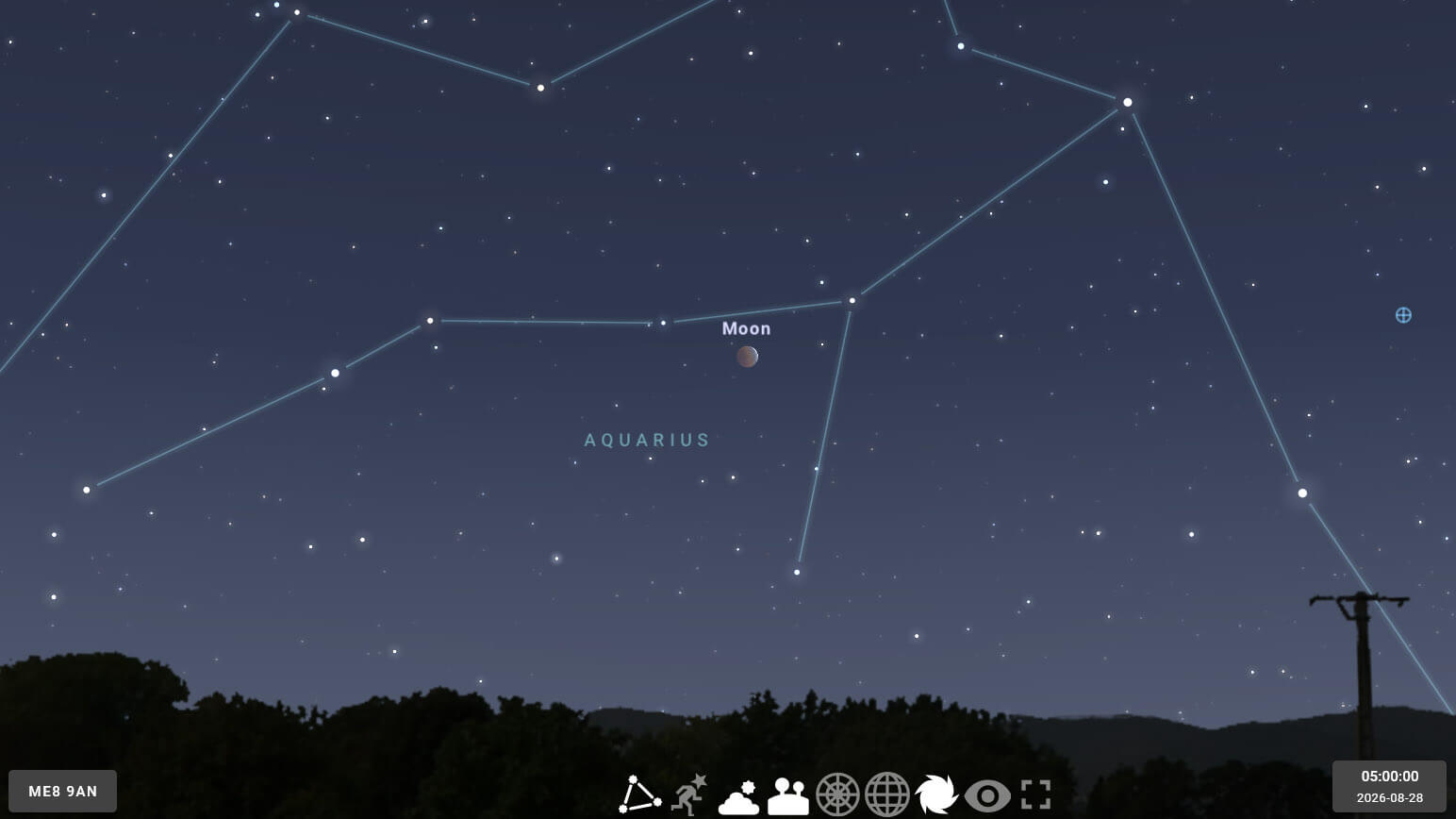
Image credit: Stellarium
Above image: A simulated view of the large partial lunar eclipse on the morning of 28 Aug 2026.
Lunar Conjunctions
| Date | Time | Event |
|---|---|---|
| 03 Aug 2026 | After 23:00 | Moon near Saturn |
| 07 Aug 2026 | After 01:00 | Moon near Pleiades |
| 09 Aug 2026 | After 02:00 | Moon near Mars |
| 16 Aug 2026 | After 21:00 | Moon near Venus |
| 20 Aug 2026 | After 21:30 | Moon near Antares |
Clair-Obscur Effects
22 Aug 2026: Jewelled Handle visible at around 22:00. A large arc of light extends across the terminator as a result of sunlight hitting a mountain range on the lunar surface.
Clair-Obscur is French for "light" (clair) and "shadow" (obscur). Astronomers use this term to refer to various effects created by light and shadow on the Moon's surface.
Solar Observations
Partial Solar Eclipse (12 Aug 2026)
A spectacular partial solar eclipse will take place on Wednesday, 12 August 2026. This is the number one astronomical event of 2026!
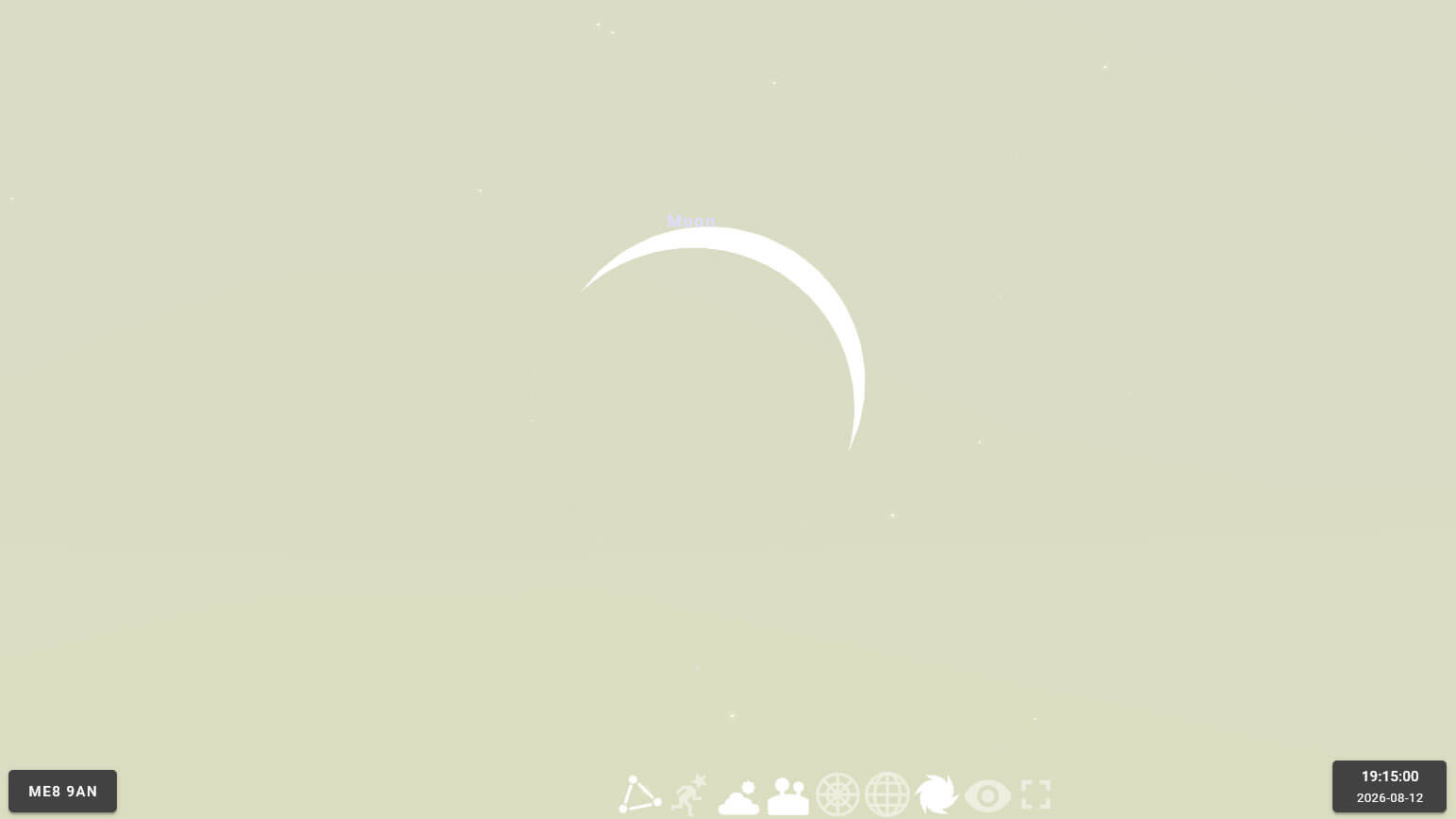
Image credit: Stellarium
Above image: A simulated view of the large partial solar eclipse on the evening of 12 Aug 2026. Roughly 90% of the Sun will be covered by the Moon!
The Moon first clips the edge of the Sun at 18:18, when the Sun will be at an altitude of 18 degrees.
The point of maximum eclipse will occur at 19:14, when around 90% of the Sun will be covered by the Moon. The Sun will still be 13 degrees above the horizon, so we'll get a clear view from the park.
Last contact will be at 20:07 as the sun is setting. It'll only be 5 degrees above the horizon, so we might lose sight of it behind the houses shortly before the end of the eclipse.
If the sky's clear, this will be the best solar eclipse we'll see from Kent for many decades.
| Time | Description | Sun Altitude |
|---|---|---|
| 18:18 | First Contact | 18 degrees |
| 19:14 | Maximum Eclipse | 10 degrees |
| 20:07 | Last Contact | 2 degrees |
TRAC Special Astronomy Operation
We'll meet at 17:30 and get everything set up and ready to go by 18:00. We have quite a lot of equipment to carry to the far side of the park.
Our preparations started in June. We still have a few things to get sorted over the next 10 days.
Review our June 2026 Action Plan to check what we need to do and check our Partial Solar Eclipse event page.
Meteor Showers
The Perseids
- Active Dates: All month
- Peak Night: 13 Aug 2026 (AM)
- Peak Rate: Up to 100 meteors per hour
- Radiant: Perseus
- This shower is caused by Earth passing through debris from Comet Swift–Tuttle.
- The best time to look for Perseid meteors is between 01:00 and dawn.
The Perseids in 2026:
Ideal conditions since the peak coincides with the New Moon.
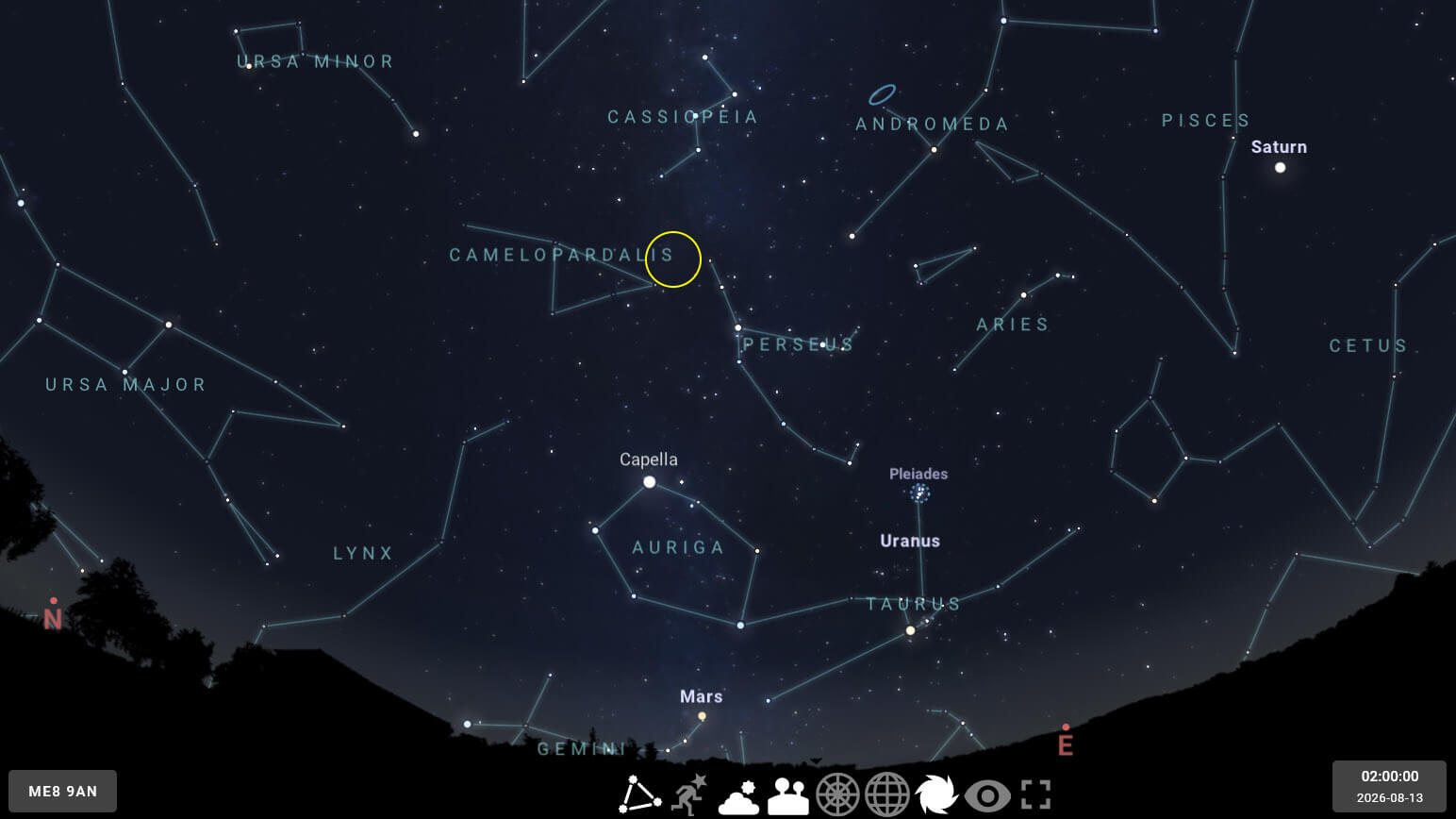
Image credit: Stellarium
Above image: The radiant of the Perseid meteor shower in the constellation Perseus, below Cassiopeia (W-shaped constellation).
Summary
Top Priorities for August 2026
In descending order of importance:
See You Out There
The main focus this month is, of course, the two eclipse events. Anything else we have time to see will be a bonus.
James M
TRAC Team Leader
01 Aug 2026 – Rainham, Kent

TRAC is an amateur astronomy group based in Rainham (Kent) in the United Kingdom.
On clear nights, you'll find us outside, observing stars, planets, moons, galaxies, satellites, meteors, and comets.
This action plan is specifically tailored for our location (Rainham, Kent), schedules, optical equipment, level of experience, personal interests, and local sky conditions.
Unless stated otherwise, magnitude values refer to apparent magnitude and have usually been rounded to one decimal place; photos of deep-sky objects credited to TRAC were taken using a Seestar S50 smart telescope; our observations were made from Rainham, Kent; and times and dates are in the UK's local time zone (GMT or BST, depending on the time of year).
We welcome any questions, feedback, or suggestions you may have. Please let us know if anything is unclear or if you notice an error, inaccuracy, or typo. Contact us via email.
© 2026 Taverners Road Astronomy Club