
Our Location
Urban Astronomy in Medway
Welcome to Rainham
We're based in Rainham (Kent), near Gillingham (Kent), on the eastern edge of the Medway Towns.
Observing the galaxy from here can be very challenging.
Our Stargazing Site
Many of our best observations are made from Ryetop Playing Fields. The park offers us a wide view of the night sky, away from the glare of the street lights.
Map Links: Google Maps | Apple Maps | Bing Maps | OpenStreetMap
Our Latitude
We are located approximately 51.5° North – that's roughly in line with London.
For most astronomical events, the timings given for London will also be valid for Rainham, give or take a few minutes.
Annual Darkness
The chart below shows the amount of darkness we get throughout the year. The best astronomical observations are conducted under total darkness. Known as astronomical darkness, this occurs when the Sun is more than 18 degrees below the horizon.
The black area indicates the period of astronomical darkness at our latitude.
The winter months are of course the best for astronomy. January and February are normally particularly good (weather permitting).
We never enjoy a totally dark sky here in Rainham due to the constant skyglow caused by the light pollution from the millions of lights surrounding us in the urban north Kent environment.
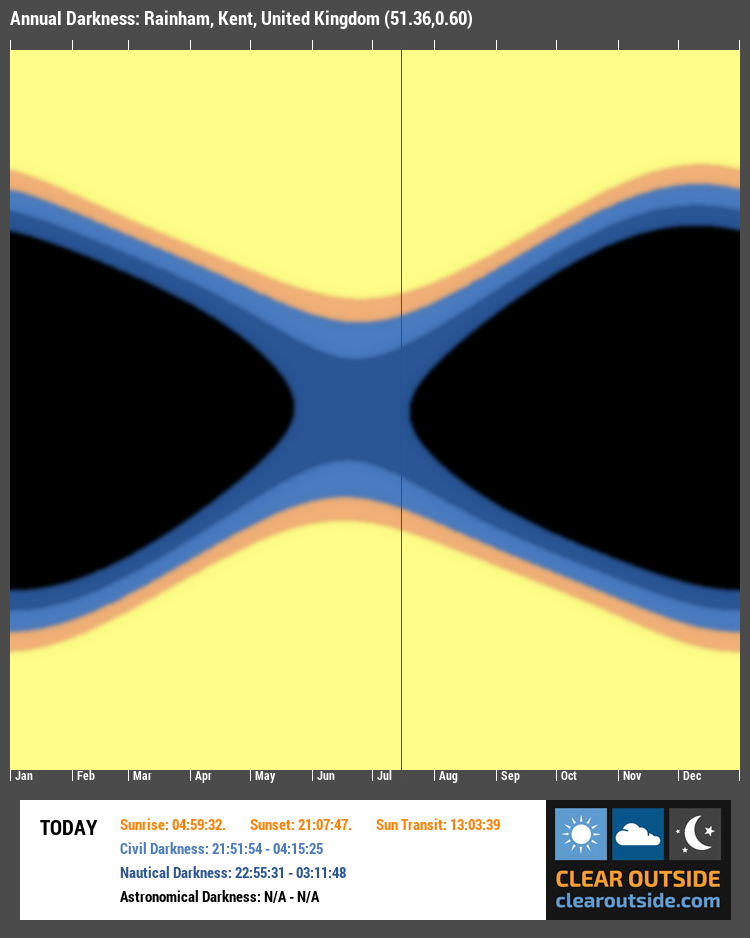
Image credit: Clear Outside
Light Pollution
Light Pollution Map
We're located in a red-orange area on the map below.
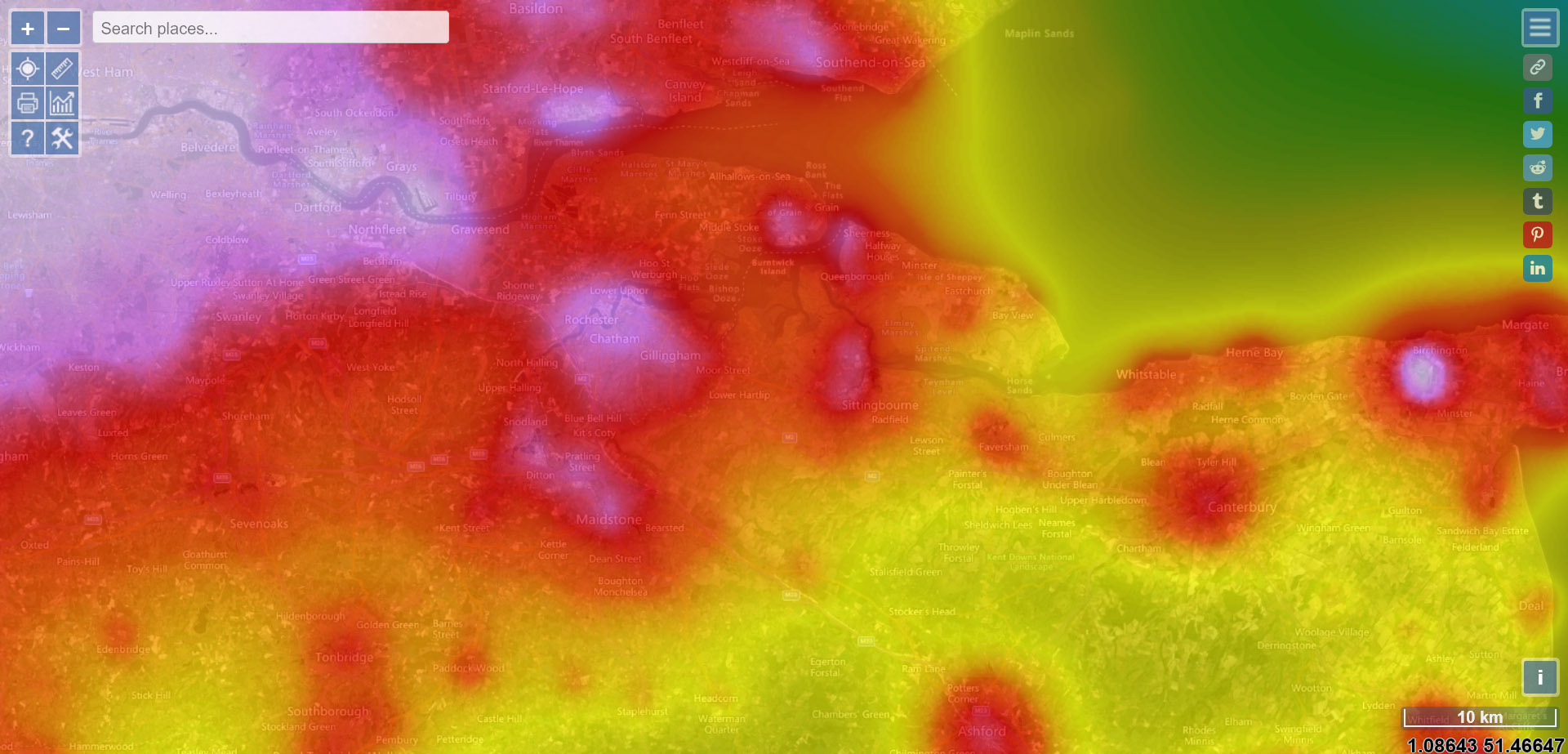
Image credit: Lightpollutionmap.info
Sky Quality
Rainham (Kent) Zenith sky brightness information (2015):
| Measurement | Value |
|---|---|
| SQM | 19.56 mag./arc sec2 |
| Brightness | 1.62 mcd/m2 |
| Artif. bright. | 1450 μcd/m2 |
| Ratio | 8.47 |
| Bortle | class 5 |
| Naked Eye Limit Mag. | +5.5 to +6.0 |
| Elevation | 70 meters |
Astronomy Under Bortle 5/6 Skies
Although the sky conditions here aren't the best for astronomy, we've still been able to observe most of the celestial targets we've set out to see.
From Rainham, we've been able to locate and observe:
- Every planet in the Solar System
- The large moons of Jupiter and Saturn
- The phase of Venus (including at dichotomy on 10 Jan 2025)
- Galilean moon transits, shadow transits, occulatations, etc
- Saturn's rings, including the Cassini Division
- Jupiter's "Great Red Spot" (GRS)
- Surface details on Mars including its northern polar ice cap
- All the famous constellations plus many more
- Most of the prominent craters on the Moon
- The partial solar eclipses on 29 Mar 2025 and 12 Aug 2026
- The partial lunar eclipse on 28 Aug 2026
- Several faint comets (12P, C/2023 A3, C/2025 A6)
- Asteroids / minor planets / dwarf planets
- The Andromeda Galaxy
- Star clusters (Pleiades, Beehive, etc)
- The Orion Nebula (and several other nebulae)
- Lunar/planetary conjunctions and occulatations
- Sunspots on the Sun's photosphere
- Many bright, colourful meteors (including a few fireballs)
- The Starlink satellite train and thousands of individual satellites
- The ISS (International Space Station)
- Northern Lights: the aurora was seen twice at solar maximum (2025)
All of these observations were possible with relatively inexpensive equipment. A professional 5-inch (127 mm) telescope will reveal all of the objects listed above.
Observing most of these sights is even possible with standard 10 x 50 mm binoculars – even the distant planet Neptune – if you know exactly where to point them.
The Weather
Rainy Rainham
"Oh no ... not more rain again! Well, they didn't call it Sunnyville, did they?"
The British weather is our main enemy. The image below shows a typical weather forecast for our area. Look at all that red! It's a bad situation.
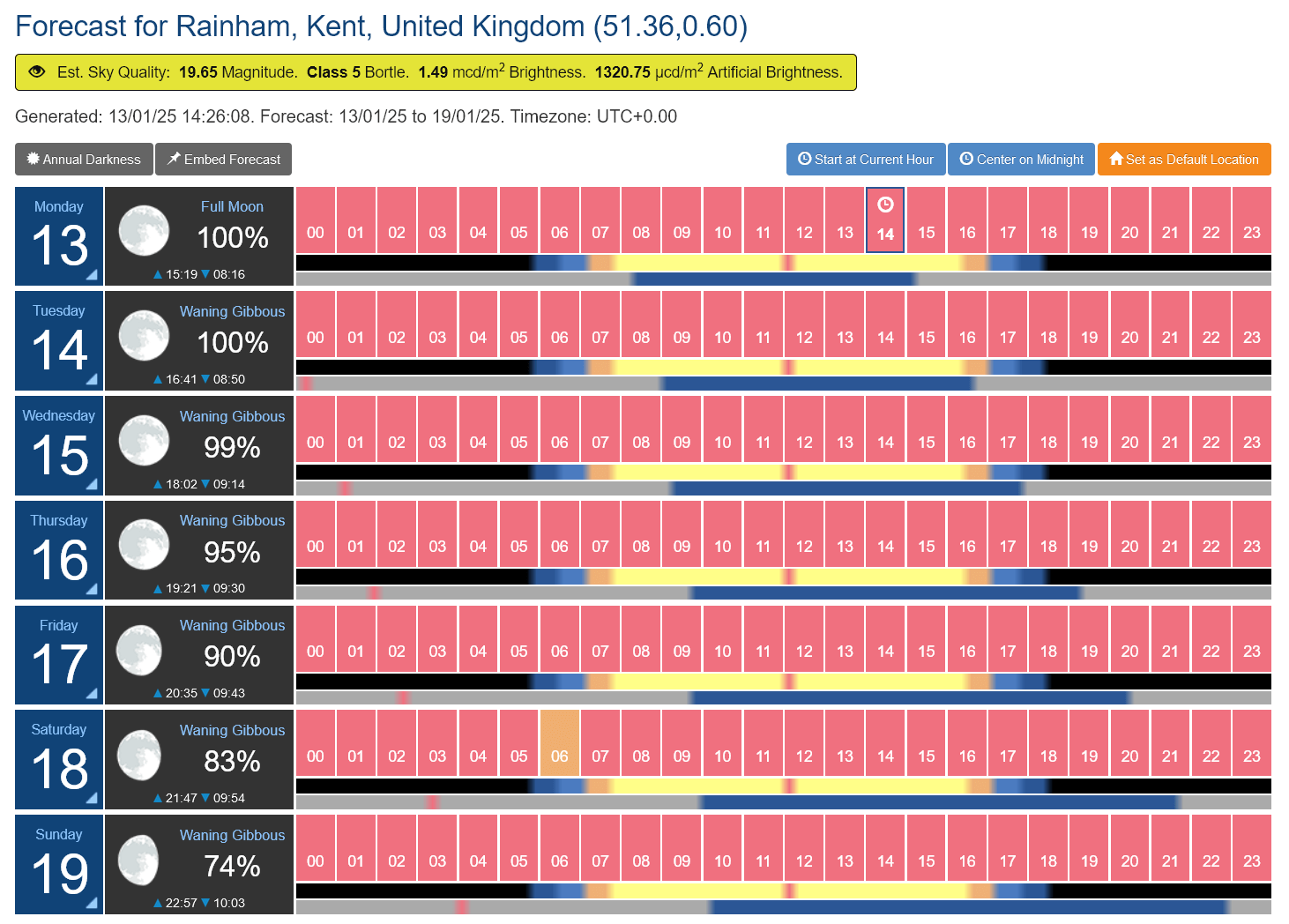
Image credit: Clear Outside
We Want to See Green
Every few weeks, we get a night where the chart is green for the entire evening (meaning no clouds). As astronomers, those are the kinds of nights we live for, and we always strive to make the most of the clear skies when they arrive.
When the weather's clear, our observations have a high success rate.
Patience Pays Off
Even on cloudy nights it can be possible to make interesting observations if you get a break in the clouds. Astronomy under fast-moving cloud requires a great deal of patience.
In our experience, the conditions frequently improve as the hours roll by. Between midnight and 2 AM tends to be the best: astronomical darkness has descended and the atmosphere seems to be calmer than earlier in the evening.