TRAC Monthly Report: April 2026
- Category: Monthly Reports
- Author: JM
- Published: 01 May 2026
- Last updated: 02 May 2026
Stargazing
The Lyrids in 2026
Well, what can I say about this year's Lyrids? On the night that the shower peaked, Krum K, David M, and I spent 30 minutes in the park facing NE, looking up high until our necks ached.
I can report that we saw exactly one meteor. Just as I pointed out the tip of the bear’s tail in Ursa Major to Krum, a tiny white meteor streaked across the sky. And that was the only one we saw.
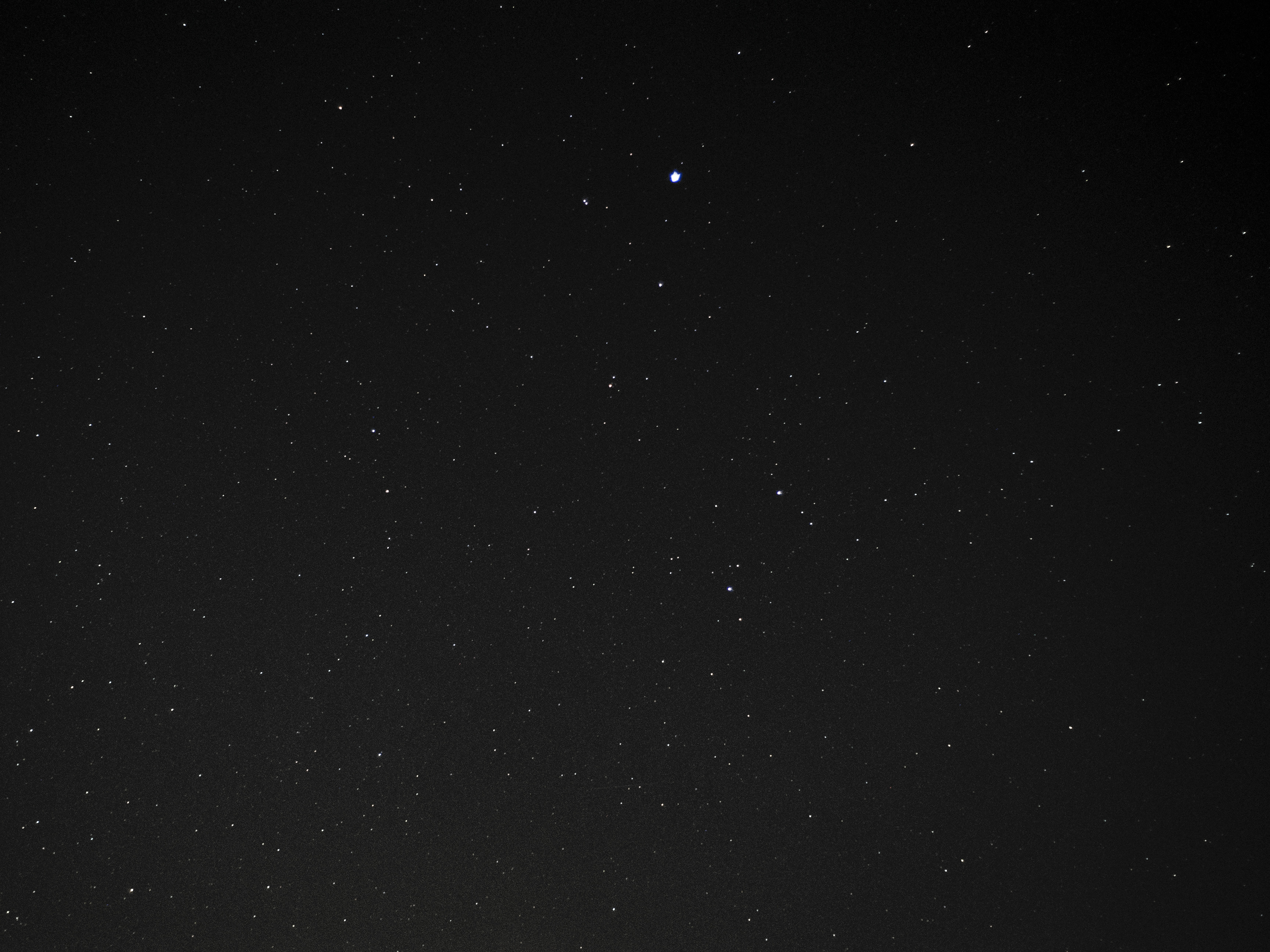
Image credit: JM (TRAC)
Above image: The view towards Lyra on the night of the peak of the annual Lyrid Meteor Shower. Taken at 23:44 on 22 Apr 2026. Camera: Nikon D80. F-stop: f/2.2. Exposure: 5 sec. ISO-1600. Focal length: 50mm.
![Lyra (Vega) [Annotated] - 14 Mar 2026](/static/images/photos/obs/2026/04/2026_04_22_DSC_9597-2_Lyra_Vega_2_ANNOTATED.jpg)
Image credit: JM (TRAC)
Above image: An annotated version of the previous photo. Click or tap to view a more detailed, full-screen version.
Astrophotography (AP)
We continued to make the most of 2026's "Galaxy Season" by photographing Messier objects in Leo and Coma Berenices:
- M95 & M96 in Leo
- M98
- Needle Galaxy (NGC 4565)
- Black Eye Galaxy (M64)
- Mirror Galaxy (M100)
- St. Catherine's Wheel (M99)
We also selected two iconic Messier galaxies positioned high above us in the constellations of Ursa Major and Canes Venatici:
M95 and M96 in Leo
M95 and M96 are part of the "M96 Group", a group of galaxies in the constellation Leo. M105 is also a member of this galaxy group.
M95 (NGC 3351)
- M95 is a magnitude +9.7 barred spiral galaxy in Leo.
- It lies close to M96 and M105 and other fainter galaxies in the Leo I Group.
- TRAC's Seestar S50 photo of M95 shows the bright galactic core and central bar with a bright inner ring, a region of star formation.
M96 (NGC 3368)
- M96 is a magnitude +10.1 spiral galaxy.
- It's asymmetric due to the gravitation pull of nearby galaxies.
- Looking closely, you can see that our photo managed to capture the asymmetry of M96.
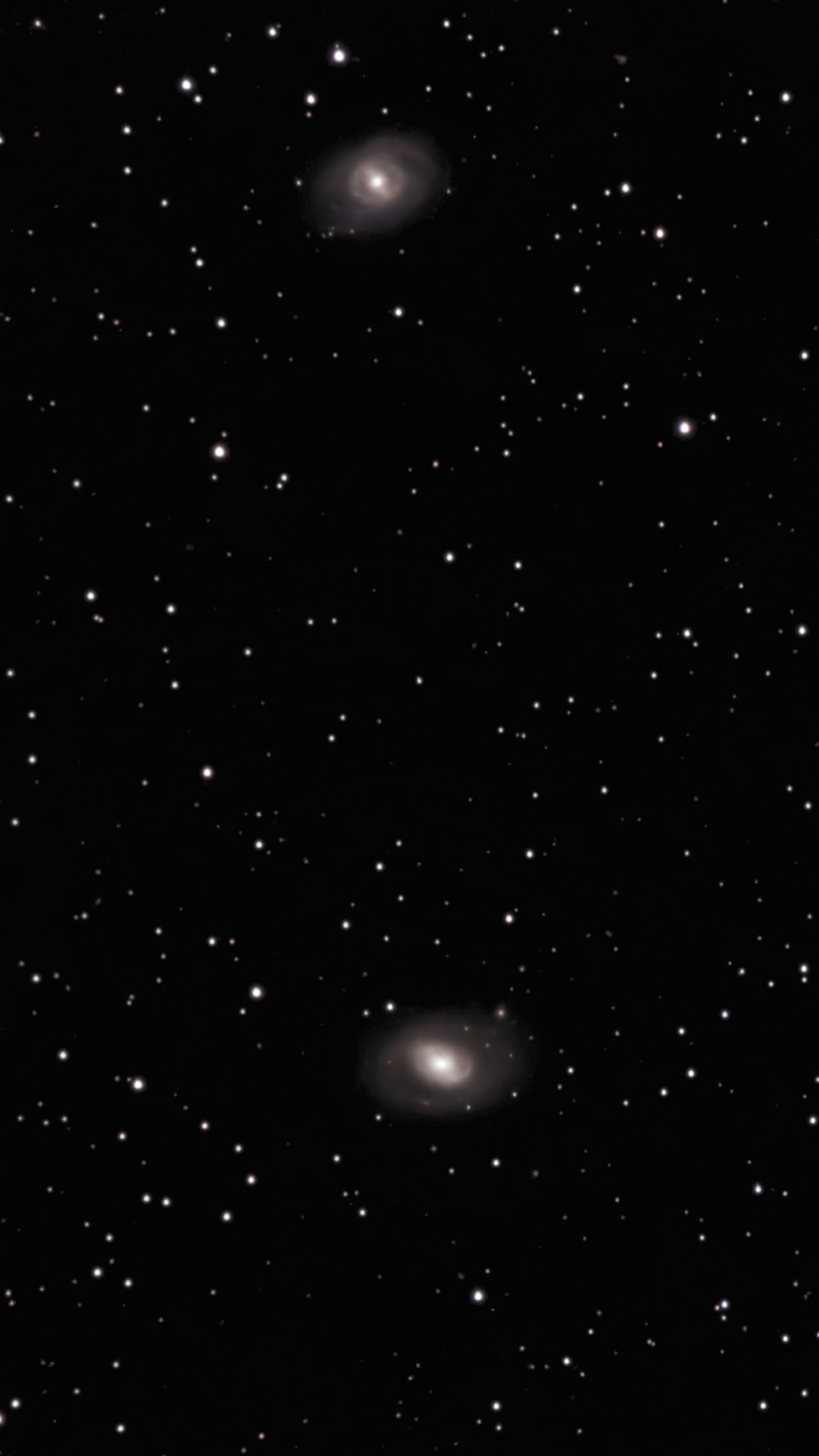
Image credit: JM (TRAC)
Above image: At the top, M95 displays its bright core, surrounded by a ring and bar. Below, M96 shows a slightly asymmetric spiral arm and a galactic core that's not perfectly centred. Total exposure time: 1 hr 23 mins (501 x 10 secs). Taken at 00:03 on 07 Mar 2026.
M98
Messier 98 (NGC 4192) is a +10.1 magnitude intermediate spiral galaxy about 44 million light-years away in Coma Berenices.
Galaxies as faint as magnitude 10 are tough to see from Rainham. However, the Seestar S50 was able to take a photo showing the orientation of M98 and hints of its spiral nature. That's probably the best we can expect from our light-polluted location.
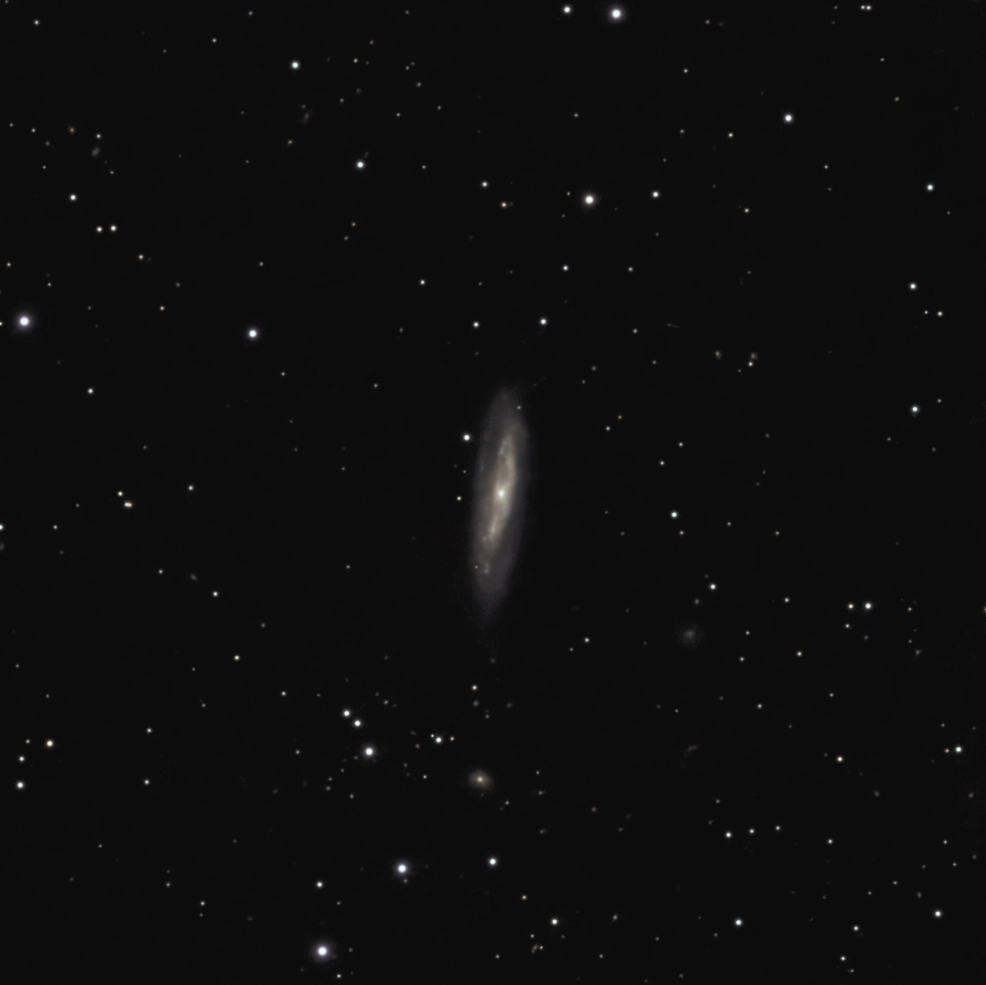
Image credit: JM (TRAC)
Above image: The orientation and spiral nature of M98 were picked up, but no finer details were revealed in this one-hour shot. Total exposure time: 60 mins (361 x 10 secs). Taken at 00:31 on 06 Apr 2026.
Needle Galaxy (NGC 4565)
NGC 4565 is an edge-on spiral galaxy about 30 to 50 million light-years away in Coma Berenices.
The Needle Galaxy is an excellent example of an edge-on spiral galaxy, and our photo showed this structure clearly in comparison to other spiral galaxies we've photographed.

Image credit: JM (TRAC)
Above image: The Needle Galaxy's slender profile and central bulge were captured perfectly in this photo. Ignore the satellite trail cutting through the frame. Total exposure time: 1 hr 30 mins (538 x 10 secs). Taken at 00:15 on 08 Apr 2026.
Black Eye Galaxy (M64)
Messier 64 (NGC 4826) is a +9.8 magnitude spiral galaxy about 17 million light-years away in Coma Berenices.
Its name comes from the dark band of dust in front of part of its bright nucleus. The Seestar photo didn't really capture this well.

Image credit: JM (TRAC)
Above image: The "Black Eye" or "Evil Eye" galaxy appears with a small dark region to the left of the nucleus in our photo. Total exposure time: 1 hr 36 mins (577 x 10 secs). Taken at 23:14 on 08 Apr 2026.
Mirror Galaxy (M100)
Messier 100 (NGC 4321) is a +10.1 magnitude grand-design spiral galaxy about 56 million light-years away in Coma Berenices.
M100 is undergoing an extremely high rate of star formation. Galaxies of this nature are known as starburst galaxies.
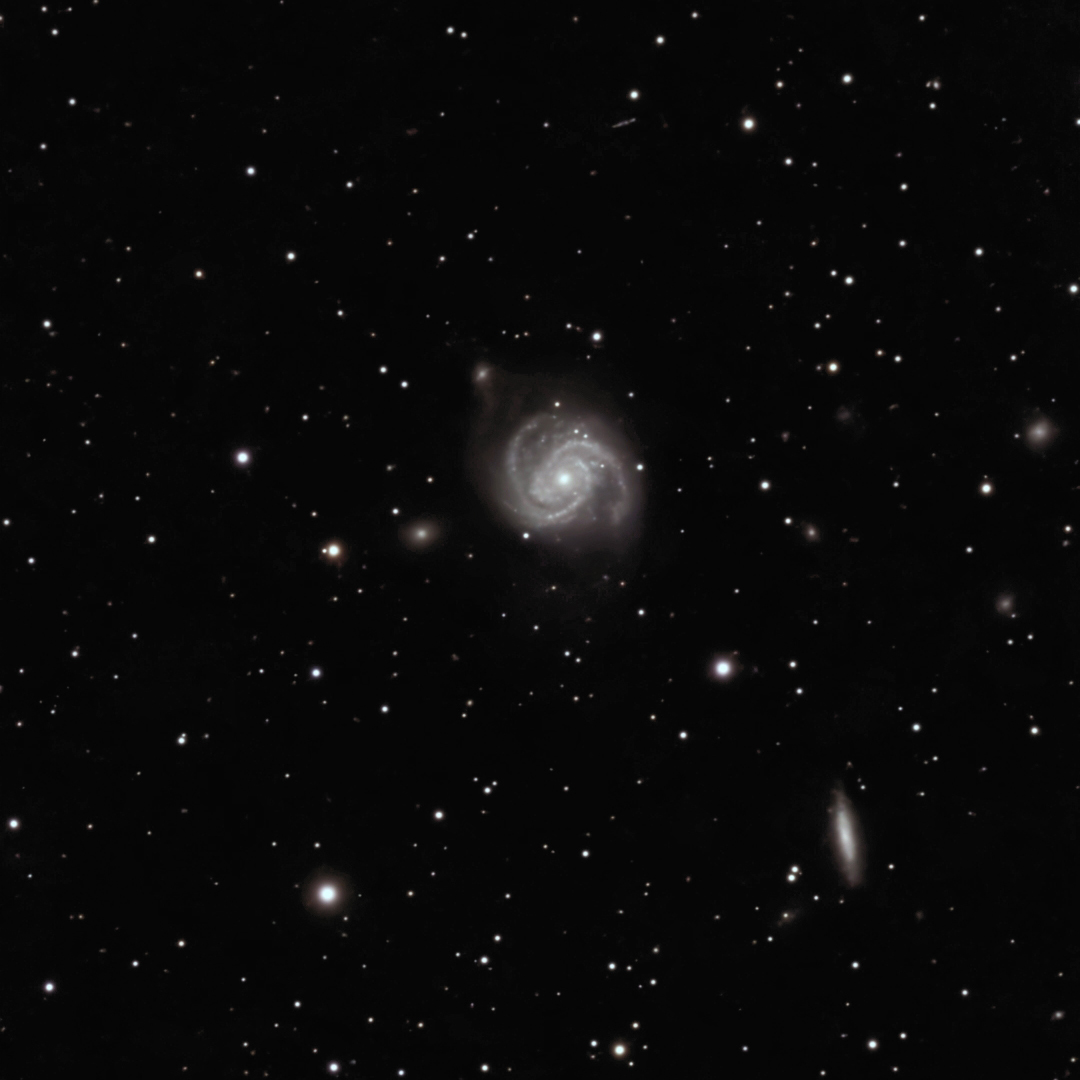
Image credit: JM (TRAC)
Above image: The Seestar S50 did a fantastic job picking up the galaxy's prominent spiral arms. Total exposure time: 1 hr 24 mins (505 x 10 secs). Taken at 00:42 on 14 Apr 2026.
St. Catherine's Wheel (M99)
Messier 99 (NGC 4254) is a +10.4 magnitude grand-design spiral galaxy about 55 million light-years away in Coma Berenices.
M99 features long, loosely wound arms, giving it a distinct appearance compared to the galaxies above. The photo was taken under less-than-ideal weather. The evening started off clear, but by midnight, conditions began to deteriorate.
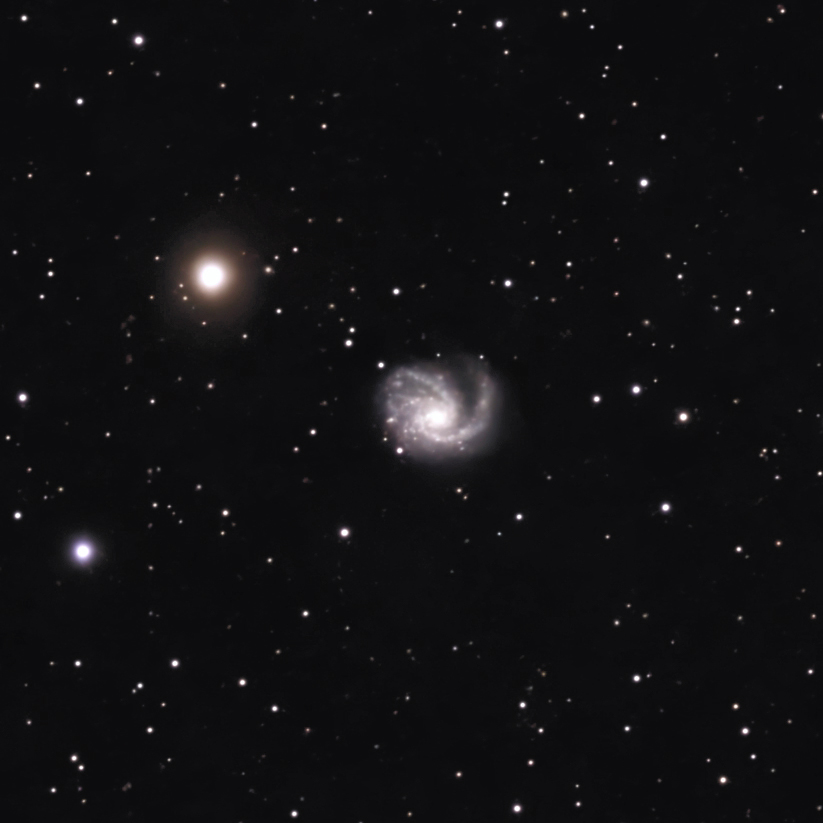
Image credit: JM (TRAC)
Above image: M99's long spiral arms and overall structure were captured well. Total exposure time: 1 hr 27 mins (524 x 10 secs). Taken at 00:41 on 22 Apr 2026.
Whirlpool Galaxy (M51)
Messier 51, known as the Whirlpool Galaxy, is a magnitude +8.4 spiral galaxy located 31 million light-years away in the constellation Canes Venatici.
Krum K used the Seestar S50 to take a photo of the Whirlpool Galaxy after our meteor-spotting session on 22 Apr 2026. He learnt how to set up the telescope, adjust the level, activate the anti-dew heater, and select the target using the tablet computer.
He was concerned that the bright moonlight might affect the photo, but the end result turned out better than expected. Krum was pleased with his first Seestar shot.
Compare Krum's photo of M51 with Matey's shot of the same galaxy taken last month.
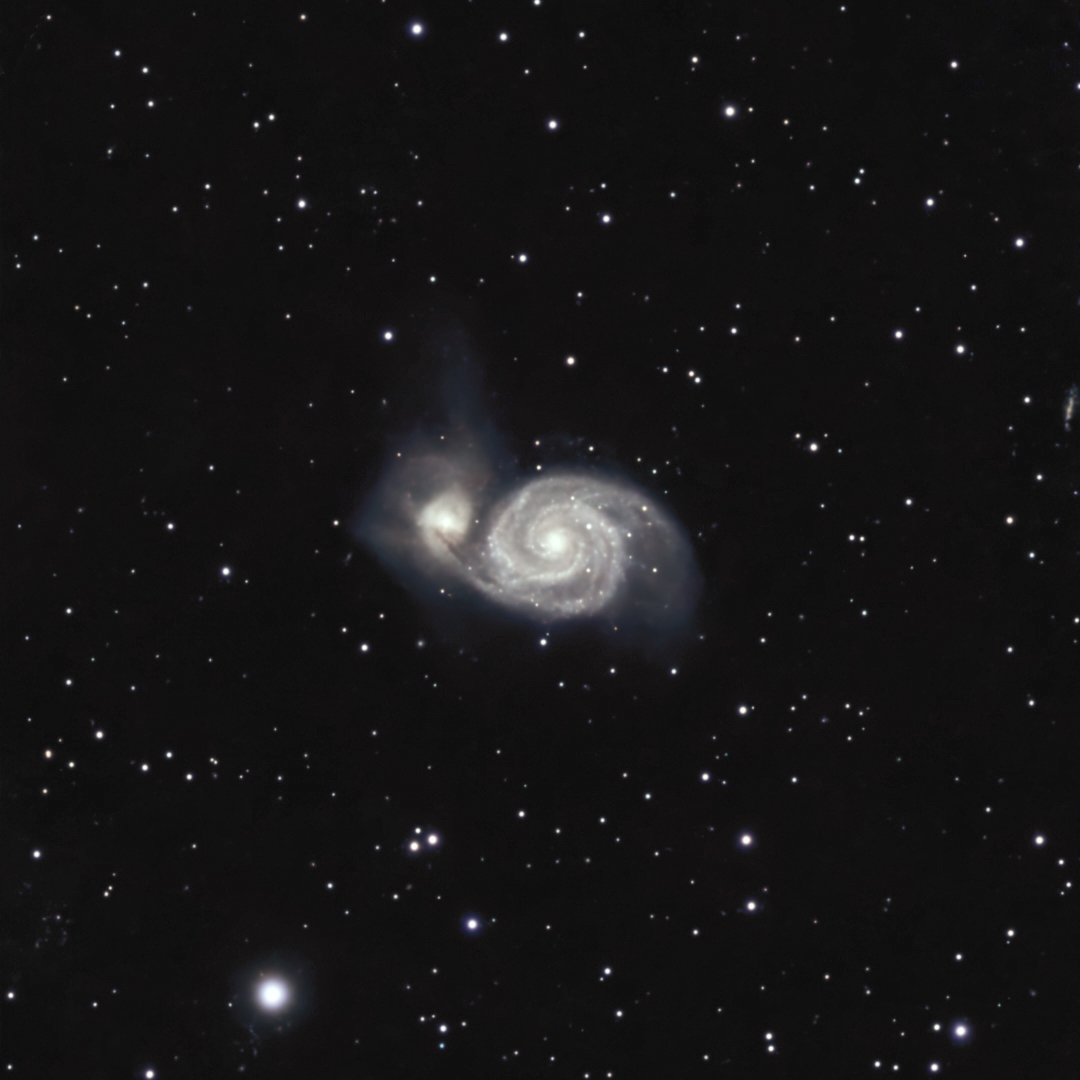
Image credit: KK/JM (TRAC)
Above image: The Whirlpool Galaxy seen interacting with its smaller companion, NGC 5195 (Messier 51b), to its left in the photo. Total exposure time: 1 hr 31 mins (544 x 10 secs). Taken at 01:03 on 23 Apr 2026.
Bode's Galaxy (M81)
Messier 81, known as "Bode's Galaxy", is a magnitude +6.9 spiral galaxy located 12 million light-years away. It's located in the constellation Ursa Major.

Image credit: JM (TRAC)
Above image: The shape of M81 is well-represented in this image. It's a pity about the satellite trails criss-crossing the photo, but at least they passed above and below the target. Total exposure time: 2 hrs 18 mins (827 x 10 secs). Taken at 01:31 on 26 Apr 2026.
Lunar Observations
Moon - Nikon D80 Photo (25 Apr 2026)
One of our key goals for 2026 as an astronomy club is to improve our astrophotography skills, which includes exploring more advanced imaging techniques and upgrading our equipment.
We were kindly lent a Nikon D80 DSLR camera, and the first proper test was to image our nearest celestial neighbour – the Moon!
A few days before the Full Moon is widely considered one of the best times to photograph the Moon. The image below was taken on day 9 of the lunar cycle, when the Moon was 70% illuminated.
The Nikon D80 was paired with a Celestron NexStar SLT 127mm telescope for the shoot. The scope's eyepiece was removed, and the camera's lens was detached. Next, the camera was attached to the telescope's star diagonal using a T-adapter and T-ring. With the telescope tube acting as the camera lens, we were working with an impressive 1,500mm focal length!
Around 100 photos were taken. The best one can be viewed below.
The photo was saved in RAW format and edited using Photoshop. The final image shows better definition and improved sharpness of the Moon's largest craters compared to our afocal phone camera images.
I am particularly happy with how the mountain ranges, such as Montes Apenninus, turned out. You can really get a sense of the Moon's 3D surface.

Image credit: JM (TRAC)
Above image: The 9-day-old Moon at 70% illumination. Camera: Nikon D80. Exposure: 1/40 sec. ISO-200. Telescope: Celestron NexStar SLT 127mm (5"). Focal length: 1500mm. Taken at 23:46 on 25 Apr 2026.
Moon at 36% Illumination (22 Apr 2026)
Krum K used the Seestar S50 in Lunar Mode to take a detailed photo of the Moon on 22 Apr 2026. He had a clear view of the Moon, which was 36%-lit.
His photo shows the large maria (dark patches) and prominent craters on the Moon's eastern limb.
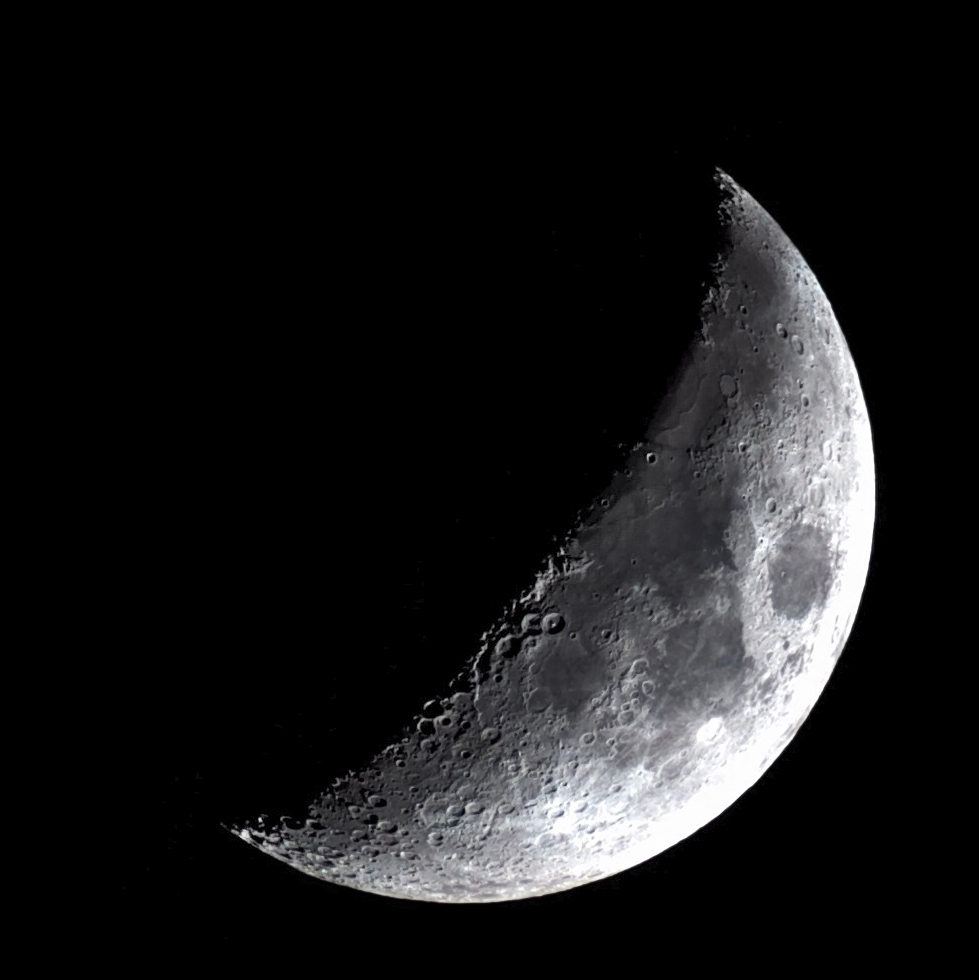
Image credit: KK (TRAC)
Above image: Krum's photograph of the Moon stands out as one of his finest. The Moon's rugged landscape can be appreciated by looking at the craters along the terminator, the line that separates the illuminated and dark sides of the Moon. Taken at 22:31 on 22 Apr 2026.
Venus–Moon Conjunction (18 Apr 2026)
We expected the weather to ruin any chance of seeing this conjunction, but, despite the 75% cloud cover, the view to the west was clear after 20:00.

Image credit: JM (TRAC)
Above image: Venus beaming brightly above the Crescent Moon lower down. Camera: Lumix DMC-TZ60. F-stop: f/4.8. Exposure: 4 sec. ISO-400. Focal length: 15mm. Taken at 20:21 on 18 Apr 2026.
Venus–Moon–Pleiades Conjunction (19 Apr 2026)
Matey K and I headed to the park equipped with a Nikon D80. Our aim was to experiment with various ISO, shutter, and aperture settings to capture the Moon, with the earthshine effect, above the Pleiades star cluster and Venus sitting just above the skyline.
Our ISO was low (ISO-100) so that the brightness of the Moon wasn't overpowering, and we used a 2.5 sec shutter speed to allow in enough light for the six brightest stars of the Pleiades to be picked up by the camera.
We fared better than at the same time in April when the Lumix camera refused to focus properly and its zoom malfunctioned. Using a decent DSLR camera is definitely the way to go.

Image credit: MK (TRAC)
Above image: The crescent Moon, softly illuminated by earthshine, sits above the sparkling Pleiades, while Venus shines brilliantly beneath. Camera: Nikon D80. F-stop: f/1.8. Exposure: 2.5 sec. ISO-100. Focal length: 50mm. Taken at 21:53 on 19 Apr 2026.
For fun, we asked GPT to describe the scene; its tone was very poetic:
"A breathtaking celestial dance unfolds in the evening sky: a delicate crescent Moon hovers gracefully above the glittering Pleiades star cluster, while brilliant Venus shines like a cosmic beacon nearby. This rare alignment of sky jewels captures the serene beauty and infinite wonder of the universe in a single frame – an astronomical moment that feels both intimate and epic."
Planets
Venus & Jupiter
The Solar System's two brightest planets – Venus and Jupiter – dominated the evening sky throughout April 2026.
Each night, Venus climbed a little higher while Jupiter lost a little altitude. These small changes in position were apparent to astronomers with a keen eye. This celestial dance will continue into May, leading towards the Venus–Jupiter conjunction in June.
Summary
Much Photography Experience Gained
Lots of Messier objects were photographed this month. One skill we need to work on is photo editing. We need to learn how to remove satellite trails because they were a major problem with quite a few of our galaxy photos.
A big thanks to George and Nadia for the generous loan of their Nikon D80.
Just like March 2026, April 2026 can be remembered as one of TRAC's most productive months to date.
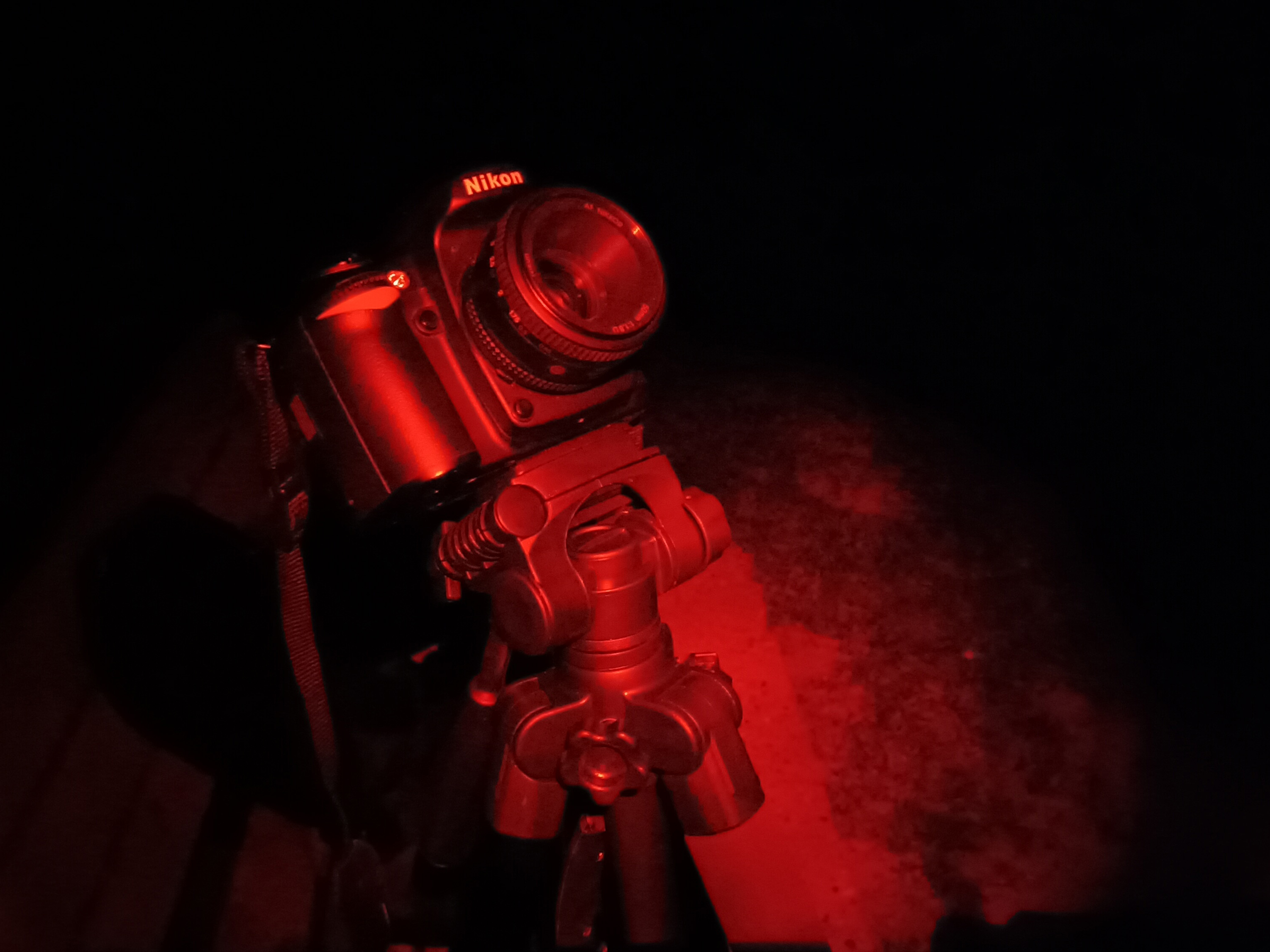
Image credit: JM (TRAC)
Above image: The Nikon D80 mounted on a sturdy tripod pointing towards Jupiter. It is ready for its next photo, eagerly waiting to spring into action.

Image credit: JM (TRAC)
Above image: The Nikon D80 mounted on a Celestron NexStar 127 SLT telescope. This configuration was used to take a detailed image of the Moon on 25 Apr 2026.

Image credit: JM (TRAC)
Above image: Look at the size of its nose! That's the T-ring and T-adapter needed to fit the Nikon D80 to the telescope star diagonal.
Artemis II Success!
We celebrated the success of NASA's Artemis II mission, which saw four astronauts complete a 10-day, 1.1 million km journey around the Moon. Watching the launch on 01 Apr 2026 was exciting, and watching the reentry and splashdown on 11 Apr 2026 was unnerving!
TRAC members are looking forward to the next step in space exploration as NASA prepares to land people on the Moon in 2028.
Looking Ahead
Next month, we'll focus on galaxies in the Virgo Cluster. Virgo will be higher in the sky, though we'll need to work at later times due to the later sunsets.
James M
TRAC Team Leader
01 May 2026 – Rainham, Kent

TRAC is an amateur astronomy group based in Rainham (Kent) in the United Kingdom.
On clear nights, you'll find us outside, observing stars, planets, moons, galaxies, satellites, meteors, and comets.
This monthly report is intended to keep club members informed of our observational activities, track progress towards the club's long-term goals, celebrate successes, and record memorable moments.
Unless stated otherwise, magnitude values refer to apparent magnitude and have usually been rounded to one decimal place; photos of deep-sky objects credited to TRAC were taken using a Seestar S50 smart telescope; our observations were made from Rainham, Kent; and times and dates are in the UK's local time zone (GMT or BST, depending on the time of year).
We welcome any questions, feedback, or suggestions you may have. Please let us know if anything is unclear or if you notice an error, inaccuracy, or typo. Contact us via email.
© 2026 Taverners Road Astronomy Club