TRAC Action Plan: December 2025
- Category: Action Plans
- Author: JM
- Published: 01 Dec 2025
- Last updated: 01 Dec 2025
December 2025 Calendar
- Thu, 04 Dec Full Moon ("Supermoon")
- Sun, 07 Dec Moon close to Jupiter in Gemini (19:00 onwards)
- Mon, 08 Dec Uranus passes close to bright stars in Taurus (08-28 Dec)
- Wed, 10 Dec Moon occults Regulus (Starts at 07:30)
- Thu, 11 Dec Last Quarter Moon
- Sun, 14 Dec Geminid Meteor Shower peaks
- Sat, 20 Dec New Moon
- Sun, 21 Dec Winter Solstice
- Mon, 22 Dec Ursid Meteor Shower peaks
- Sat, 27 Dec First Quarter Moon
- Wed, 31 Dec Moon close to the Pleiades all night
Stargazing
Winter Constellations
Constellations to look out for this month include:
- Cancer
- Canis Major
- Canis Minor
- Taurus
- Orion
- Lepus
- Auriga
- Gemini
All of our favourite winter constellations, like Orion, Taurus, and Gemini, are now visible all evening.
Northern Circumpolar Constellations
These are the constellations which are visible all year round. They never set below the horizon when viewed from northern latitudes like the UK.
This group of constellations includes:
- Ursa Major
- Ursa Minor
- Cassiopeia
- Cepheus
- Lacerta
- Draco
Seeing these constellations and learning why they are visible all year round is part of our "Mission for 2025". We still have a few weeks left to complete this goal!
Deep Sky Objects
Orion Nebula (M42)
- The Orion Nebula (mag. +4.0) is visible to the naked eye.
- It's located below the three bright belt stars in Orion.
- It lies approximately 1,344 light-years away from Earth.
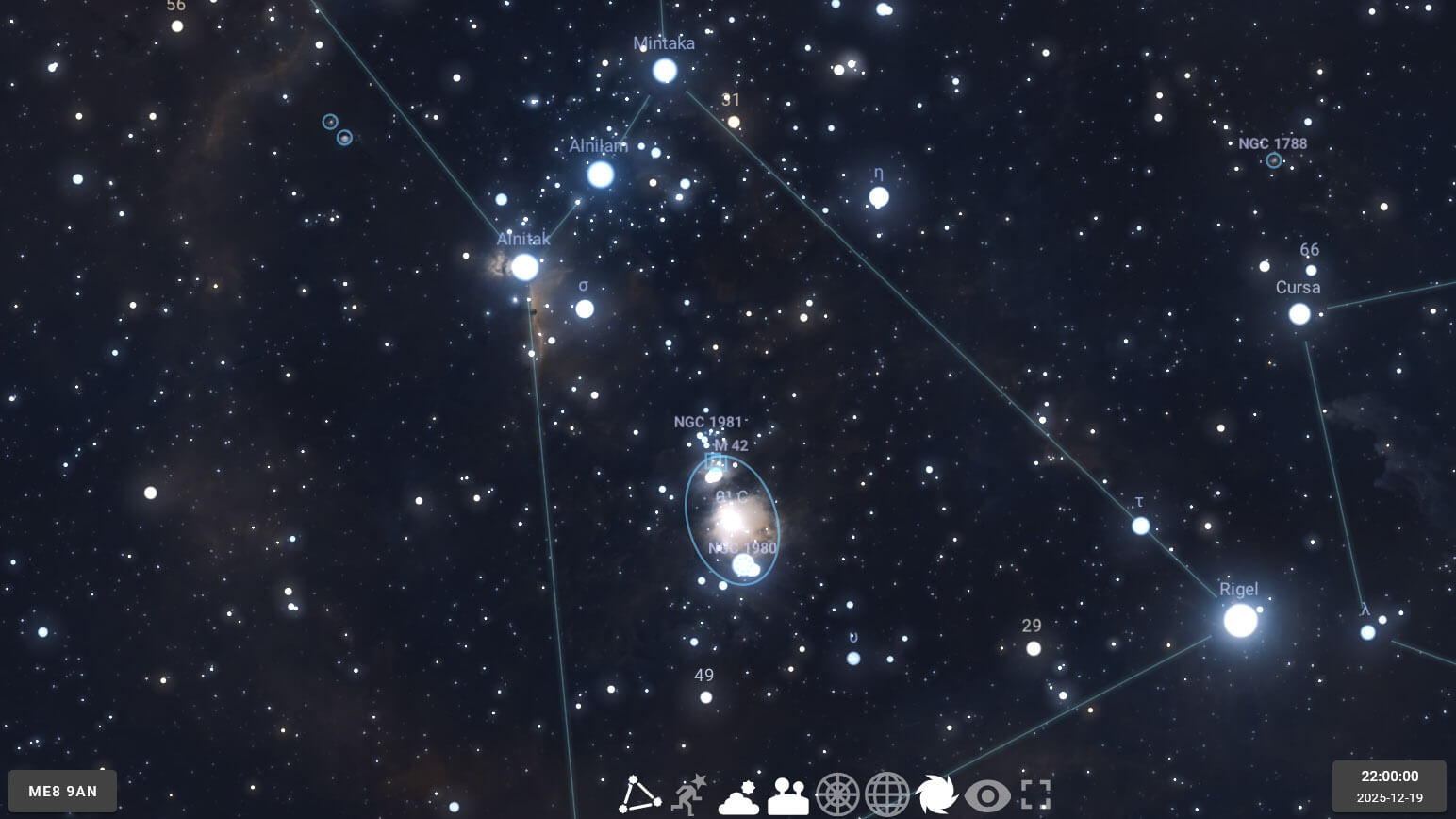
Image credit: Stellarium
Above image: The Orion Nebula, located below the three bright belt stars in Orion.
Let's aim to get some wide-angle shots of the entire Orion constellation, then zoom in with the telescope and take some photos of the Orion Nebula.
Planets
Skip to: Mercury | Venus | Mars | Jupiter | Saturn | Uranus | Neptune
Mercury
- Mercury (mag. -0.5) reaches greatest western elongation on 07 Dec 2025.
- It's an object in the morning sky and rises around two hours before the Sun.
- If you're awake earlier than me, you can see it in the east at 07:00.
Venus
- Venus (mag. -3.9) is now too close to the Sun to be seen.
- It will be visible again as an evening planet in Jan 2026.
Mars
Mars is not visible this month.
Jupiter
- Jupiter (mag. -2.6) is a stunning sight in the evening sky all month.
- See it in Gemini near to the bright stars Castor and Pollux.
- It reaches a peak altitude of approximately 60 degrees.
- TRAC is still looking for the GRS, which is smaller than it once was.
Jupiter Event Timings:
Callisto Shadow Transit: 07 Dec 2025 19:20-22:49
Saturn
- Saturn (mag. +1.1) is high all evening in Aquarius.
- Its rings will appear almost edge-on and will appear to get even smaller until 07 Dec 2025.
- Will its rings completely disappear when seen in a small telescope?
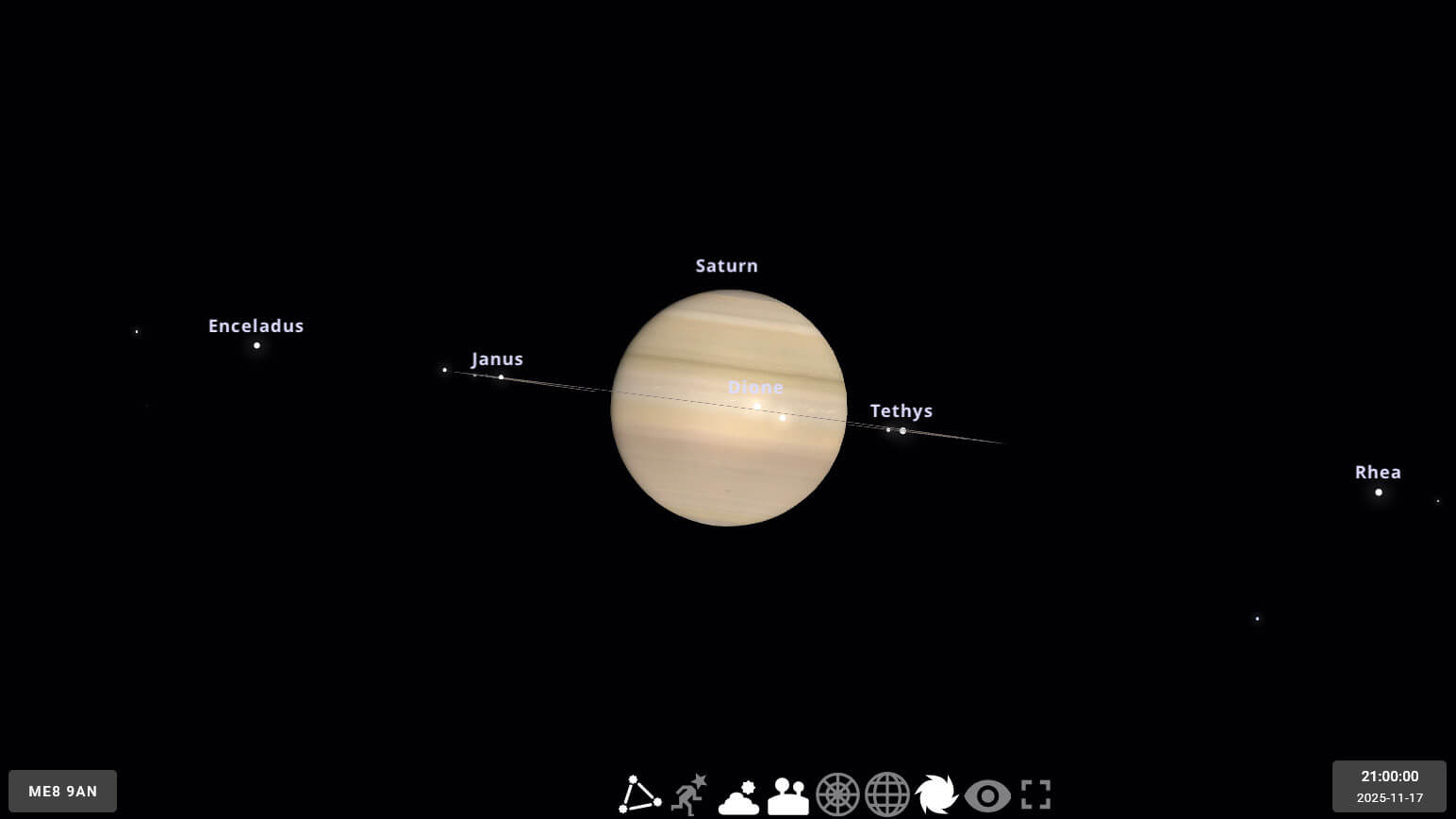
Image credit: Stellarium
Above image: Saturn with its rings edge-on to us in mid-November 2025.
Special Saturn Events:
- Titan Transit: 08 Dec 2025 17:38-23:58
- Titan close to Rhea: 09 Dec 2025 ~23:50
- Titan Occulted by Saturn: 16 Dec 2025 16:23-22:05
Uranus
- Uranus (mag. +5.6) reached opposition on 21 Nov 2025 in Taurus.
- The planet is still excellently placed for us, rising high by 19:00.
- It currently lies south of the Pleiades, making it easy to locate with binoculars.
- Our telescope, at a magnification of ~100x, should show the planet as a tiny, turquoise (or cyan) disc.
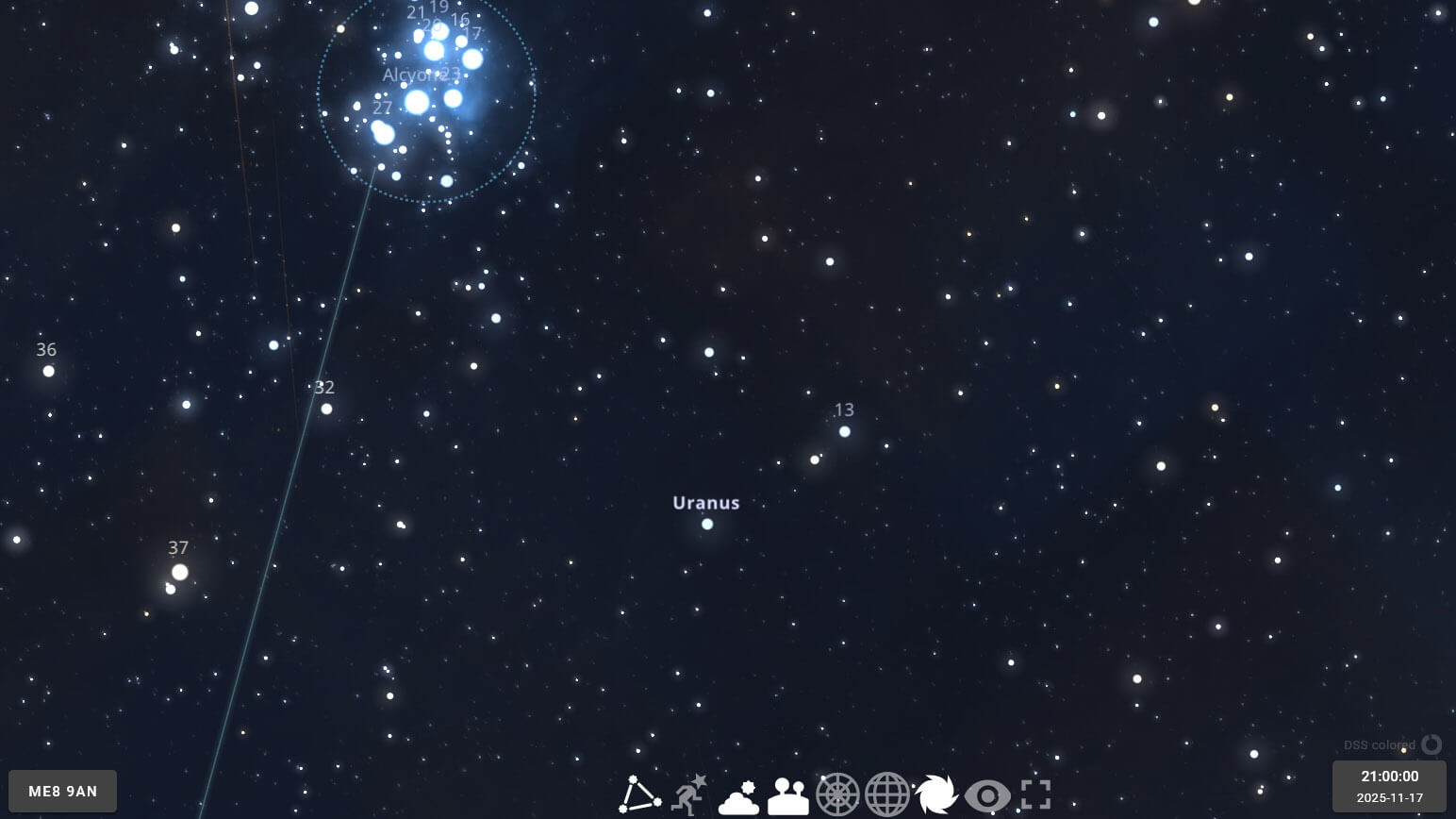
Image credit: Stellarium
Above image: Uranus's position close to the Pleiades in mid-November 2025.
Neptune
- Neptune (mag. +7.9) is still slightly northeast of Saturn.
- It will be best viewed at the start of the month.
- The Sky Live will show you exactly where Neptune is right now.
Lunar Observations
December 2025 Lunar Calendar
- Full Moon Thu 04
- Last Quarter Thu 11
- New Moon Sat 20
- First Quarter Sat 27
December 2025 Full Moon ("Supermoon")
On 04 Dec 2025, there'll be another Perigee Full Moon (a.k.a. a "Supermoon").
Refer back to our Nov 2025 Action Plan for more information about the Supermoon.
Hopefully, we'll be in the park to watch the Moon rise. Invite your friends and family to come and see the "Supermoon" through a telescope.
Meteor Showers
The Geminids
- Active Dates: 04-20 Dec
- Peak Night: 14 Dec
- Peak Rate: ~100 meteors per hour
- Radiant: Gemini, close to Castor
- Often touted as the best meteor shower of the year.
- The best meteor shower to see before midnight.
- Slower than other meteors and often last longer.
The Geminids in 2025:
The Moon is in its waning crescent phase, so conditions are favourable this year.
The Ursids
- Active Dates: 17-26 Dec
- Peak Night: 22 Dec
- Peak Rate: ~5-10 meteors per hour
- Radiant: Ursa Minor, close to Polaris
- Debris from Comet 8P/Tuttle
The Ursids in 2025:
The Moon is in its waxing crescent phase and will set at 18:00, so conditions are favourable this year.
Admin Tasks
- Design a 2025 TRAC bookmark.
- Research the Orion Nebula.
- Think about our club goals for 2026.
Summary
Top Priorities for December 2025
In descending order of importance:
See You Out There
The Winter Solstice on 21 Dec 2025 marks the official start of astronomical winter. Nighttime is longest, and daytime is shortest.
Bad weather meant we missed last month's "Supermoon". Perhaps we'll have more luck in December and can watch the bright Full Moon rise from the park on 04 Dec 2025.
Let's see how many meteors we can see during the Geminids this year.
We'll also test the new binoculars and research how to set up the Seestar S50 and how to get the best quality photos for our location and sky conditions.
James M
TRAC Team Leader
01 Dec 2025 – Rainham, Kent

TRAC is an amateur astronomy group based in Rainham (Kent) in the United Kingdom.
On clear nights, you'll find us outside, observing stars, planets, moons, galaxies, satellites, meteors, and comets.
This action plan is specifically tailored for our location (Rainham, Kent), schedules, optical equipment, level of experience, personal interests, and local sky conditions.
Unless stated otherwise, magnitude values refer to apparent magnitude and have usually been rounded to one decimal place; photos of deep-sky objects credited to TRAC were taken using a Seestar S50 smart telescope; our observations were made from Rainham, Kent; and times and dates are in the UK's local time zone (GMT or BST, depending on the time of year).
We welcome any questions, feedback, or suggestions you may have. Please let us know if anything is unclear or if you notice an error, inaccuracy, or typo. Contact us via email.
© 2025 Taverners Road Astronomy Club