TRAC Action Plan: September 2026
- Category: Action Plans
- Author: JM
- Published: 01 Sep 2026
- Last updated: 01 Sep 2026
September 2026 Calendar
- Tue, 01 Sep Venus close to Spica (19:30)
- Wed, 02 Sep Moon near Pleiades
- Fri, 04 Sep Last Quarter Moon
- Fri, 11 Sep New Moon
- Mon, 14 Sep Moon near Venus
- Fri, 18 Sep First Quarter Moon
- Sat, 19 Sep Event: Observe the Moon Night 2026
- Tue, 22 Sep Venus at max brightness
- Wed, 23 Sep Autumn Equinox
- Fri, 25 Sep Neptune (mag. +7.8) Opposition
- Sat, 26 Sep Full Moon near Saturn
- Wed, 30 Sep Moon near Pleiades
Stargazing
Autumn Constellations
Constellations to look out for this month:
- Cygnus
- Taurus
- Lyra
- Pegasus
- Cepheus
- Aquila
- Andromeda
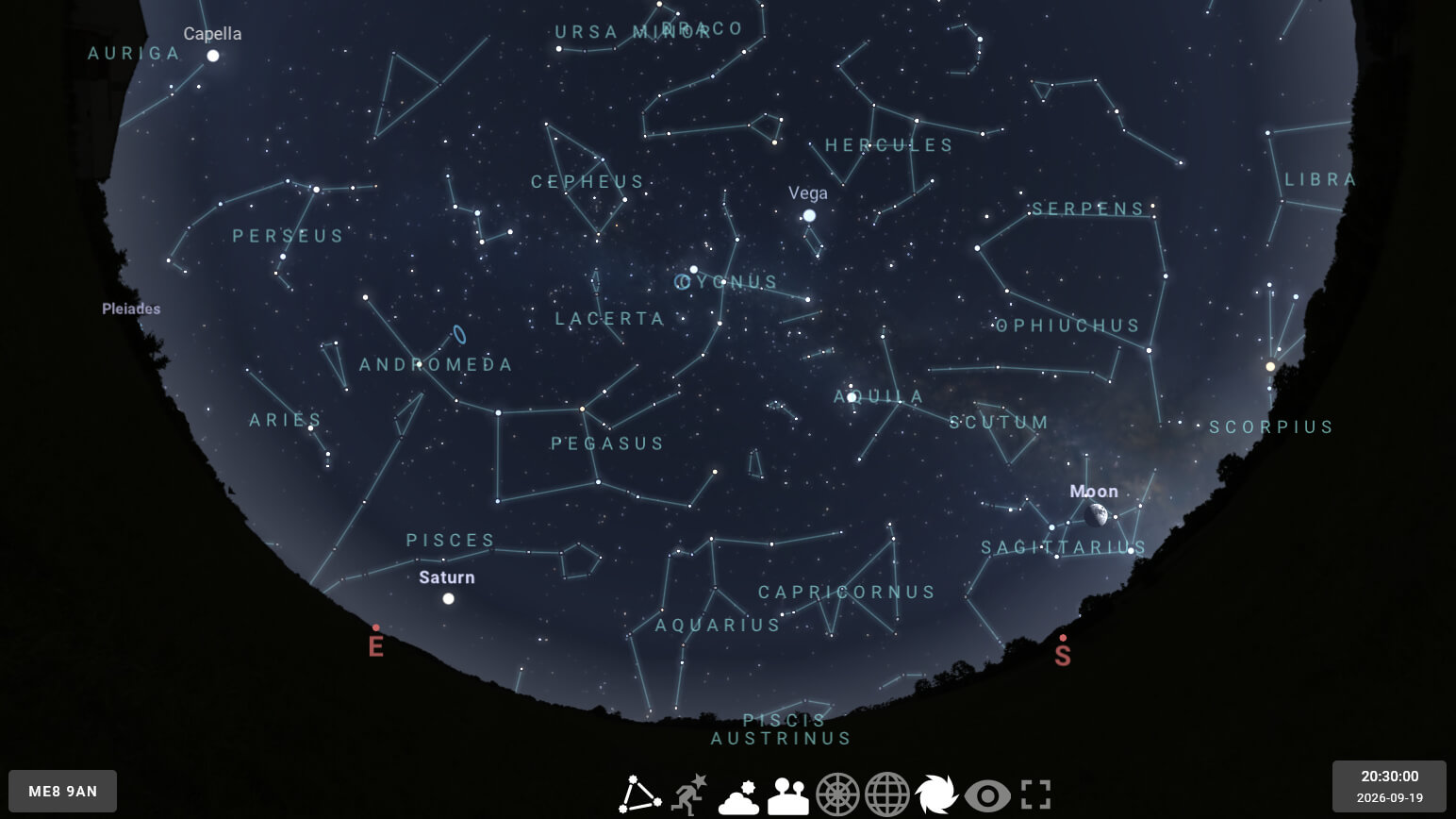
Image credit: Stellarium
Above image: A view of the constellations visible in the autumn night sky looking south-east on 19 Sep 2026.
Astrophotography
TRAC's number one mission for 2026 is to photograph as many deep-sky objects as possible.
Autumn is approaching, and the sky is getting darker much earlier, so we should get time to take photos of some deep-sky objects using the Seestar S50 on clear nights this September.
Possible targets this month include:
- M11 (mag. +6.3) - The Wild Duck Cluster
- M27 (mag. +7.4) - The Dumbbell Nebula
- Brocchi's Cluster (mag. + 3.6) - The "Coathangar" Cluster
Comet 10P/Tempel
No attempts were made to observe this comet in July or August. We might get a chance around the New Moon (11 Sep) at midnight, but it'll be very low due south.
Refer back to our July 2026 Action Plan for the full details of Comet 10P.
Planets
Mercury
- Reachesd superior conjunction on 27 Aug 2026.
- Too low after sunset to observe this month.
- Magnitude: -1.4
Venus
- Best viewed at the start of the month.
- Reaches its maximum brightness on 22 Sep 2026.
- Sets 30 mins after sunset.
- Below Spica in Virgo on 01 Sep 2026 at 19:30.
- Magnitude: -4.5
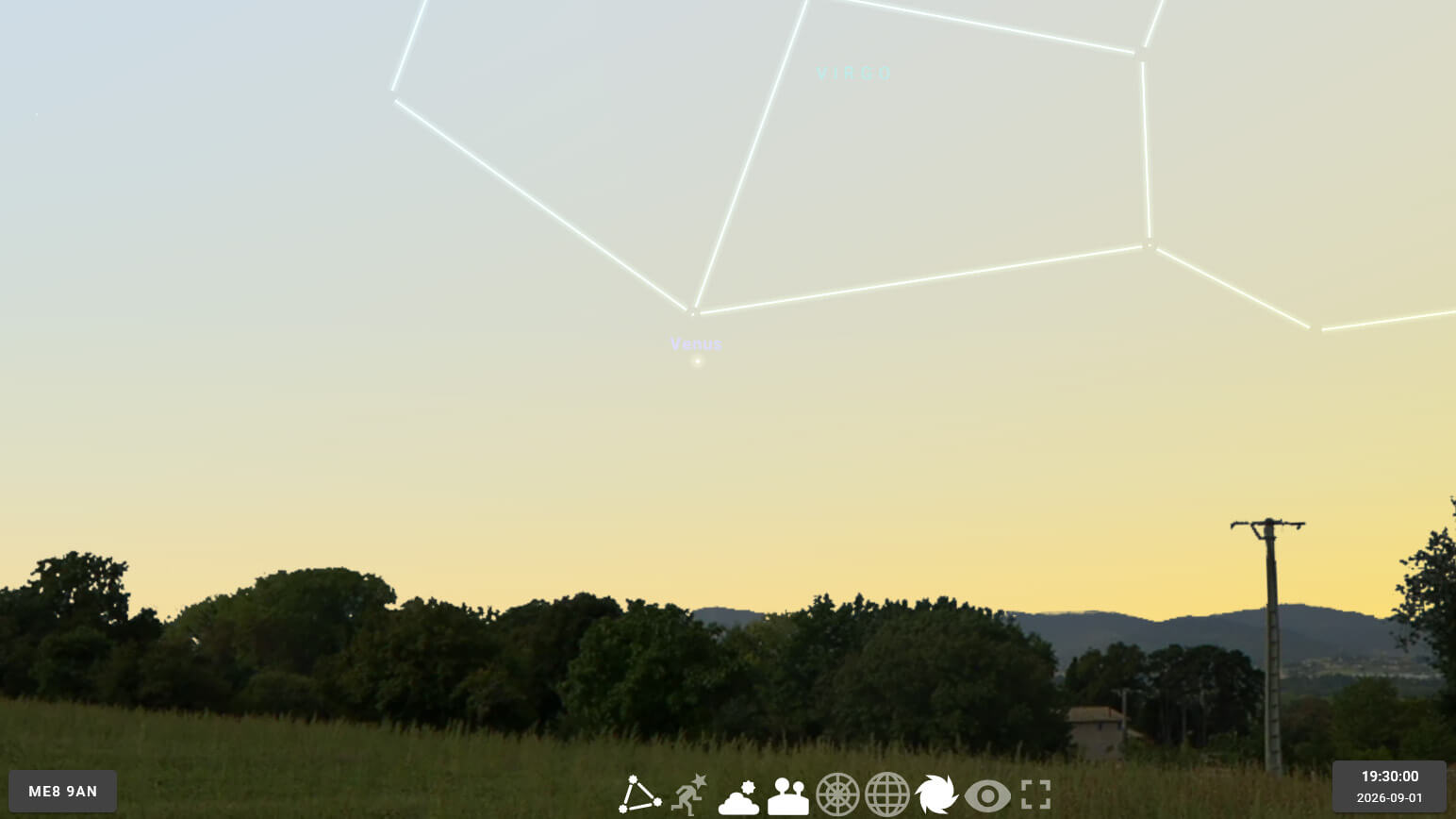
Image credit: Stellarium
Above image: Venus sits below Spica in Virgo at 19:30 on 01 Sep 2026.
Mars
- Rises at 01:00 at the start of the month.
- Better views over the winter.
- Reaches opposition in Feb 2027.
- Magnitude: +1.2
Jupiter
- Visibility is improving.
- Now rising two hours before the Sun.
- Magnitude: -1.8
Saturn
- Visible after 21:00 by mid-September.
- Good views coming up in the winter.
- Rings due to brighten around opposition on 04 Oct 2026.
- Magnitude: +0.5
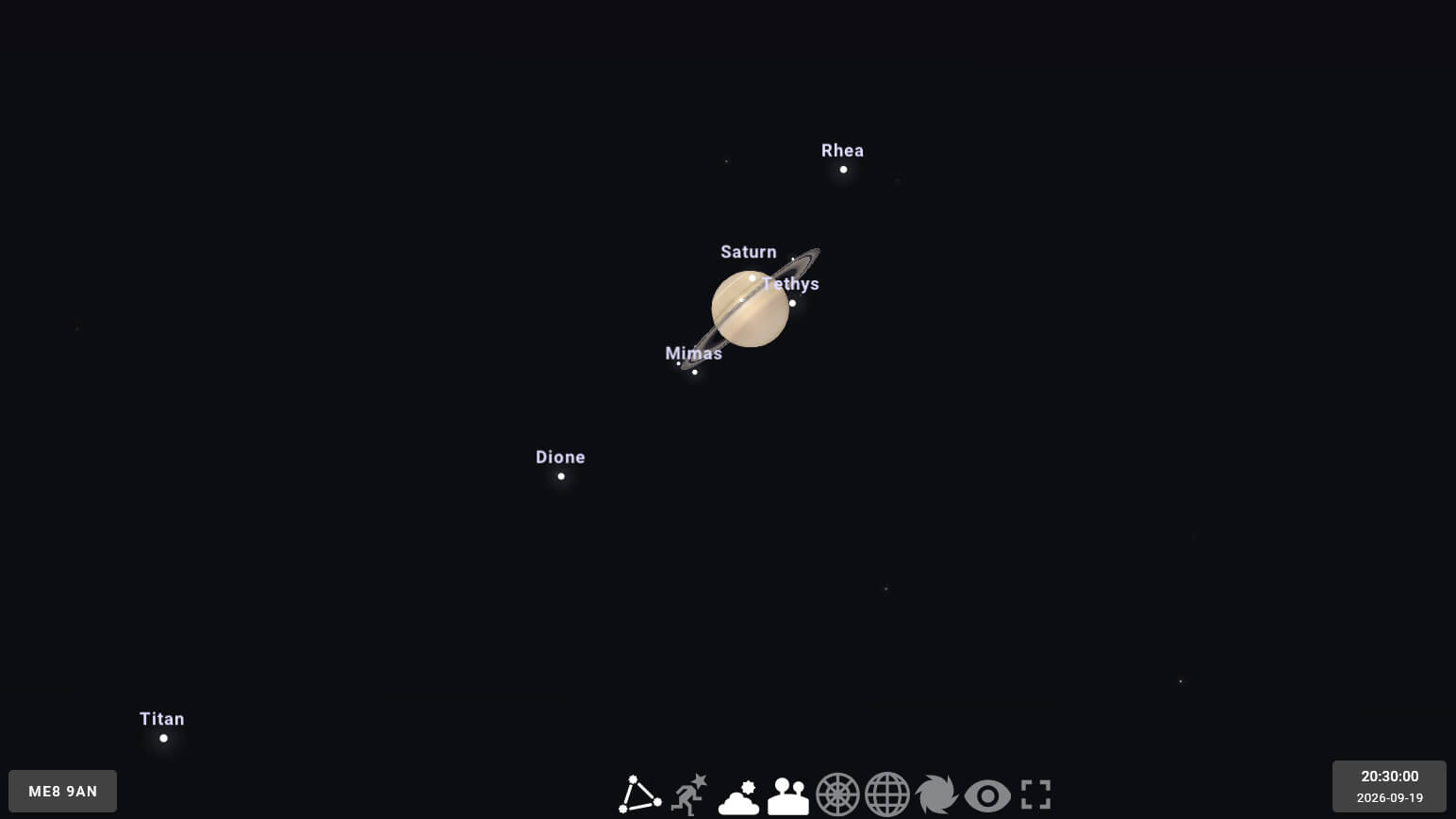
Image credit: Stellarium
Above image: The orientation of Saturn and position of its largest moons at 20:30 on 19 Sep 2026.
Uranus
- Visible after 23:00 close to Omega Tauri (mag. +4.9).
- We'll focus on Uranus later this year.
- Magnitude: +5.7
Neptune
- Neptune is 10 degrees from Saturn.
- Reaches opposition on 26 Sep 2026.
- Our aim is to see its blue colour and largest moon, Triton (mag. +13.4), with the Seestar S50.
- Magnitude: +7.8
Dwarf Planets
Pluto
- Pluto reaches opposition on 26 Aug 2026.
- We'll attempt to view it on a night where the Moon is below the horizon.
- The Seestar should be able to photograph this distant minor planet.
- Magnitude: +15.5
Juno
- Juno reached opposition on 24 Jul 2026.
- We'll attempt to view it with the telescope and the Seestar.
- Extra effort is required since Juno is not near any bright stars currently.
- Magnitude: +9.7
Lunar Observations
September 2026 Lunar Calendar
- Last Quarter Fri 04
- New Moon Fri 11
- First Quarter Fri 18
- Full Moon Sat 26
September 2026 Full Moon
- Date: 26 Sep 2026 (17:49)
- Moonrise: 18:25
- Traditional Name: "Corn Moon"
- Constellation: Pisces
Lunar Conjunctions
| Date | Time | Event |
|---|---|---|
| 02 Sep 2026 | After 22:30 | Moon near Pleiades |
| 07 Sep 2026 | After 02:30 | Moon near Mars |
| 09 Sep 2026 | After 04:30 | Moon near Jupiter |
| 14 Sep 2026 | After 19:00 | Moon near Venus |
| 17 Sep 2026 | After 20:00 | Moon near Antares |
| 30 Sep 2026 | After 21:30 | Moon near Pleiades |
Lunar Occultations
14 Sep 2026: Venus is behind the Moon as it rises. See the planet emerge from 11:30. A good view looking south-east is required.
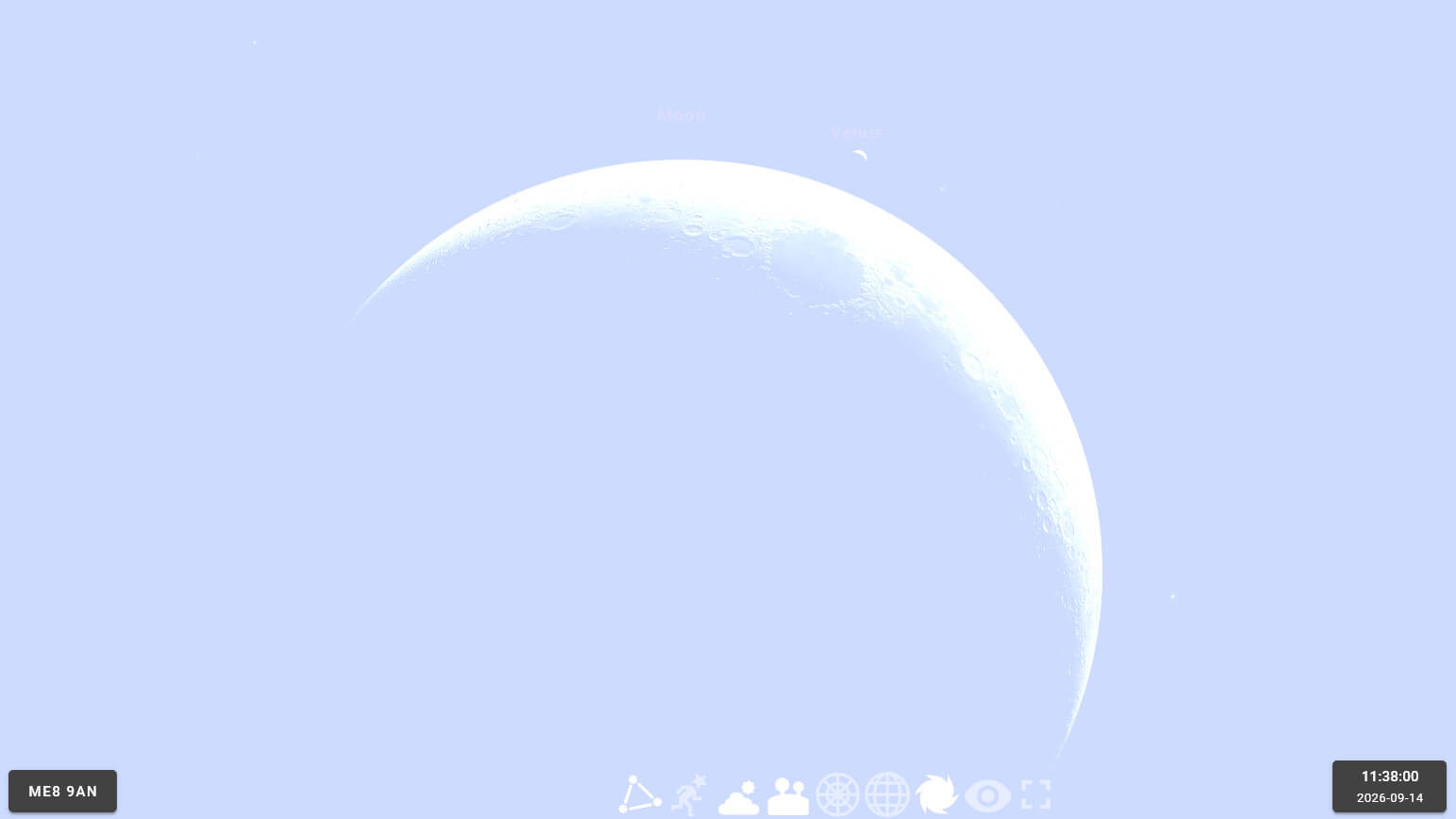
Image credit: Stellarium
Above image: Venus will emerge from behind the Moon on the morning of 14 Sep 2026.
Observe the Moon Night 2026
TRAC will take part in NASA's annual International Observe the Moon Night on Saturday, 19 September 2026.
We'll set up a few telescopes in the park so visitors can take an up-close look at the Moon and other sights like Saturn, Albireo, and the Andromeda Galaxy.
Check our Public Events page for more details.
Meteor Showers
There are no major meteor showers this month.
Summary
Top Priorities for September 2026
In descending order of importance:
- Observe the Moon Night - 19 Sep 2026
- Dwarf Planets (Pluto & Juno)
- Astrophotography
- Comet 10P (Attempt)
- Saturn
Autumn Equinox (23 Sep 2026)
Autumn begins in September. In 2026, the autumn equinox falls on 23 Sep and marks the start of astronomical autumn. Around the autumn equinox, the length of night increases rapidly, while daylight becomes noticeably shorter each day. This is when the transition from longer summer days to shorter autumn days is most pronounced, with the Sun setting progressively earlier each evening.
See You Out There
The main focus this month is our Observe the Moon Night event on 19 Sep 2026. We need to plan and rehearse what we'll do on the night and practise using the new telescopes.
Hopefully, we'll get some clear nights around the date of the New Moon (11 Sep) so we can locate Juno, attempt to photograph Pluto, maybe find Neptune, and take a clearer photo of Albireo.
James M
TRAC Team Leader
01 Sep 2026 – Rainham, Kent

TRAC is an amateur astronomy group based in Rainham (Kent) in the United Kingdom.
On clear nights, you'll find us outside, observing stars, planets, moons, galaxies, satellites, meteors, and comets.
This action plan is specifically tailored for our location (Rainham, Kent), schedules, optical equipment, level of experience, personal interests, and local sky conditions.
Unless stated otherwise, magnitude values refer to apparent magnitude and have usually been rounded to one decimal place; photos of deep-sky objects credited to TRAC were taken using a Seestar S50 smart telescope; our observations were made from Rainham, Kent; and times and dates are in the UK's local time zone (GMT or BST, depending on the time of year).
We welcome any questions, feedback, or suggestions you may have. Please let us know if anything is unclear or if you notice an error, inaccuracy, or typo. Contact us via email.
© 2026 Taverners Road Astronomy Club