TRAC Action Plan: April 2026
- Category: Action Plans
- Author: JM
- Published: 01 Apr 2026
- Last updated: 15 Apr 2026
April 2026 Calendar
- Wed, 01 Apr NASA Artemis II Launch
- Thu, 02 Apr Full Moon
- Fri, 10 Apr Last Quarter Moon
- Fri, 17 Apr New Moon
- Sat, 18 Apr Moon close to Venus (20:45)
- Sun, 19 Apr Moon close to Pleiades and Venus (21:00)
- Tue, 21 Apr Crescent Moon close to open cluster M35
- Wed, 22 Apr Lyrid Meteor Shower peaks
- Wed, 22 Apr Moon close to Jupiter
- Fri, 24 Apr First Quarter Moon
Stargazing
Spring Constellations
Constellations to look out for this month:
- Cancer
- Leo
- Boötes
- Hydra
- Gemini
- Leo Minor
- Coma Berenices
- Crater
- Virgo
In Leo, we'll aim the telescope at Algeiba, a close pair (double star). It is meant to be possible for us to split the two yellow stars (mag. +2.2 and +3.5) with our 127 mm telescope. Let's see if we can do it!
21 Apr 2026: The crescent Moon passes close to open cluster M35 at 23:00. Look out for this with binoculars.
Astrophotography
TRAC's number one Mission for 2026 is to photograph as many deep-sky objects as possible.
As always, we need a clear, moonless night to achieve the best results possible with the Seestar S50.
We'll aim to take photos of several prominent galaxies in the constellations of Leo, Coma Berenices, Virgo, and Ursa Major:
These regions contain hundreds of interesting objects. We'll focus on the ones listed below in April and May this year.
Leo Galaxies
In March, we took photos of eight galaxies in Leo, plus the Leo Cluster. The only major galaxy we missed in Leo is M95. We'll photograph M95 this month to complete our gallery of prominent galaxies in Leo.
Coma Berenices Galaxies
The Needle Galaxy (mag. +8.0)
NGC 4565, also known as the "Needle Galaxy", is an edge-on spiral galaxy about 30 to 50 million light-years away.
The Black Eye Galaxy (mag. +9.8)
M64 (NGC 4826), also known as the "Black Eye Galaxy" or "Evil Eye Galaxy", is a spiral galaxy 17 million light-years away.
M98, M99, and M100 (mag. +9.8)
These three Messier objects lie close together, roughly 50 million light-years away.
Virgo Galaxies
Markarian's Chain (mag. +8.9 and higher)
This iconic arc-shaped grouping of galaxies within the Virgo Cluster is made up of 8-10 prominent galaxies. These include M84, M86, NGC 4435, and NGC 4438.
The Sombrero Galaxy (mag. +8.0)
M104 (NGC 4594), also known as the "Sombrero Galaxy", is a peculiar galaxy of uncertain classification, located on the border between Virgo and Corvus.
Messier 49 (mag. +9.4)
M49 (NGC 4472) is a huge elliptical galaxy about 60 million light-years away in the Virgo Cluster of galaxies. The Seestar might be able to detect many of the fainter galaxies which lie in the vicinity of M49.
Messier 87 (mag. +9.6)
M87 (NGC 4486), also known as Virgo A, is a giant elliptical galaxy about 55 million light-years away. M87 is the largest galaxy in the Virgo cluster and contains several trillion stars.
Ursa Major Galaxies
There are a few more iconic galaxies overhead in Ursa Major which we can view clearly from the garden. Let's aim for these two:
Bode's Galaxy (mag. +6.9)
M81 (NGC 3031), also known as "Bode's Galaxy", is a grand design spiral galaxy roughly 12 million light-years away.
The Cigar Galaxy (mag. +8.4)
M82 (NGC 3034), also known as the "Cigar Galaxy", is a starburst galaxy about 12 million light-years away.
Planets
Mercury
- Mercury will be extremely low down in the morning sky.
- April is not the time to go looking for Mercury!
- Magnitude: -0.1
Venus
- Venus will be shining brightly in the west after sunset.
- 19 Apr 2026: Venus will be below the crescent Moon (21:00).
- Magnitude: -3.9
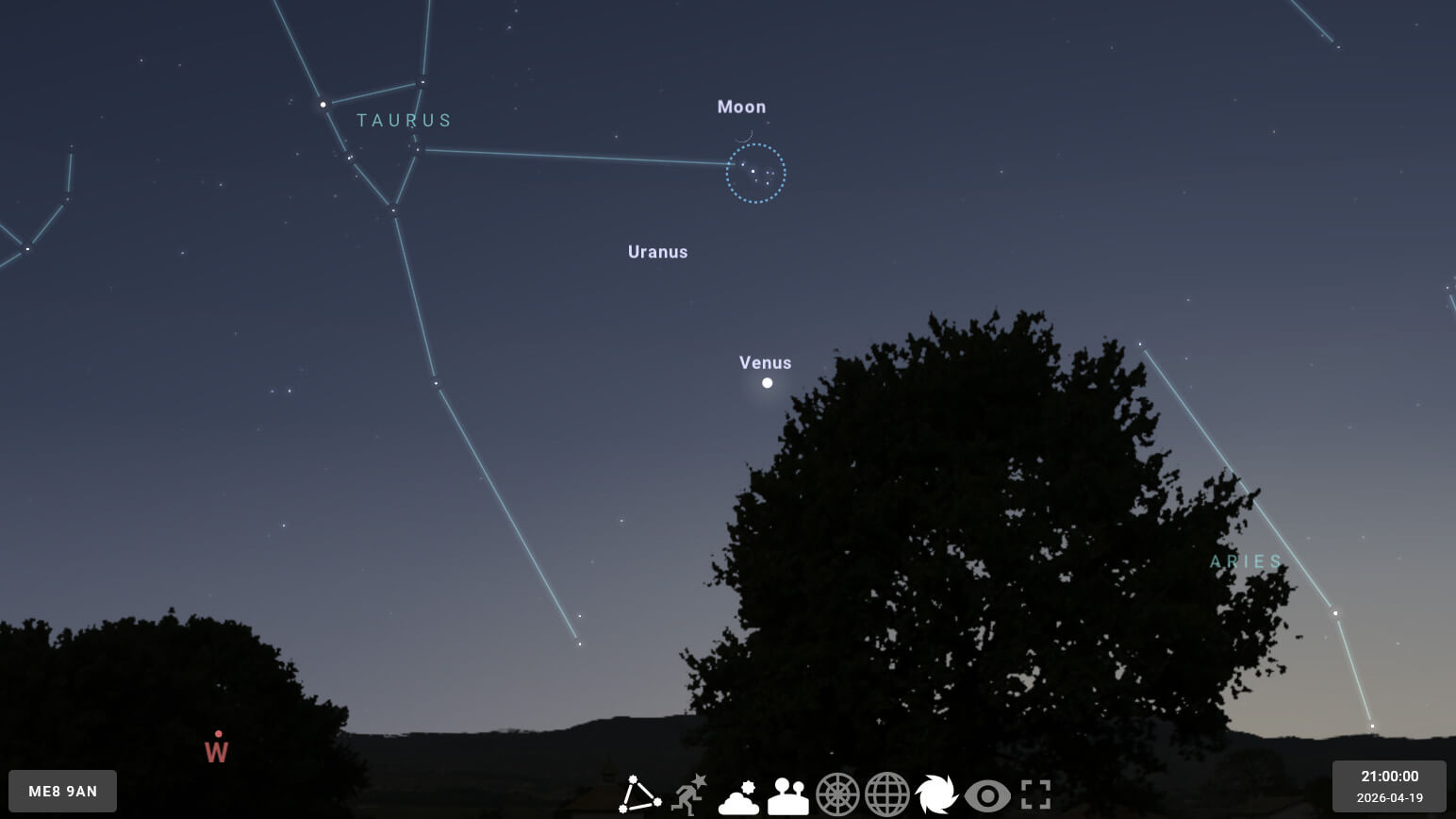
Image credit: Stellarium
Above image: A simulated view showing the crescent Moon close to the Pleiades with the planet Venus below at twilight on 19 Apr 2026.
Mars
- Mars will be extremely low down in the morning sky.
- It's now emerged from the other side of the Sun, but will not be easily seen until around August or September.
- Magnitude: +1.2
Jupiter
- Jupiter still dominates the night sky all month.
- 29 Apr 2026: The planet will pass very close to Wasat (+3.5) in Gemini at 23:00.
- Magnitude: -2.1
Jupiter Event Timings:
Special Galilean Moon Events:
- 09 Mar 2026: Callisto eclipsed by Jupiter's shadow (20:16 - 00:32)
- 17 Mar 2026: Callisto transit (19:40 - 23:35)
- 08 Mar 2026: Ganymede occulted by Jupiter (19:10 - 22:20)
Saturn
- Saturn is now technically a morning planet, but it's too close to the Sun before sunrise for us to see it.
- Magnitude: +0.9
Uranus
- Uranus will very likely be too low in the west for us to see.
- Magnitude: +5.8
Neptune
- Neptune is not visible this month.
Lunar Observations
April 2026 Lunar Calendar
- Full Moon Thu 02
- Last Quarter Fri 10
- New Moon Fri 17
- First Quarter Fri 24
April 2026 Full Moon
- 01 Apr 2026: The Full Moon will rise at 19:15.
- April's Full Moon is called a "Pink Moon".
- It will be located in the constellation of Virgo.
Lunar Conjunctions
- 19 Apr 2026: Thin crescent Moon just above the Pleiades with Venus below in the west after sunset (21:00).
- 22 Apr 2026: 36%-lit Moon close to Jupiter and Castor and Pollux in Gemini (visible all night).
Meteor Showers
The Lyrids
- Active Dates: 16 Apr - 25 Apr
- Peak Night: 22 Apr 2026
- Peak Rate: Up to 80 meteors per hour
- Radiant: Close to Vega
- Debris left by Comet Thatcher.
- Meteors can sometimes leave dusty trails as they burn up.
The Lyrids in 2026:
Best seen after the Moon sets at 02:00 on 23 Apr 2026.
Summary
Top Priorities for April 2026
In descending order of importance:
NASA Artemis II
Artemis II is set to launch on 01 Apr 2026!
Artemis II is NASA's first crewed test flight around the Moon and will launch from the agency's Kennedy Space Center in Florida no earlier than 18:24 EDT on 01 Apr 2026 – that's at 23:24 BST.
The crew will travel around the Moon on a 10-day mission.
Watch the final launch preparations live online from 17:50 UK time.
NASA web links:
- Artemis II - Mission Information (NASA)
- Artemis II - Crew Launches to the Moon (Official Broadcast)
- LIVE: Artemis II Launch Day Updates
See You Out There
March was a highly productive month for our club. Let's see if we can beat our record and photograph even more galaxies and star clusters this month.
When we observe the Moon at the start of April, there could be four astronauts on their way to visit it!
James M
TRAC Team Leader
01 Apr 2026 – Rainham, Kent

TRAC is an amateur astronomy group based in Rainham (Kent) in the United Kingdom.
On clear nights, you'll find us outside, observing stars, planets, moons, galaxies, satellites, meteors, and comets.
This action plan is specifically tailored for our location (Rainham, Kent), schedules, optical equipment, level of experience, personal interests, and local sky conditions.
Unless stated otherwise, magnitude values refer to apparent magnitude and have usually been rounded to one decimal place; photos of deep-sky objects credited to TRAC were taken using a Seestar S50 smart telescope; our observations were made from Rainham, Kent; and times and dates are in the UK's local time zone (GMT or BST, depending on the time of year).
We welcome any questions, feedback, or suggestions you may have. Please let us know if anything is unclear or if you notice an error, inaccuracy, or typo. Contact us via email.
© 2026 Taverners Road Astronomy Club