TRAC Action Plan: October 2026
- Category: Action Plans
- Author: JM
- Published: 01 Oct 2026
- Last updated: 01 Oct 2026
October 2026 Calendar
- Sat, 03 Oct Last Quarter Moon (14:25)
- Sun, 04 Oct Saturn at Opposition
- Mon, 05 Oct Moon very near Mars (05:30)
- Tue, 06 Oct Jupiter close to crescent Moon (Daytime - 11:24)
- Sat, 10 Oct New Moon (16:50)
- Sun, 11 Oct Mars occults Praesepe (02:00)
- Mon, 12 Oct Mercury Greatest Elongation (18:15)
- Wed, 14 Oct Moon near Antares (18:15)
- Sun, 18 Oct First Quarter Moon (17:12)
- Tue, 20 Oct Clair-obsur effect: Jewelled Handle (20:00)
- Wed, 21 Oct Orionids Peak
- Sat, 24 Oct Moon near Saturn
- Sun, 25 Oct BST Ends
- Sun, 25 Oct Full Moon (Moonrise: 16:00)
- Sun, 25 Oct TRAC - 3rd Anniversary Party
- Tue, 27 Oct Moon occults the Pleiades (23:30)
Stargazing
Autumn Constellations
Constellations to look out for this month:
- Cygnus
- Taurus
- Lyra
- Pegasus
- Cepheus
- Aquila
- Andromeda
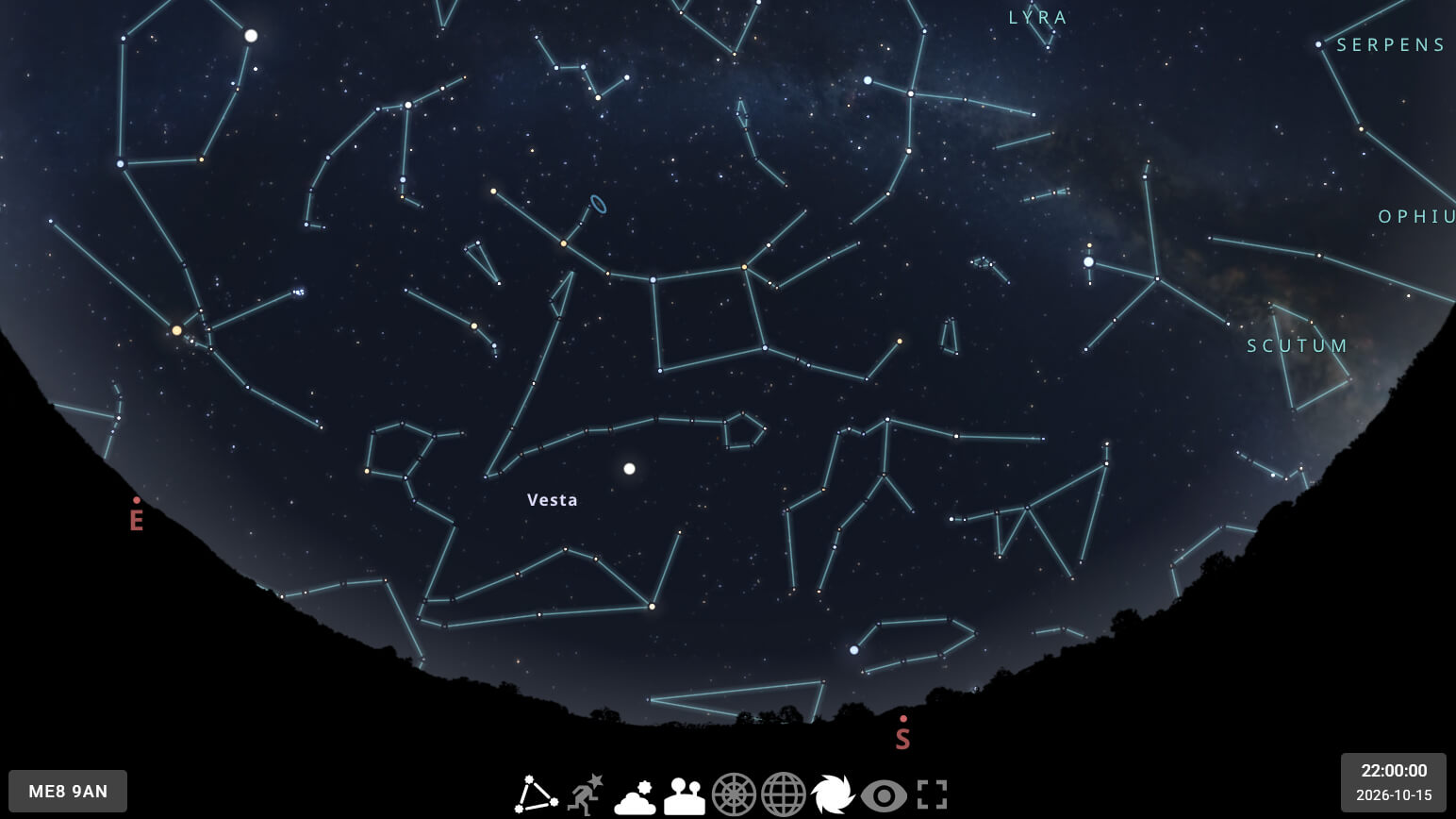
Image credit: Stellarium
Above image: A view of the constellations visible in the autumn night sky looking south-east on 15 Oct 2026.
Astrophotography
TRAC's number one mission for 2026 is to photograph as many deep-sky objects (DSOs) as we can.
Possible DSO targets this October include:
- M33 (mag. +5.8) - Triangulum Galaxy
- M57 (mag. +8.8) - The Ring Nebula
- M31 (mag. +3.4) - Andromeda Galaxy and its satellite galaxies
- Brocchi's Cluster (mag. +3.6) - The "Coathangar" Cluster
- IC 1396A (mag. +5.6)- Elephant's Trunk Nebula in Cepheus
Planets
Mercury
- Reaches greatest eastern elongation on the evening of 12 Oct 2026, when it'll be 22 degrees from the Sun.
- Very low after sunset and therefore hard to see.
- Magnitude: -0.1
Venus
- Very poor positioning from here in the UK.
- Reaches inferior conjunction on 24 Oct 2026, when it'll lie between the Sun and the Earth.
- Venus will reappear in the morning sky at the end of October.
- Magnitude: -4.4
Mars
- Visible by 01:00 at the end of the month.
- Mars is gradually getting closer to Jupiter.
- Reaches opposition in Feb 2027.
- 11 Oct 2026 - Occults M44, The Beehive Cluster, at 6 AM.
- Magnitude: +1.1
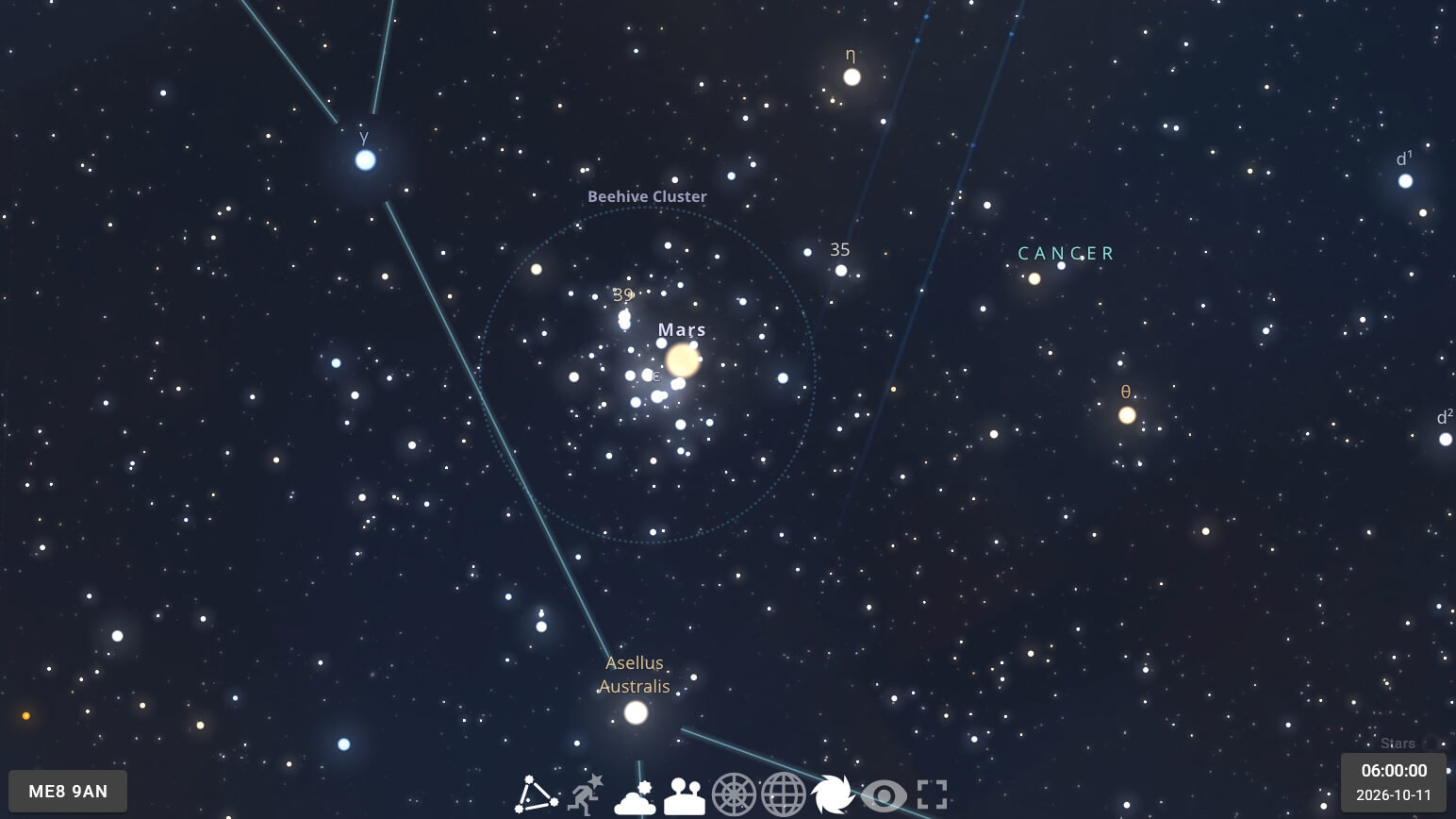
Image credit: Stellarium
Above image: Mars will move in front of the Beehive Cluster on 11 Oct 2026.
Jupiter
- Now visible by 01:00.
- 06 Oct 2026 - At 11:24, Jupiter will lie just above the 19% lit waning crescent Moon.
- Best seen later in the year.
- Magnitude: -1.9
Saturn
- Visible all evening this month.
- Reaches opposition on 04 Oct 2026.
- Its rings will brighten around the date of opposition.
- 1,262 million km from Earth!
- Magnitude: +0.5
Uranus
- Visible all month in Taurus, between the star Ain and the Pleiades.
- We're looking for the planet's slight green-blue tint.
- Magnitude: +5.6
Neptune
- Neptune is 10 degrees from Saturn.
- Reached opposition on 26 Sep 2026.
- Located in the vicinity of Saturn – we could track it down with starchart print outs.
- Our aim is to see its blue colour and largest moon, Triton (mag. +13.4), with the Seestar S50.
- Magnitude: +7.8
Minor Planets
Pluto (134340)
- Pluto reached opposition on 26 Aug 2026.
- We'll see if it's possible to photograph Pluto with the Seestar.
- Magnitude: +15.5 (!!!)
Pallas (2)
- The second minor planet to be discovered (1802).
- Opposition on 04 Oct 2026.
- Magnitude: +8.2
Juno (3)
- The third minor planet to be discovered (1804).
- Juno reached opposition on 24 Jul 2026.
- Extra effort is required since Juno is not near any bright stars currently.
- Magnitude: +10.0
Vesta (4)
- The fourth minor planet to be discovered (1807).
- Opposition on 13 Oct 2026.
- Magnitude: +6.5
Lunar Observations
October 2026 Lunar Calendar
- Last Quarter Sat 03
- New Moon Sat 10
- First Quarter Sun 18
- Full Moon Sun 25
October 2026 Full Moon
- Date: 25 Sep 2026 (04:12 on 26 Oct)
- Moonrise: 16:00
- Traditional Name: "Hunter's Moon"
- Constellation: Pisces
Lunar Conjunctions
| Date | Time | Event |
|---|---|---|
| 05 Oct 2026 | After 05:00 | Moon near Mars |
| 14 Oct 2026 | After 18:15 | Moon near Antares |
| 24 Sep 2026 | After 18:30 | Moon near Saturn |
Lunar Occultations
Moon Occults Pleiades
27 Oct 2026: The Moon will occult the Pleiades star cluster beginning at around midnight and progressing into the early hours of the 28th.
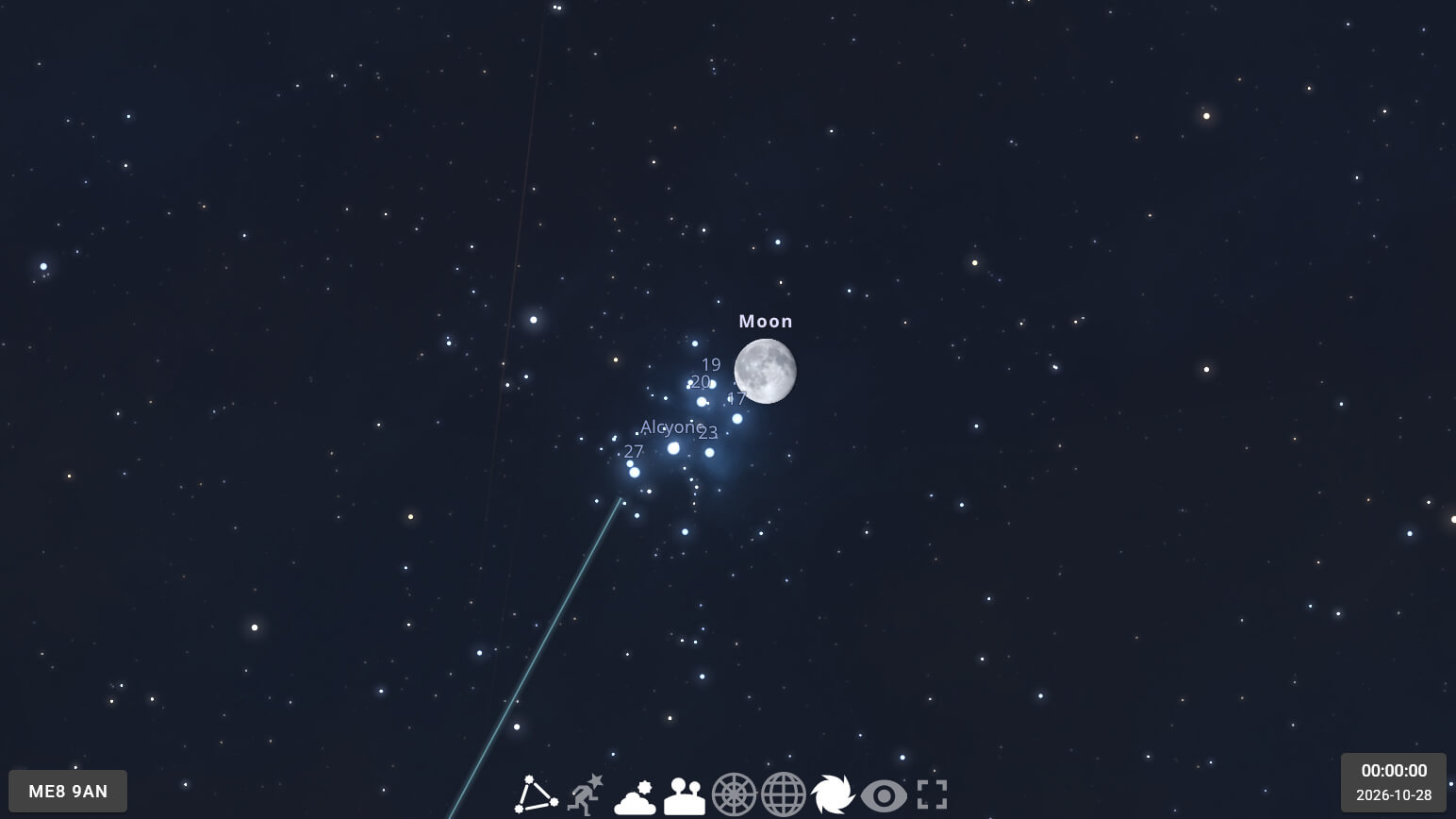
Image credit: Stellarium
Above image: The Moon begins moving in front of the Pleiades star cluster at midnight on 28 Oct 2026.
Meteor Showers
The Orionids
- Active Dates: All month
- Peak Night: 22 Oct 2026 (AM)
- Peak Rate: Around 10-20 meteors per hour
- Radiant: Orion, close to Betelgeuse
- This shower is caused by Earth passing through debris from Halley's Comet.
- The best time to look for Orionid meteors is between 02:00 and dawn.
The Orionids in 2026:
The bright gibbous Moon will interfere earlier in the night. Conditions will be best after 2 AM, when the Moon has set.
Summary
Top Priorities for October 2026
In descending order of importance:
- DSO Astrophotography
- Minor Planets (Pluto & Juno, etc)
- Saturn Opposition
- Jupiter in the daytime
- Uranus and Neptune (if there's enough time)
British Summer Time Ends (25 Oct 2026)
In the UK the clocks go back 1 hour at 2 AM on the last Sunday in October. This year that's the 25th.
When the clocks go back, the UK is on Greenwich Mean Time (GMT).
Astronomy Club - 3rd Anniversary Party
TRAC will celebrate its third anniversary on Sunday, 25 Oct 2026! Perhaps you can come up with some ideas for how we can mark this special occasion in style!
See You Out There
The main focus this month will be astrophotography with the Seestar S50. There are many DSOs we can aim to photograph as well as minor planets.
October 2026 should be a productive month for us. The nights are drawing in, and there's a two-week school holiday for some lucky astronomy club members!
James M
TRAC Team Leader
01 Oct 2026 – Rainham, Kent

TRAC is an amateur astronomy group based in Rainham (Kent) in the United Kingdom.
On clear nights, you'll find us outside, observing stars, planets, moons, galaxies, satellites, meteors, and comets.
This action plan is specifically tailored for our location (Rainham, Kent), schedules, optical equipment, level of experience, personal interests, and local sky conditions.
Unless stated otherwise, magnitude values refer to apparent magnitude and have usually been rounded to one decimal place; photos of deep-sky objects credited to TRAC were taken using a Seestar S50 smart telescope; our observations were made from Rainham, Kent; and times and dates are in the UK's local time zone (GMT or BST, depending on the time of year).
We welcome any questions, feedback, or suggestions you may have. Please let us know if anything is unclear or if you notice an error, inaccuracy, or typo. Contact us via email.
© 2026 Taverners Road Astronomy Club