TRAC Action Plan: March 2025
- Category: Action Plans
- Author: JM
- Published: 28 Feb 2025
- Last updated: 05 Mar 2025
March 2025 Calendar
- Sat, 01 Mar Moon close to Venus and Mercury after 17:30
- Sun, 02 Mar Moon close to Venus after 17:30
- Thu, 06 Mar First Quarter Moon near Jupiter
- Sat, 08 Mar Clair-obscur effect: Jewelled Handle at 14:00
- Sat, 08 Mar Mercury at greatest eastern elongation
- Sat, 08 Mar Moon close to Mars after 22:00
- Wed, 12 Mar Mercury and Venus in conjunction after sunset
- Fri, 14 Mar Full Moon (Total Lunar Eclipse at 7AM)
- Thu, 20 Mar Spring Equinox (Vernal Equinox)
- Sat, 22 Mar Last Quarter Moon
- Sat, 29 Mar New Moon (Partial Solar Eclipse)
Once again, we also have some more Moon Transit Events on Jupiter to observe. Check the timings in the documents below:
Winter-Spring Stargazing
Leo and Boötes Return
A few of the most iconic spring constellations are already visible in the east at the start of March. We'll focus our attention on Leo, Cancer, Hydra, and Boötes. Do you remember them from last spring?
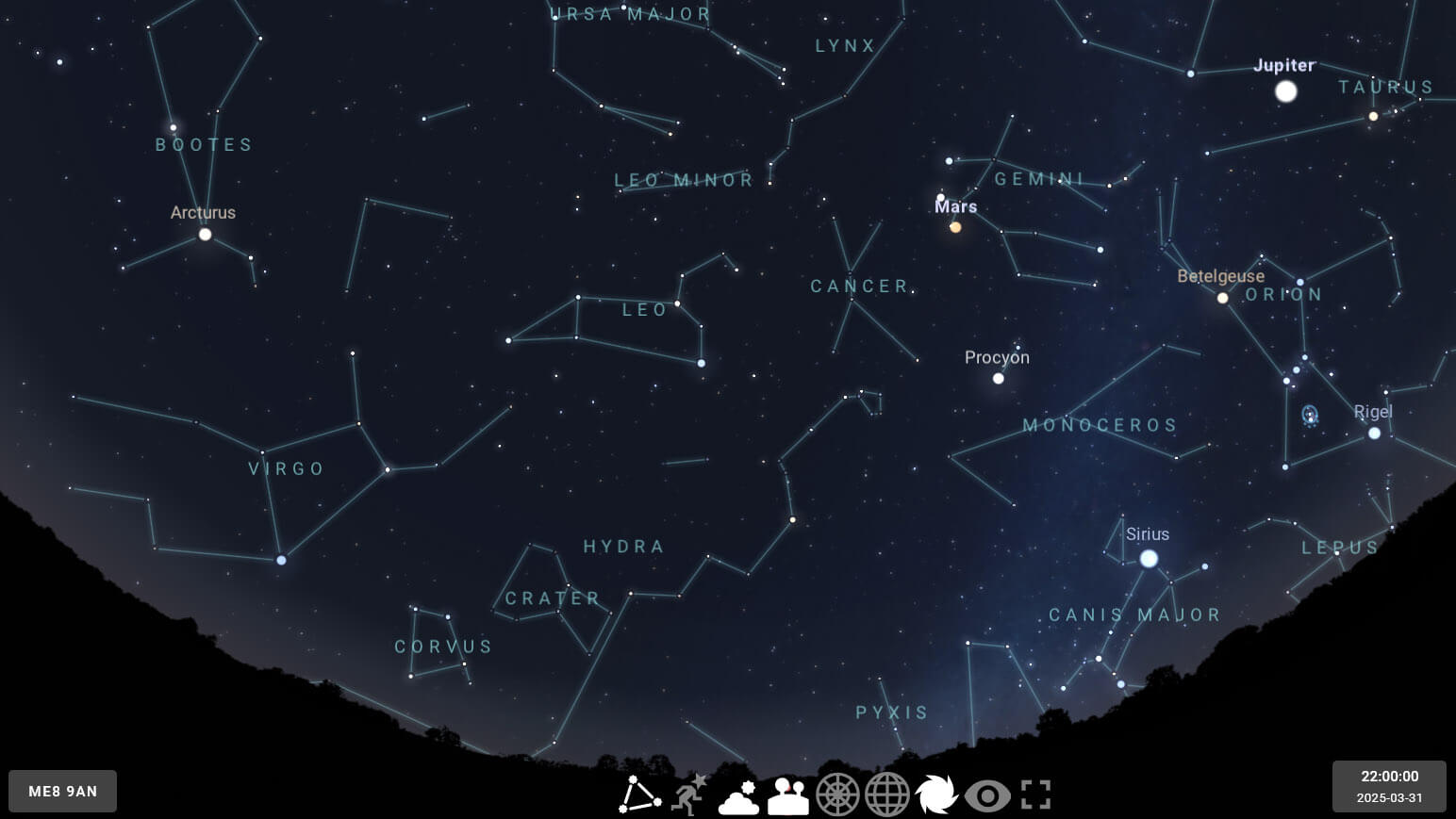
Image credit: Stellarium
We will also revisit the Orion Nebula before it sinks lower in the sky as spring approaches.
Spring Arrives
The Spring Equinox occurs on 20 Mar 2025. It marks the beginning of spring in the Northern Hemisphere. The word "equinox" comes from the Latin meaning "equal night". Around the date of the equinox, we get equal hours of day and night.
The Earth's tilt is the cause of the seasons we experience throughout the year. At the equinox, the Earth's poles are not tilted towards or away from the Sun.
An good explanation of the equinox can be seen in this video from BBC Weather:
Open Star Clusters
Around the date of the New Moon, we still have the following open star clusters to observe and photograph:
In February, TRAC acquired a 0.5x focal reducer. It should allow us to achieve a wider view of these star clusters. We can test it out and see if we can fit the whole cluster in the field of view.
Solar Observations
Warning!
NEVER look directly at the Sun without using certified solar filters.
Incorrectly viewing the Sun can cause serious eye damage or permanent blindness. The following ways are NOT safe:
- The naked eye
- Sunglasses
- Binoculars
- Smoked glass
- Cameras
- Phones
- ISO-certified eclipse glasses from a reputable manufacturer and supplier
NEVER allow children to view the Sun on their own.
Your eyesight is priceless. Do NOT take any risks.
Here Comes the Sun
In 2024, we viewed the Sun through the eclipse glasses. We were able to observe a large cluster of sunspots on the Sun's photosphere.
Now, we'll use the telescope to take a much closer look at our nearest star as we approach the date of the partial solar eclipse.
The March Sun
March is not the greatest time to view the Sun. Most days are cloudy. We need to make the most of any sunny afternoons we get. The days are starting to get noticeably longer, so that's one thing that's in our favour.
We'll look out for sunspots, and we'll take a photo of the Sun at a magnification of around 50x. Then we can go online and compare our photos to the latest images of the Sun from NASA's Solar Dynamics Observatory.
Working out how to best photograph the Sun is an important part of our preparations for the partial solar eclipse. We will want to get some photos of the eclipse at its various stages.
Partial Solar Eclipse - 29 Mar 2025
We have an exciting event to look forward to at the end of the month. The Earth, Moon, and Sun will almost exactly align at 11:00, creating a partial solar eclipse that will be visible from Rainham!
From here in Kent, about 30% of the Sun will disappear behind the Moon.
This alignment is the next best thing to a total solar eclipse, which will not occur in the UK until 2090.
If the sky is clear, this event will be the astronomical highlight of the year!
But bear in mind, the odds of clear skies aren't good. According to Time and Date, 29 March "was cloudy 74% of the time (since 2000)."

Image credit: Stellarium
Above image: The Moon will pass directly between the Earth and the Sun on the morning of 29 Mar 2025.

Image credit: Stellarium
Above image: A simulated view of the eclipse at the deepest point of the eclipse (11:03), when the Moon is covering the greatest amount of the Sun's disc.
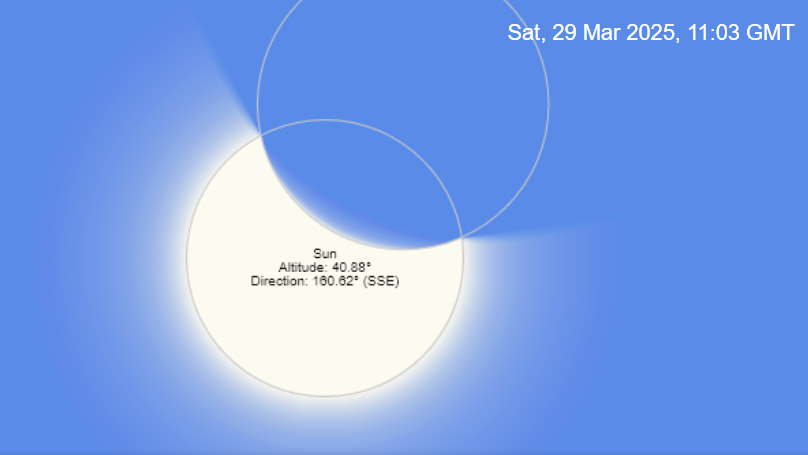
Image credit: Time and Date
Above image: A diagram illustrating the maximum amount of the Sun that will be covered by the Moon at approximately 11:03.
It's important for us to gain more experience at viewing the Sun using the telescope and solar filter so that we're fully prepared for the solar eclipse.
29 March 2025 - Eclipse Timings:
- 10:08 – The eclipse begins
- 11:03 – Maximum effect seen
- 12:00 – The eclipse ends at noon
A final weather assessment will be made at 09:00. If it's looking good, we'll meet at the TRAC HQ at 09:15 on Saturday, 29 March 2025.
More details of the 2025 solar eclipse from external sites:
Planets
The Planetary Parade
The press is reporting that seven planets - Mars, Jupiter, Uranus, Venus, Neptune, Mercury, and Saturn - will all be briefly visible in the evening sky at the very start of the month.
"This phenomenon, known as a 'planetary parade' is a rare sight, and it will be the last time seven planets can be seen simultaneously so well until 2040," according to astronomers who spoke to the BBC.
TRAC Assessment:
- The brighter planets (Venus, Jupiter, and Mars) will be easy to see.
- We stand a very good chance of seeing Mercury so long as the sky is clear immediately after sunset.
- Seeing Saturn will not be possible given its low altitude after sunset and how faint it will appear against the bright twilight sky. By the time the sky gets darker, Saturn will be almost touching the horizon.
- It might be possible for us to locate Uranus with the telescope.
- Seeing Neptune will be impossible from our location (and across most of the UK).
More details of the planetary parade from external sites:
- A seven-planet parade visible this weekend? (Sky at Night Magazine)
- Seven planets to be visible in night sky for last time until 2040 (BBC News)
- 'Planet parade' 2025: See the ultra-rare planetary alignment peak this week, before Saturn gets swallowed by the sunset (Live Science)
Mercury
Mercury (mag. -0.9) will appear low in the evening sky at the start of March 2025 and gradually fade. It was spotted from the park on 27 Feb 2025 with binoculars.
Don't miss out on this opportunity: it's our best chance to see Mercury in 2025!
08 Mar 2025: Mercury reaches greatest eastern elongation, the furthest point from the Sun in its orbit.
12 Mar 2025: Mercury will be in conjunction with Venus after sunset.
Venus
Venus (mag. -4.4) now appears as a thin crescent through the telescope. It will disappear from our skies this month as it passes between the Earth and the Sun on 23 Mar 2025.
Venus will return to our morning skies from April 2025 until November 2025.
We'll aim to observe Venus in its thin crescent phase and take some more photos.
Some people claim that they can see the phase of Venus without any optical aids. Venus will be 56 arcseconds across so this feat will take exceptional eyesight!
01 & 02 Mar 2025: Venus will lie close to the Moon after sunset.
Mars
Mars (mag. -0.2) has been dimming after it reached opposition on 16 Jan 2025. By the end of March, it'll fade to mag. +0.5.
Anyone interested in seeing surface details on Mars (such as the dark markings and polar ice caps) will need to act fast, as March will likely be the last chance to get a decent view of the red planet.
08 Mar 2025: The Moon will lie close to Mars after 22:00.
Reminder: a huge model of Mars is still on display at Rochester Cathedral until 08 Mar 2025.
Jupiter
Jupiter (mag. -2.1) will be bright and visible all night until May 2025.
We're still aiming to get a clear view of Jupiter's Great Red Spot (GRS). Check the transit times below to find out when the GRS will be visible from Earth.
Jupiter's moons will also be positioned in interesting arrangements at the following times:
- 04 Mar 2025, 23:30 - Two simultaneous shadow transits
- 05 Mar 2025, 19:30 - Callisto near Jupiter's north pole
- 22 Mar 2025, 19:00 - Four moons close to Jupiter
We'll also look out for some more Jovian moon shadow transits.
Transit timings for the GRS and moon events are listed here:
Saturn
Saturn (mag. +1.1) will be almost impossible to see since it now sets by 18:30.
Saturn will return to our evening skies in August 2025.
Uranus
Uranus (mag. +5.8) is still visible to the south-west of the Pleiades on the boundary between Taurus and Aries.
We'll aim to locate this distant planet on a night with very clear sky conditions.
Neptune
Neptune (mag. +8.0) will be lost in the twilight glow. The last few months of 2025 will be the best time to look for Neptune.
Moon Shadow Transits
Please refer to the November 2024 Action Plan for more information about moon shadow transits.
All transit timings are in UT and may vary by a few minutes.
Titan Shadow Transits
Saturn sets very early in the evening, so we won't be able to see any Titan shadow transits this month.
Jupiter Moon Transits
We've seen a few Jovian shadow transits now, but we've never seen one of Jupiter's moons crossing the planet. We'll aim to see one of those this month.
Full listings of Jovian moon transits, shadow transits, occultations, and eclipses can be viewed here:
Some of the highlights are detailed below.
Io Transits of Jupiter
These three Io transits are highlighted because the times work out well for us:
- Io Tra start: 2025 Mar 05 20:11
- Io Sha start: 2025 Mar 05 21:31
- Io Tra end: 2025 Mar 05 22:24
- Io Sha end: 2025 Mar 05 23:44
- Io Tra start: 2025 Mar 21 18:35
- Io Sha start: 2025 Mar 21 19:52
- Io Tra end: 2025 Mar 21 20:48
- Io Sha end: 2025 Mar 21 22:05
- Io Tra start: 2025 Mar 28 20:34
- Io Sha start: 2025 Mar 28 21:47
- Io Tra end: 2025 Mar 28 22:47
- Io Sha end: 2025 Mar 29 00:01
Jupiter Moon Events: 04 & 29 Mar 2025
An interesting sequence of events will take place on 04 Mar 2025 and 29 Mar 2025 involving three of Jupiter's moons (Io, Europa, Ganymede):
- III Tra end : 2025 Mar 04 19:44
- II Tra start: 2025 Mar 04 21:01
- III Sha start: 2025 Mar 04 22:40
- I Occ start: 2025 Mar 04 22:59
- II Tra end : 2025 Mar 04 23:36
- II Sha start: 2025 Mar 04 23:37
- II Tra start: 2025 Mar 29 18:17
- III Occ start: 2025 Mar 29 19:35
- II Sha start: 2025 Mar 29 20:40
- II Tra end : 2025 Mar 29 20:54
- I Ecl end : 2025 Mar 29 21:13
- III Occ end : 2025 Mar 29 22:04
- II Sha end : 2025 Mar 29 23:19
I = Io
II = Europa
III = Ganymede
29 Mar 2025 is eclipse day, so you might be fed up with astronomy. But maybe not! Just take a short nap in the afternoon. That's what I'm planning to do.
Lunar Observations
March 2025 Lunar Calendar
- First Quarter Thu 06
- Full Moon Fri 14
- Last Quarter Sun 22
- New Moon Sat 29
Note: We must remember to use the variable polarising filter to reduce the brightness when viewing the full moon.
Partial Lunar Eclipse - 14 Mar 2025
A partial lunar eclipse, when the Moon moves into the Earth's shadow, is technically visible from Rainham on the morning of 14 Mar 2025.
The timings of this eclipse are terrible for the following reasons:
- The Moon will only be a few degrees above the horizon - out of view.
- The eclipse starts at around 05:00 - too early for most of us.
I hope we'll be able to see a lunar eclipse at some point. The total lunar eclipse on 07 Sep 2025 will offer us a better chance, but even that one is far from ideal.
One- or Two-Day-Old Moon
One of our challenges as a club is to see the Moon one day after the date of the new moon. In this phase, the moon appears as a very thin crescent.
It's very difficult to see for these reasons:
- The Moon is so close to the Sun that it can only be seen after sunset.
- Moonset is not long after sunset, so we only have a small window of opportunity to see it.
- Only 1% of its Earth-facing side is illuminated, so it's almost invisible against the bright twilight sky.
Most people have never seen the Moon in this stage of its orbit.
If the sky is clear, we'll have a go on 01 Mar 2025, when the Moon will be in day one of its phase, and again on 30 Mar 2025, when the Moon will be in day one of its phase.
Anyone who saw the three-day-old moon on 01 Feb 2025 will remember how thin it appeared in the telescope. The one-day-old moon will, of course, be even thinner.
Moon Conjunctions
Conjunctions involving the Moon and a planet or a bright star, though common, always provide good photo opportunities.
Once again, the first half of the month offers a few celestial close encounters. Here's what we'll look out for:
| Date | Approx Time | Planet/Star | Moon Phase |
|---|---|---|---|
| Sat 01 Mar | After Sunset | Venus, Mercury, & Saturn | 4% Thin Crescent |
| Sun 02 Mar | After Sunset | Venus, Mercury, & Saturn | 10% Crescent |
| Wed 05 Mar | All Evening | Jupiter & Pleiades | 40% First Quarter |
| Thu 06 Mar | All Evening | Jupiter | 51% First Quarter |
| Fri 07 Mar | All Evening | Between Jupiter & Mars | 62% Waxing Gibbous |
| Sat 08 Mar | After 23:00 | Mars | 73% Waxing Gibbous |
Clair-Obscur Effect: Jewelled Handle
08 Mar 2025: A clair-obscur effect known as the "Jewelled Handle" will be visible on the surface of the Moon in the middle of the day.
Clair-obscur effects occur when sunlight hits the surface of the Moon at certain angles. The illuminated lunar features and dark shadows create familiar shapes on the Moon's surface.
TRAC has never seen any clair-obscur effects. Daytime is not the best time to see this effect, so it will be an experiment! Will we be able to see this one with only ours eyes? Or maybe with binoculars? Or will we need to use a small telescope?
More information:
Admin Tasks
Planning for the Solar Eclipse
We have a lot of preparations to get done!
- Print and distribute leaflets and posters.
- Design a certificate for children.
- Produce an information sheet explaining how the eclipse works.
- Buy more solar eclipse glasses and create a safety notice for parents.
- Do a trial run to make sure we know what we're doing.
Website Content
- We'll review the photos and videos taken in February 2025 and add the best ones to the website.
- We need to create a page with information about the solar eclipse for people who are interested in coming along to view it with us.
- We still need to create avatars to put alongside our names on the "Meet the Team" page.
TRAC Research
Topics we need to read up on include:
- How solar eclipses works
- Safety information for viewing the Sun
- How we can make the most of the eclipse this month
- Dates and times of future eclipses
Summary
Top Priorities for March 2025
In descending order of importance:
- The Sun (and Partial Solar Eclipse)
- Mercury at Greatest Eastern Elongation
- Mars (Ice caps and surface markings)
- Photographing the Phase of Venus
- Moon Conjunctions (Astrophotography)
- Moon Shadow Transits
- Winter/Spring Constellations
- One-day old Moon
- Jupiter's GRS
March Astrophotography
Photography opportunities this month include:
- Various Moon Conjunctions
- Open Star Clusters (Pleiades/Hyades/Beehive)
- The Sun (Sunspots and Partial Solar Eclipse)
- The Phase of Venus
- Surface Markings / Ice Caps on Mars (very difficult)
- Jupiter's GRS (if we get perfect conditions)
See You Out There
The first half od the month looks busy. If the weather's bad, we'll devote more time to planning for the eclipse at the end of the month.
It's eclipse month! Let's hope for clear skies in March 2025 – especially between 10:00 and 12:00 on 29 Mar 2025!
And let's make the most of all of the planets on display at the start of the month!
James M
TRAC Team Leader
28 Feb 2025 – Rainham, Kent

TRAC is an amateur astronomy group based in Rainham (Kent) in the United Kingdom.
On clear nights, you'll find us outside, observing stars, planets, moons, galaxies, satellites, meteors, and comets.
This action plan is specifically tailored for our location (Rainham, Kent), schedules, optical equipment, level of experience, personal interests, and local sky conditions.
Unless stated otherwise, magnitude values refer to apparent magnitude and have usually been rounded to one decimal place; photos of deep-sky objects credited to TRAC were taken using a Seestar S50 smart telescope; our observations were made from Rainham, Kent; and times and dates are in the UK's local time zone (GMT or BST, depending on the time of year).
We welcome any questions, feedback, or suggestions you may have. Please let us know if anything is unclear or if you notice an error, inaccuracy, or typo. Contact us via email.
© 2025 Taverners Road Astronomy Club