TRAC Monthly Report: October 2024
- Category: Monthly Reports
- Author: JM
- Published: 03 Nov 2024
- Last updated: 03 Nov 2024
Autumn Constellations
In October, due to the weather, we didn't go out looking for constellations per se, but we did see these ones while looking for other celestial objects:
- Pegasus – The large "Square of Pegasus" is impossible to miss in the autumn sky. It helped us pinpoint Andromeda by first finding Alpheratz at the north-eastern corner of the square and following the bright stars further east to reach Mirach.
- Andromeda – Home of M31, the Andromeda Galaxy, which we saw by hopping two stars higher than Mirach on Oct 05 and Oct 11.
- Vulpecula – A small constellation containing only a few bright stars that are meant to represent a fox. This is where we found the Coathanger asterism on Oct 31.
- Taurus – The Pleiades star cluster is located in Taurus, the bull, and currently the planet Uranus can be found in this constellation.
- Auriga – We used its brightest star, Capella, to set up the sky align.
The Coathanger (Star Cluster)
After the Halloween festivities wrapped up, Matey and I grabbed the binoculars and headed to the park to hunt down the asterism "Brocchi's Cluster" – also known as the "Coathanger" (for obvious reasons when you see it).
Despite the poor weather, we easily found it lurking along the imaginary line between the stars Altair and Vega. We then used the telescope to get a closer look at its 10 bright stars, which range from magnitude 5 to 7.
One day, we'll try to photograph it.
Comet C/2023 A3 (Tsuchinshan–ATLAS)
Comet of the Year
Observing Comet A3 wasn't mentioned in our October 2024 Action Plan because I presumed it was going to be so faint and so low on the horizon after sunset that we didn't stand any chance of seeing it from the park.
But against all the odds, not only did we see the comet with binoculars, it was also naked-eye visible for approximately 10 minutes on Oct 17 at around 19:00. Well done to everyone who saw this spectacular sight!
A Special Celestial Visitor
It's extraordinarily rare to be able to look up at the sky and see a comet with your own eyes! I don't suppose it will happen again anytime soon.
Comet A3 is not only being described as the "comet of the year", but also as the "comet of the century" by some observers.
Look online for breathtaking photos of Comet A3 from across the UK and around the world.
Ring Nebula and Andromeda Galaxy
Finding the Ring Nebula proved impossible due to the weather.
The Andromeda Galaxy was easier to find using binoculars and appeared as a bright patch of light when using the telescope. The galaxy couldn't be seen with the naked eye, and the view was not as clear as I'd hoped.
We'll attempt to locate both of these deep-sky objects again next month.
The "Supermoon" (Full Moon at Perigee)
We saw the full moon on Oct 17 and 18. On both nights, it had a warm, golden glow, appearing more yellow than usual. It didn't look any larger than normal to me, but it was definitely much brighter – almost blindingly bright when we viewed it through the telescope eyepiece.
We used the variable polarising filter to reduce the light transmission by roughly 75% in order to see more detail of the lunar features.
The term "supermoon" is popular in the media, where the event is often overhyped and misrepresented. The correct astronomical term is "a full moon at perigee," which simply means a full moon that occurs at the point where the Moon is closest to Earth in its elliptical orbit.
From this day forward, we'll adopt the proper scientific wording.
Starlink Satellite Train
Another Unexpected Sight
Another surprise last month was the flyby of a group of recently launched Starlink satellites on the evenings of Oct 17, 18, and 19.
We spotted around 30 satellites at 19:40. They appeared as bright dots (estimated mag. 1.5) moving across the sky in a line. The satellites were reflecting light from the Sun as they passed over an hour after sunset.
Annoyed Astromoners
Starlink now has over 7,000 satellites in orbit and over four million paying subscribers. Their aim is to provide global satellite broadband coverage.
The satellite train is fun to see, but the astronomical community is generally opposed to the deployment of satellites on this scale. The additional light pollution they cause has a negative impact on ground-based observations. Starlink satellites also have the potential to produce significant electromagnetic interference in the radio spectrum.
Andrei has found a website (findstarlink.com) that predicts when the satellite train will be visible from any location. No doubt it will be possible for us to see some more satellite trains over the winter.
The Northern Lights Return to Rainham's Skies
Come Outside!
The aurora borealis returned to the skies above Rainham on the night of Oct 10. A massive thank you to Matey (and his mum) for being so alert and telling me to come outside – I'm so glad we didn't miss it!
To the northeast, the sky had a soft pinkish hue at the level just above the rooftops, while slightly further west, the sky had a subtle greenish hue.
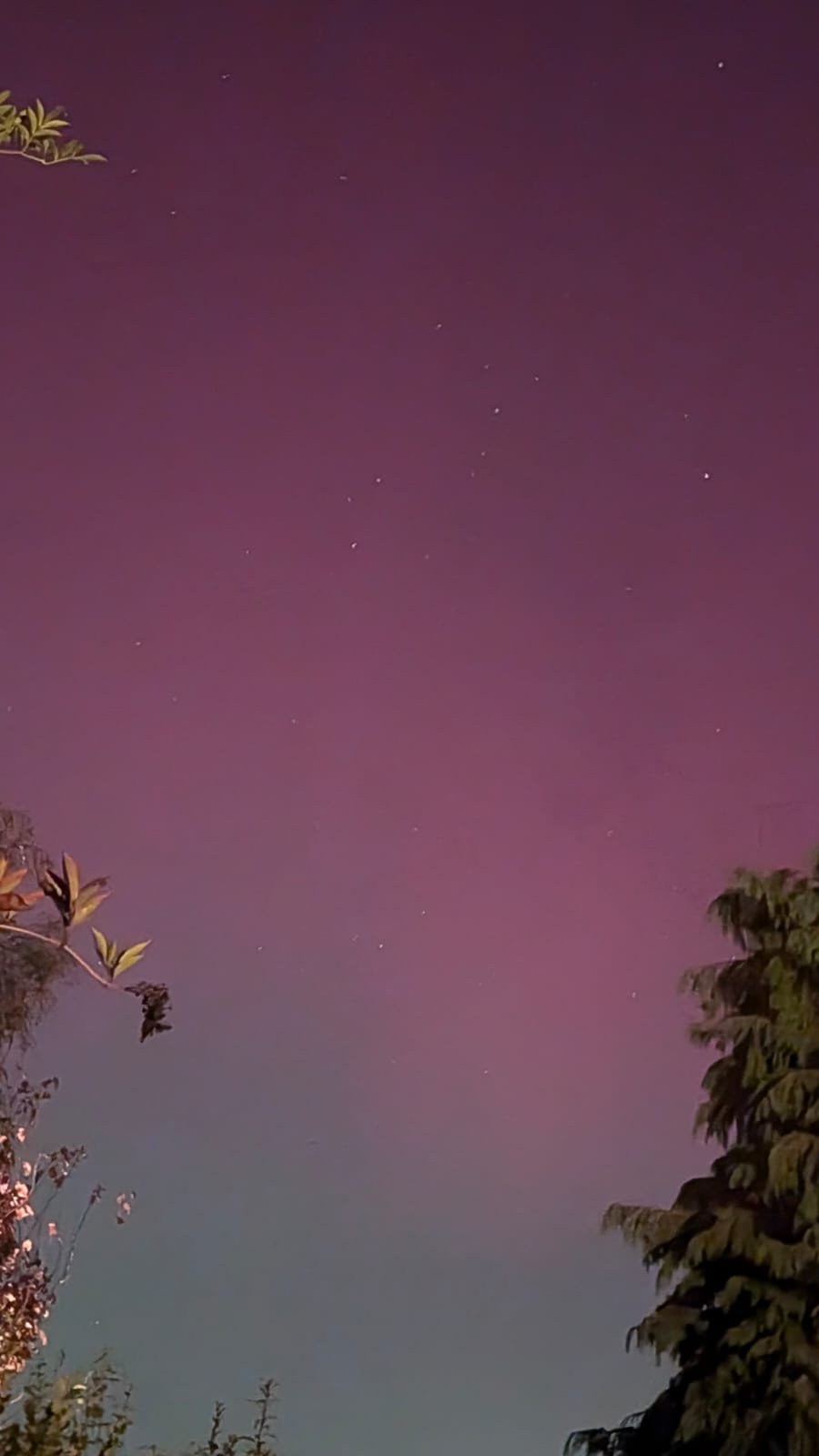
Image credit: KK (TRAC)
Krum took this photo of the aurora from his garden in Rainham on the evening of 10 Oct 2024. The aurora borealis lit up most of the northern sky with a vibrant pink hue, which Krum managed to capture in this image.
It was a breathtaking display, rarely seen this far south - incredible stuff!
Mega Magnetic Measurements
Matey and I checked the AuroraWatch UK website and saw a "Red alert: aurora likely" message. The geomagnetic activity was off the charts – peaking at over 1,500 nT, compared to typical readings of under 50 nT.
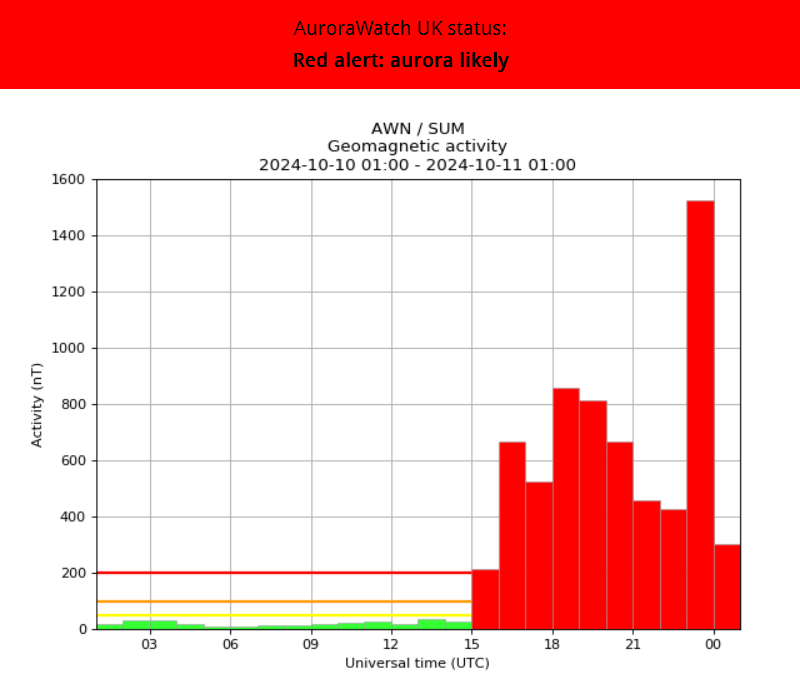
Image credit: AuroraWatch UK
We submitted a report to the Aurorasaurus project to let them know that the aurora was visible here in Rainham. Interestingly, someone in Lower Rainham, near the river, had spotted it too and filed a report that evening.
More to Come?
If you missed the aurora this time, keep an eye out for reports in the media and online about possible aurora sightings. It's rare to see the aurora at our latitude, but it could return as we approach solar maximum.
Solar Observations: Sunspots
Spotting Sunspots
Using the eclipse shades and solar filter, Matey, Krum, and I took a look at the Sun on the afternoon of 11 Oct 2024, the day after the aurora was observed. We didn't use any magnification, yet we were able to make out three large dark patches (sunspots) on the disc of the Sun.
These sunspots are regions of strong magnetic fields. They look darker because they're cooler than their blazing hot surroundings. And while they might look small from our vantage point here on Earth, they're actually absolutely enormous – some are even as large as entire planets!
NASA Images
The image below of the Sun's photosphere was captured by NASA's Solar Dynamics Observatory at 14:15 on 11 Oct 2024.
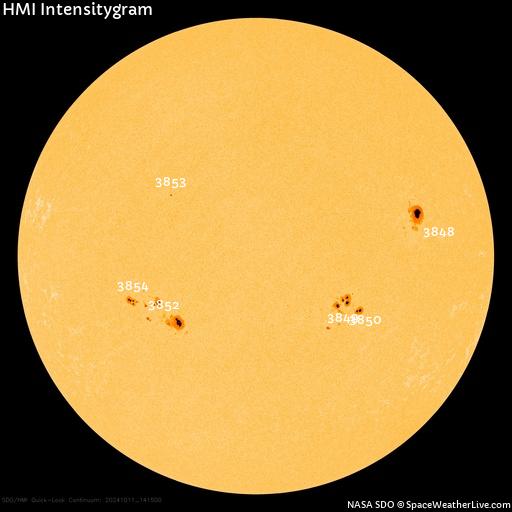
Image credit: NASA SDO
The image shows the three large clusters of sunspots that we were able to see with our solar eclipse glasses.
Planets
Mars
Matey and I saw Mars at around midnight at the start of October. It was close to the bright stars Castor and Pollux in the constellation Gemini in the north-east. The planet looked like an orange star to the naked eye.
Jupiter
The gas giant is now shining bright, like a cosmic beacon in the night sky. We got a particularly good view on Oct 11; Io was very close to the eastern side of Jupiter, just about visible before disappearing behind the planet.
In November, we'll look out for some moon shadow transits.
Saturn
We pointed the telescope at Saturn on Oct 17 while out looking at the full moon. We saw Rhea, Saturn's second-largest moon, for the first time. At magnitude 9.9, Rhea is about the faintest object we can see with the telescope. It was positioned about halfway between Saturn and Titan.
Uranus
Both our attempts at catching a glimpse of Uranus led to disappointment, mainly due to the clouds. On a more positive note, on Oct 31, Matey and I saw not one, but two brilliant meteors streaking across the sky while gazing eastwards towards Uranus in the constellation Taurus. These could've been part of the annual Taurid or Orionid meteor showers.
Telescope GoTo
History is Made
The night of Oct 05 will go down in TRAC history as the first time we worked out how to use the telescope's GoTo function. This powerful feature enables the telescope to identify, track, and locate thousands of celestial objects. But first, it needs to be correctly aligned.
The first step of the alignment procedure required us to enter our exact location and the exact date and time using the handheld controller.
Alignment
We used Google Maps to find the precise coordinates (longitude and latitude) for our location, then we used an online calculator to convert the decimal values into degrees, arcminutes, and arcseconds. We ran into a problem right from the get-go; incorrect coordinates had previously been stored in the telescope's memory, and it wasn't clear how to overwrite them. After some trial and error, we solved this issue by resetting the telescope to its default settings, then inputted the correct values.
After entering the current date and time, we moved the telescope outside and carefully levelled it using the spirit level – a crucial step to get right and one that's easy to forget!
The next step was to pick three bright stars to use for the alignment. Matey chose Capella in the north, and Vega and Deneb in the south-west. It's important that the chosen stars are spread out across the sky and do not sit on a straight line.
Success! (Partially)
The alignment worked on our first attempt! The telescope correctly displayed a list of the three target stars we selected.
However, our victory wasn't quite complete. As a test, we selected Vega from the menu. The telescope automatically pointed almost to Vega but didn't point exactly at it, so something is not quite right somewhere.
Matey and I didn't give up; we repeated the SkyAlign process two more times, using the recommended 25mm eyepiece. We followed the advice from Celestron, but each time we ran into the same problem.
Research Required
Unfortunately, this issue remains unresolved, and it's unclear to me why this problem is occurring. It will require further investigation when we get some free time on a clear night…
TRAC 1st Birthday Party
Party Time!
I hope everyone enjoyed the party on Oct 25 to celebrate the Astronomy Club's first birthday. A big thank you to everyone who brought food and drinks and good vibes – your contributions really made the evening one to remember.
Thanks to Krum, too, for helping me get everything set up and helping to blow up all the party balloons. That was no small feat!
And let's talk about that cake... A very special thank you to Matey for baking a mouth-wateringly delicious birthday cake. The taste was out of this world – the perfect cake for an astronomy club celebration!

The Future Looks Bright
It's hard for me to believe that the astronomy club has been in operation for a year already. That year went very quickly!
Here's to TRAC and to many more years of unforgettable stargazing nights! The galaxy awaits – let's keep exploring!
Letter to the Council
Thank you to all TRAC members who signed the letter to Medway Council regarding access to Ryetop Park. I posted the letter on 04 Oct 2024.
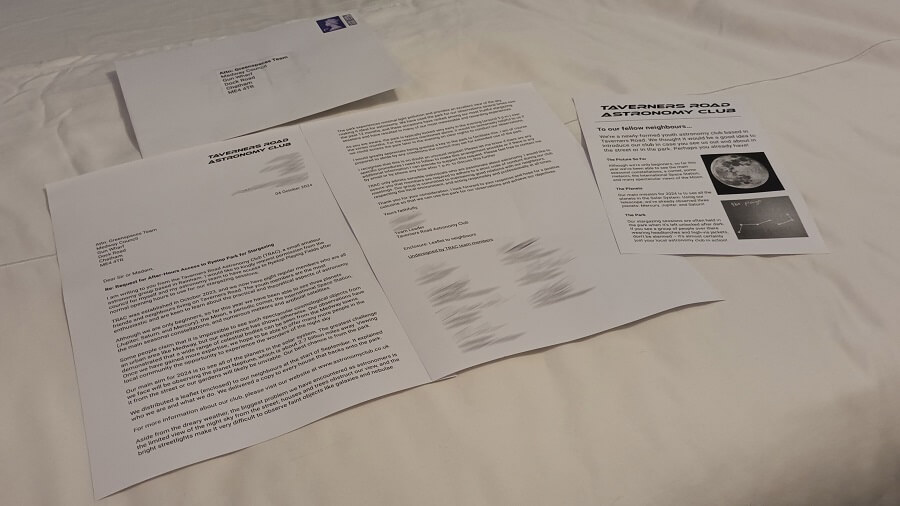
Image credit: JM (TRAC)
To my disappoint, I have not received a reply or acknowledgement of receipt. After waiting patiently, I phoned the council on 29 Oct 2024 hoping to speak directly with someone from the Greenspaces Team. Unfortunately, I was told that that isn't possible.
I gave my contact details and received a reference number via email, so at least we know our request has been logged. Now, we'll give them two more weeks to respond – let's hope we hear some good news soon!
Summary
Although the weather prevented us from seeing either of the ice giants, October was full of surprises! We unexpectedly managed to see a comet, some of us were lucky enough to see the aurora borealis light up the night sky, and everyone has now seen the Starlink satellite train pass overhead.
All in all, October was not a bad month for the astronomy club. In fact, I think October 2024 was one of our most eventful and successful months to date!
James M
TRAC Team Leader
03 Nov 2024 – Rainham, Kent

TRAC is an amateur astronomy group based in Rainham (Kent) in the United Kingdom.
On clear nights, you'll find us outside, observing stars, planets, moons, galaxies, satellites, meteors, and comets.
This monthly report is intended to keep club members informed of our observational activities, track progress towards the club's long-term goals, celebrate successes, and record memorable moments.
Unless stated otherwise, magnitude values refer to apparent magnitude and have usually been rounded to one decimal place; photos of deep-sky objects credited to TRAC were taken using a Seestar S50 smart telescope; our observations were made from Rainham, Kent; and times and dates are in the UK's local time zone (GMT or BST, depending on the time of year).
We welcome any questions, feedback, or suggestions you may have. Please let us know if anything is unclear or if you notice an error, inaccuracy, or typo. Contact us via email.
© 2024 Taverners Road Astronomy Club