TRAC Action Plan: November 2025
- Category: Action Plans
- Author: JM
- Published: 01 Nov 2025
- Last updated: 18 Nov 2025
November 2025 Calendar
- Wed, 05 Nov Full Moon ("Supermoon")
- Thu, 06 Nov Moon close to the Pleiades (17:00 onwards)
- Sun, 09 Nov Moon close to Jupiter in Gemini (21:30 onwards)
- Wed, 12 Nov Last Quarter Moon
- Wed, 12 Nov Northern Taurid Meteor Shower peaks
- Mon, 17 Nov Leonid Meteor Shower peaks
- Thu, 20 Nov New Moon
- Fri, 21 Nov Uranus at Opposition
- Fri, 28 Nov First Quarter Moon
- Sat, 29 Nov Moon close to Saturn (19:00)
Stargazing
Autumn Constellations
Constellations to look out for this month include:
- Pisces
- Pegasus (Great Square)
- Andromeda
- Perseus
- Cetus
- Aquarius
- Aries
- Taurus
- Orion
- Auriga
- Gemini
By mid-November, our favourite winter constellations like Orion and Taurus will be visible in the east after 20:00.
Deep Sky Objects
Andromeda Galaxy (M31)
November is a great time to view our closest major galaxy. It was seen with binoculars last month. We'll have a go with the telescope.
Please refer back to our September 2025 Action Plan.
Ring Nebula
If we get a very clear night, we can have another go at locating the Ring Nebula in the constellation Lyra.
Please refer back to our October 2024 Action Plan.
Planets
Skip to: Mercury | Venus | Mars | Jupiter | Saturn | Uranus | Neptune
Mercury
- Mercury (mag. -0.5) is very low in the sky after sunset.
- It's very unlikely we'll be able to see Mercury from our location.
Venus
- Venus (mag. -3.4) is a morning planet this month.
- Best seen at around 05:30 at the start of the month.
- It will gradually get closer to the Sun from our perspective.
Mars
Mars is not visible this month.
Jupiter
- Jupiter (mag. -2.3) will appear bright in Gemini and now rises earlier in the evening.
- November is an excellent time for us to see Jupiter.
- By the end of the month, Jupiter will rise as early as 19:00 so it'll be visible all night long.
Saturn
- Saturn (mag. +1.0) is high all night in Aquarius.
- Its rings will appear almost edge-on, with a tilt angle of only half a degree.
- Will its rings completely disappear when seen in a small telescope?
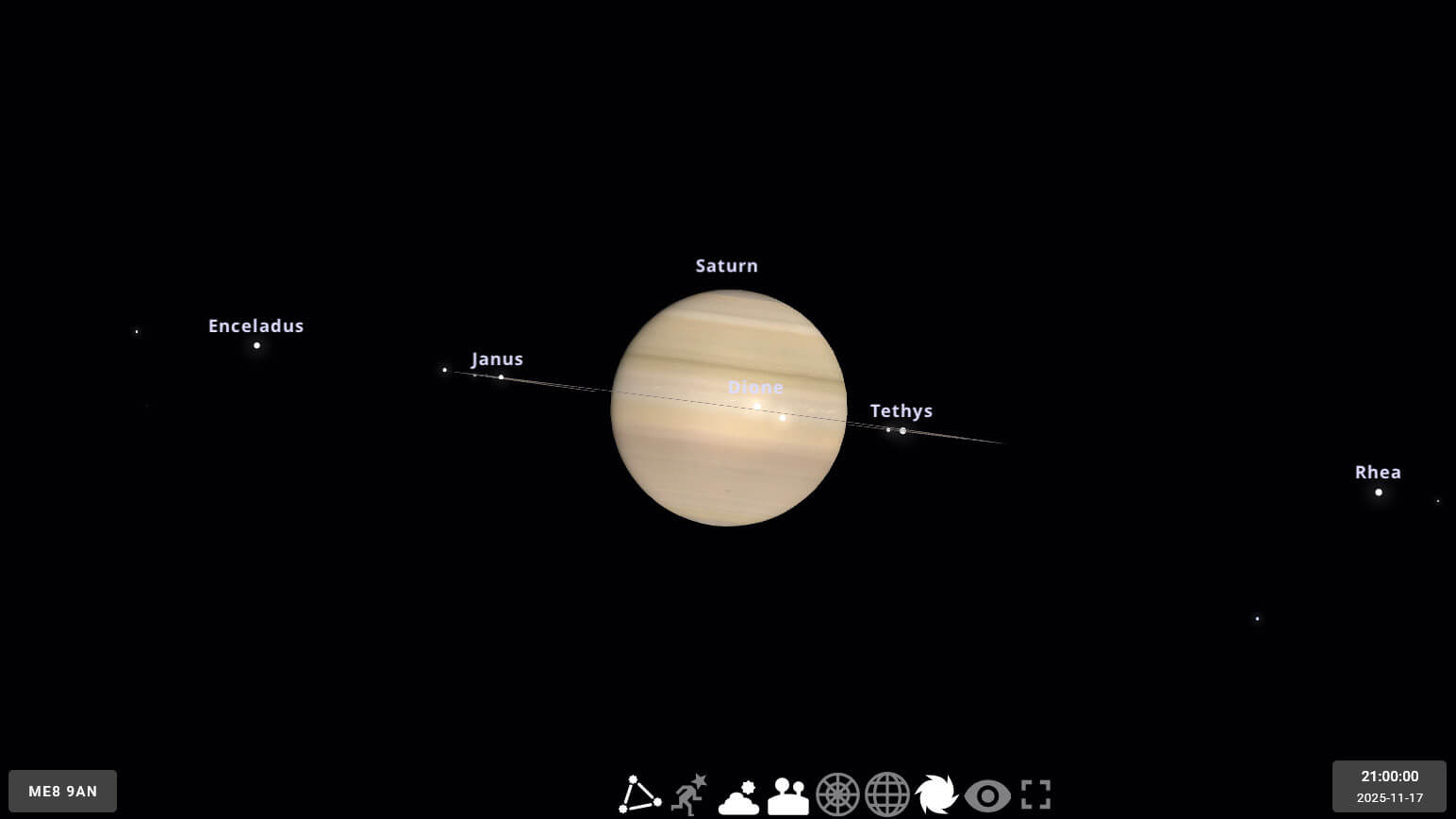
Image credit: Stellarium
Above image: Saturn with its rings edge-on to us in mid-November 2025.
Special Saturn Events:
- Titan Transit: 06 Nov 2025 20:35-02:30
- Titan Transit: 22 Nov 2025 18:55-01:10
- Titan Occulted by Saturn: 14 Nov 2025 18:50-00:35
- Titan Occulted by Saturn: 30 Nov 2025 17:25-22:05
Uranus
- Uranus (mag. +5.6) will reach opposition on 21 Nov 2025 in Taurus.
- The planet is well-placed for us, rising high by 20:00.
- It currently lies south of the Pleiades, and standard 10x50 binoculars will show the planet within the same field of view as the star cluster.
- Our telescope, at a magnification of ~100x, should show the planet as a tiny, turquoise (or cyan) disc.
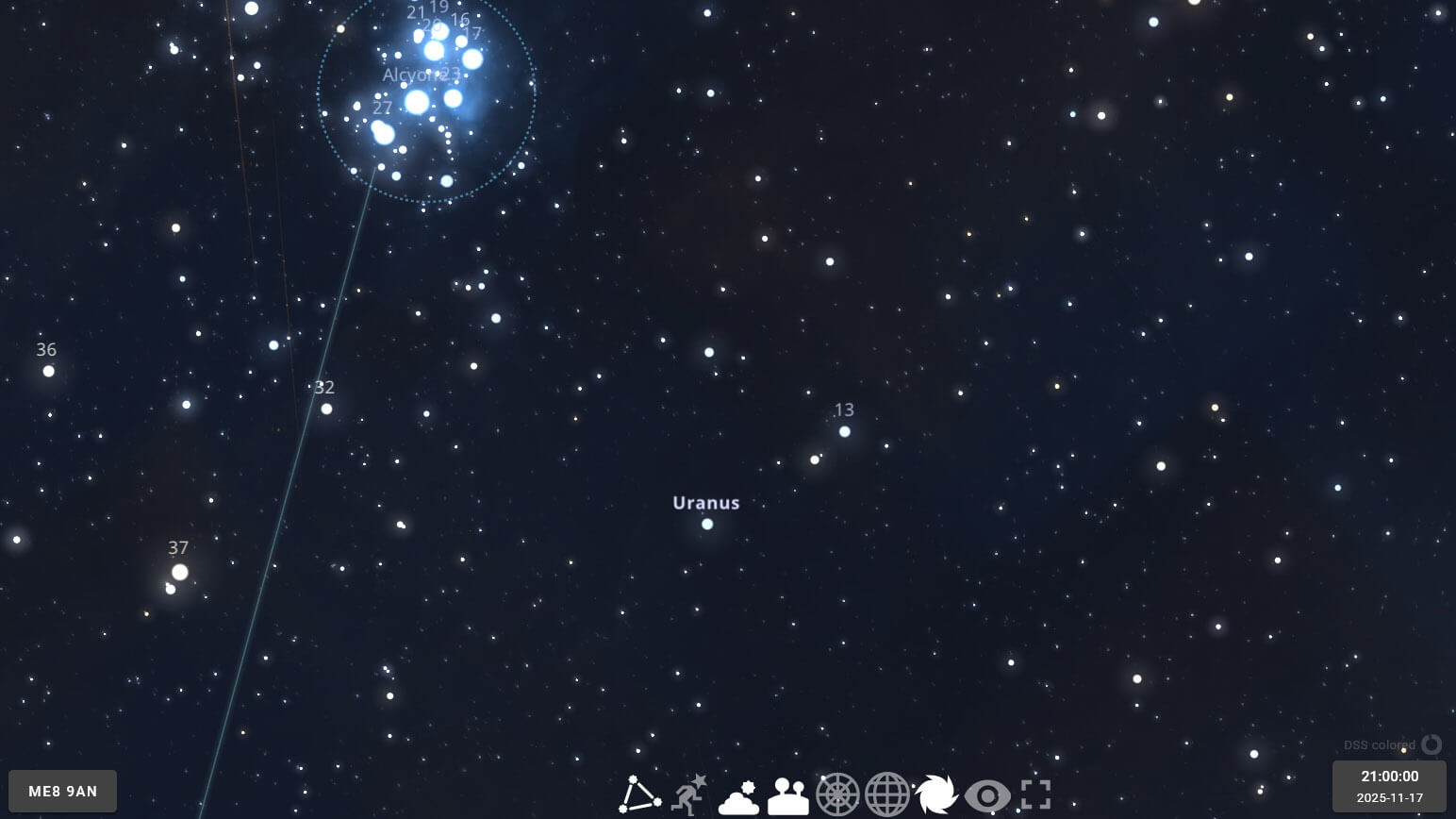
Image credit: Stellarium
Above image: Uranus's position close to the Pleides in mid-November 2025.
Neptune
- Neptune (mag. +7.9) is still well-placed, slightly northeast of Saturn.
- It's out in the celestial wilderness – not close to any bright stars.
- Our aim is to observe it as a small blue disc as opposed to a white point of light. Is it possible?
- The Sky Live will show you exactly where Neptune is right now.
Minor Planet Ceres (1)
- Ceres (mag. +8.2) reached opposition on 03 Oct 2025 and is now fading.
- If you haven't seen Ceres, it may be possible to find it after 10 Nov.
- The Sky Live will show you exactly where Ceres is right now.
Please refer back to our October 2025 Action Plan.
Lunar Observations
November 2025 Lunar Calendar
- Full Moon Wed 05
- Last Quarter Wed 12
- New Moon Thu 20
- First Quarter Fri 28
November 2025 Full Moon ("Supermoon")
On 05 Nov 2025, the Full Moon will be at its closest point to the Earth in its orbit (perigee) at a distance of about 357,000 km.
This will be the biggest and brightest of the three "supermoons" this year. It will be the biggest "supermoon" since 2019!
In our experience, the Moon will not appear any bigger to the naked eye, but it will appear much brighter (30%) than a Full Moon at apogee, when the Moon is furthest from Earth.
Hopefully, we'll be in the park to watch the Moon rise. Invite your friends and family to come and see the "Supermoon" through a telescope.
Meteor Showers
The Northern Taurids
- Peaks on the evening of 12 Nov 2025.
- Expect only around 5 meteors per hour at the peak.
- The Orionids is caused by debris from Halley's Comet (Comet 1P/Halley) burning up in Earth's atmosphere.
The Northern Taurids in 2025:
The Moon is at last quarter, so conditions are not favourable this year.
The Leonids
- Peaks on the evening of 17 Nov 2025.
- Expect around 10-15 meteors per hour at the peak.
- This shower is associated with Comet 55P/Tempel-Tuttle.
- It produces the fastest recorded meteors, which can reach 70 km/s.
- Fast meteors often leave a persistent train.
The Leonids in 2025:
The Moon rises at dawn, so conditions are favourable this year.
Admin Tasks
- Plan what we're going to do for the "Supermoon" on 04-06 Nov 2025.
- Plan our observations of Ceres, M31, and 51 Pegasi.
- Work out how to set up and operate the new telescopes.
Summary
Top Priorities for November 2025
In descending order of importance:
- Observe the "Supermoon" (04-06 Nov)
- See Uranus at Opposition
- Locating and tracking Ceres
- Andromeda Galaxy
- Monitor Comet Lemmon
See You Out There
We have a lot to see and do this month! We need to make sure we are properly prepared so we can make the most of any clear nights we get this month.
November might also be your last chance to see a comet and a minor planet this year. Do not miss this opportunity.
James M
TRAC Team Leader
01 Nov 2025 – Rainham, Kent

TRAC is an amateur astronomy group based in Rainham (Kent) in the United Kingdom.
On clear nights, you'll find us outside, observing stars, planets, moons, galaxies, satellites, meteors, and comets.
This action plan is specifically tailored for our location (Rainham, Kent), schedules, optical equipment, level of experience, personal interests, and local sky conditions.
Unless stated otherwise, magnitude values refer to apparent magnitude and have usually been rounded to one decimal place; photos of deep-sky objects credited to TRAC were taken using a Seestar S50 smart telescope; our observations were made from Rainham, Kent; and times and dates are in the UK's local time zone (GMT or BST, depending on the time of year).
We welcome any questions, feedback, or suggestions you may have. Please let us know if anything is unclear or if you notice an error, inaccuracy, or typo. Contact us via email.
© 2025 Taverners Road Astronomy Club