TRAC Action Plan: August 2025
- Category: Action Plans
- Author: JM
- Published: 01 Aug 2025
- Last updated: 04 Aug 2025
August 2025 Calendar
- Fri, 01 Aug First Quarter Moon
- Sun, 04 Aug Moon close to Antares (Scorpius)
- Sat, 09 Aug Full Moon
- Tue, 12 Aug Venus close to Jupiter (AM)
- Tue, 12 Aug Moon close to Saturn
- Tue, 12 Aug Perseid Meteor Show peaks
- Sat, 16 Aug Last Quarter Moon
- Sun, 17 Aug Moon close to the Pleiades
- Sat, 23 Aug New Moon
- Wed, 27 Aug Moon close to Spica (Virgo)
- Sun, 31 Aug First Quarter Moon
Summer Stargazing
Summer Constellations
We'll look out for the summer triangle and the main summer constellations:
- Lyra (Vega)
- Aquila (Altair)
- Cygnus (Deneb)
- Hercules (The Keystone)
- Libra
- Scorpius (Antares)
- Vulpecula
- Sagittarius
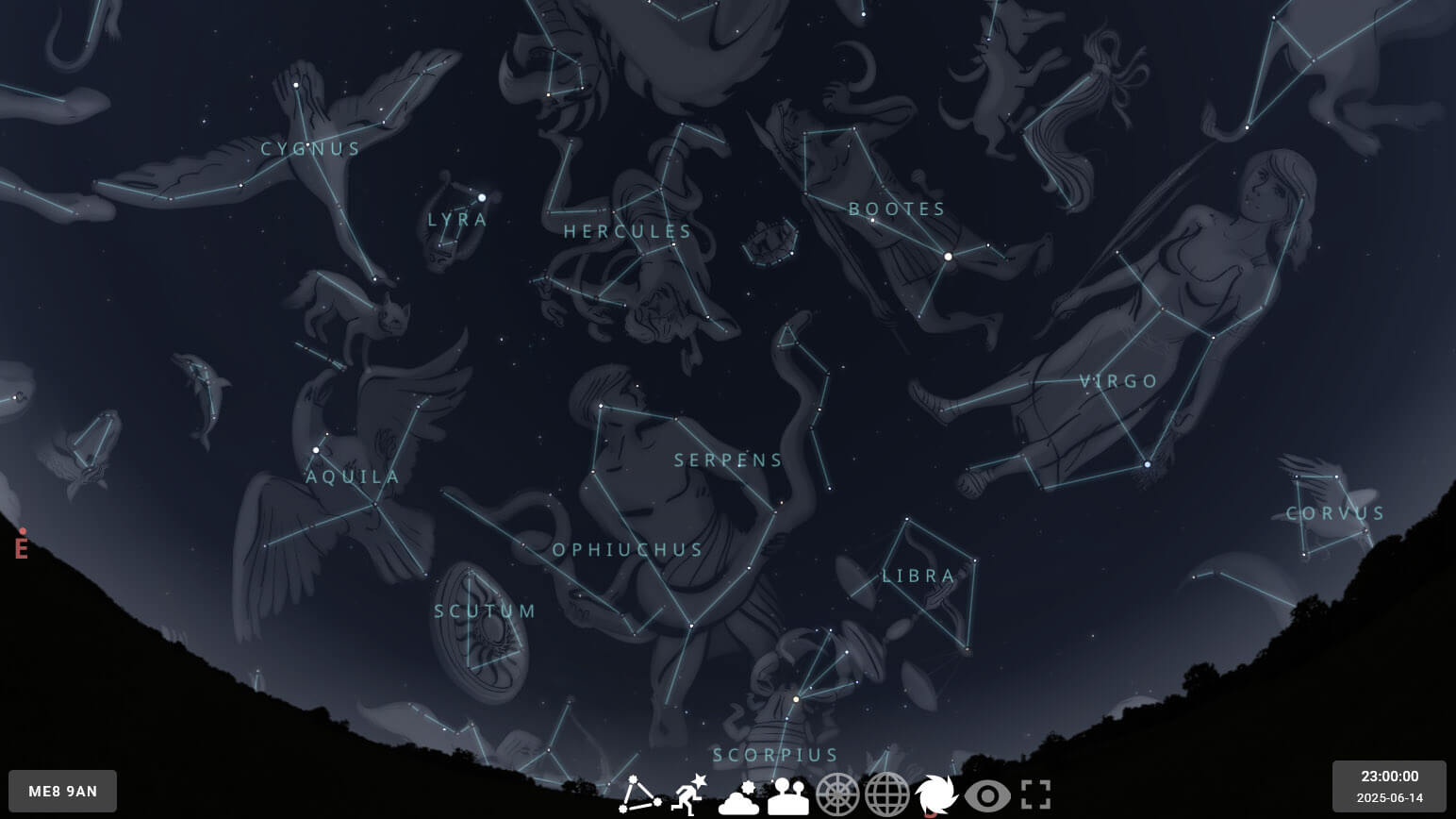
Image credit: Stellarium
Make sure you see the red star Antares if you haven't seen it so far this year. The same goes for the constellation Sagittarius, which is one of the few major constellations we didn't spot in 2024.
Perseid Meteor Shower
Every August, we're treated to one of the best meteor showers of the year – the Perseids.
Up to 100 meteors per hour might be seen under ideal conditions, but in reality you should more likely expect to see two or three. A lot of patience is required.
Perseid meteors are known to be fast-moving, and some of the brightest ones leave a persistent train across the sky. Fireballs are also occasionally seen by lucky night sky observers.
The shower is already well underway, peaking on 12 Aug 2025 and lasting until 24 Aug 2025.
This year, the timings are not favourable; the peak occurs under the glare of an 86%-lit waning gibbous moon!
In 2024, our TRAC operatives in Eastern Europe saw 27 meteors. Let's see if they can do even better this year.
Solar Observations
Sunspots and Solar Photography
We still need some extra practice at photographing the Sun.
There's the potential to view the Sun and take photos on a few consecutive sunny afternoons during the school holidays. We can then compare the images and estimate the Sun's rotational velocity.
Planets
Venus (mag. -3.9) and Jupiter (mag. -1.8) will be positioned close together on the morning (05:00) of 12 Aug 2025.
Saturn (mag. +0.8) is back in the late evening sky, now only slightly tilted towards us, so most features of its ring system will not be visible. The rings are due to completely disappear in small telescopes later this year.
Uranus (mag. +5.7) will be too low for us to see in August, but the situation will improve in autumn and winter.
Neptune (mag. +7.8) is situated close to Saturn and (technically) should be visible by the end of the month. But this is a tricky target for us!
Mercury (mag. -0.2) is between Earth and the Sun, and Mars (mag. +1.6) is lost to the evening twilight.
Lunar Observations
August 2025 Lunar Calendar
- First Quarter Fri 01
- Full Moon Sat 09
- Last Quarter Sat 16
- New Moon Sat 23
- First Quarter Sun 31
Lunar Photography
If we get the chance, we'll have another shot at using the SV105 Planetary Camera to take some detailed images of the Moon at the start of August. Last month, we ran into issues with the low altitude of the Moon, so we'll need to make sure that doesn't happen again!
Moon Conjunctions & Occultations
Conjunctions involving the Moon and a planet or a bright star, though common, always provide good photo opportunities.
The following conjunctions will occur this month:
| Date | Approx Time | Planet/Star | Moon Phase |
|---|---|---|---|
| Sun 04 Aug | After 22:00 | Antares (Scorpius) | 72% Waxing Gibbous |
| Tue 12 Aug | After 23:00 | Saturn | 84% Waning Gibbous |
| Sun 17 Aug | After 00:30 | The Pleiades | 41% Waning Gibbous |
| Wed 27 Aug | After 20:00 | Spica (Virgo) | 19% Waxing Crescent |
Admin Tasks
We will need to start looking at the possibility of observing the total lunar eclipse occurring on 07 Sep 2025. This is an important event and we'll need to prepare for it in advance.
Summary
Top Priorities for August 2025
In descending order of importance:
August Astrophotography
Photography opportunities this month include:
- Full Moon
- The Sun (Sunspots)
- Various Moon Conjunctions
- Meteors (exceptionally difficult)
See You Out There
August is another quiet month for astronomy. I'll have another attempt at using the astro camera with the telescope while the weather's likely to be good.
The highlight for August will be looking out for bright meteors during this year's Perseids – make a note of how many you see.
James M
TRAC Team Leader
01 Aug 2025 – Rainham, Kent

TRAC is an amateur astronomy group based in Rainham (Kent) in the United Kingdom.
On clear nights, you'll find us outside, observing stars, planets, moons, galaxies, satellites, meteors, and comets.
This action plan is specifically tailored for our location (Rainham, Kent), schedules, optical equipment, level of experience, personal interests, and local sky conditions.
Unless stated otherwise, magnitude values refer to apparent magnitude and have usually been rounded to one decimal place; photos of deep-sky objects credited to TRAC were taken using a Seestar S50 smart telescope; our observations were made from Rainham, Kent; and times and dates are in the UK's local time zone (GMT or BST, depending on the time of year).
We welcome any questions, feedback, or suggestions you may have. Please let us know if anything is unclear or if you notice an error, inaccuracy, or typo. Contact us via email.
© 2025 Taverners Road Astronomy Club