TRAC Monthly Report: August 2025
- Category: Monthly Reports
- Author: JM
- Published: 03 Sep 2025
- Last updated: 13 Jan 2026
Summer Night Sky
Summer Constellations
Constellations seen this month include:
- Cephus
- Draco
- Lacerta
- Cassiopeia
- Pegasus
- Delphinus
- Cygnus
- Aquila
- Perseus
- Aquarius
- Pisces
- Andromeda
Astrophotography
All of the photos in this section were taken in Bulgaria by Matey K (Head of Observations) using a Google Pixel 8.
The images were processed using Photoshop (by James) then plate solved (by James) and annotated using software from Astrometry.net and scaled (by James).
Zenith Sky & The Milky Way
In August, when looking directly overhead (at the zenith), the observer is looking inward towards the centre of our galaxy, the Milky Way.
The bright patch of sky is caused by the large number of stars in our galaxy. When we look towards the centre of the Milky Way, we are seeing many billions of stars close together, which makes that area of the sky appear brighter.

Image credit: MK (TRAC)
Above image: The Milky Way can be seen as a bright band of light stretching across the middle of the image. Photo taken on 03 Aug 2025 at 00:30.
![2025 Summer Night Sky (North-East) [Annotated] - 01 Aug 2025](/static/images/photos/obs/2025/08/2025_08_03_PXL_20250802_213011197.NIGHT2_Milky_Way_Zenith_ANNOTATED_FS.jpg)
Image credit: MK/JM (TRAC)
Above image: An annotated version of the previous image showing the names of the constellations. The bright star in Cygnus is Deneb, which forms one vertex of the Summer Triangle.
NE Sky & The Andromeda Galaxy (M31)
Looking north-east, light from the Andromeda Galaxy was detectable with the phone's small sensor. It appears as a bright patch of sky below the faint band of light produced by the millions of stars in our own Mily Way galaxy.
The Andromeda Galaxy is now thought to contain over one trillion stars. Its bright galactic core was picked up clearly, and its outer spiral structure appears as a bright area in the photo.
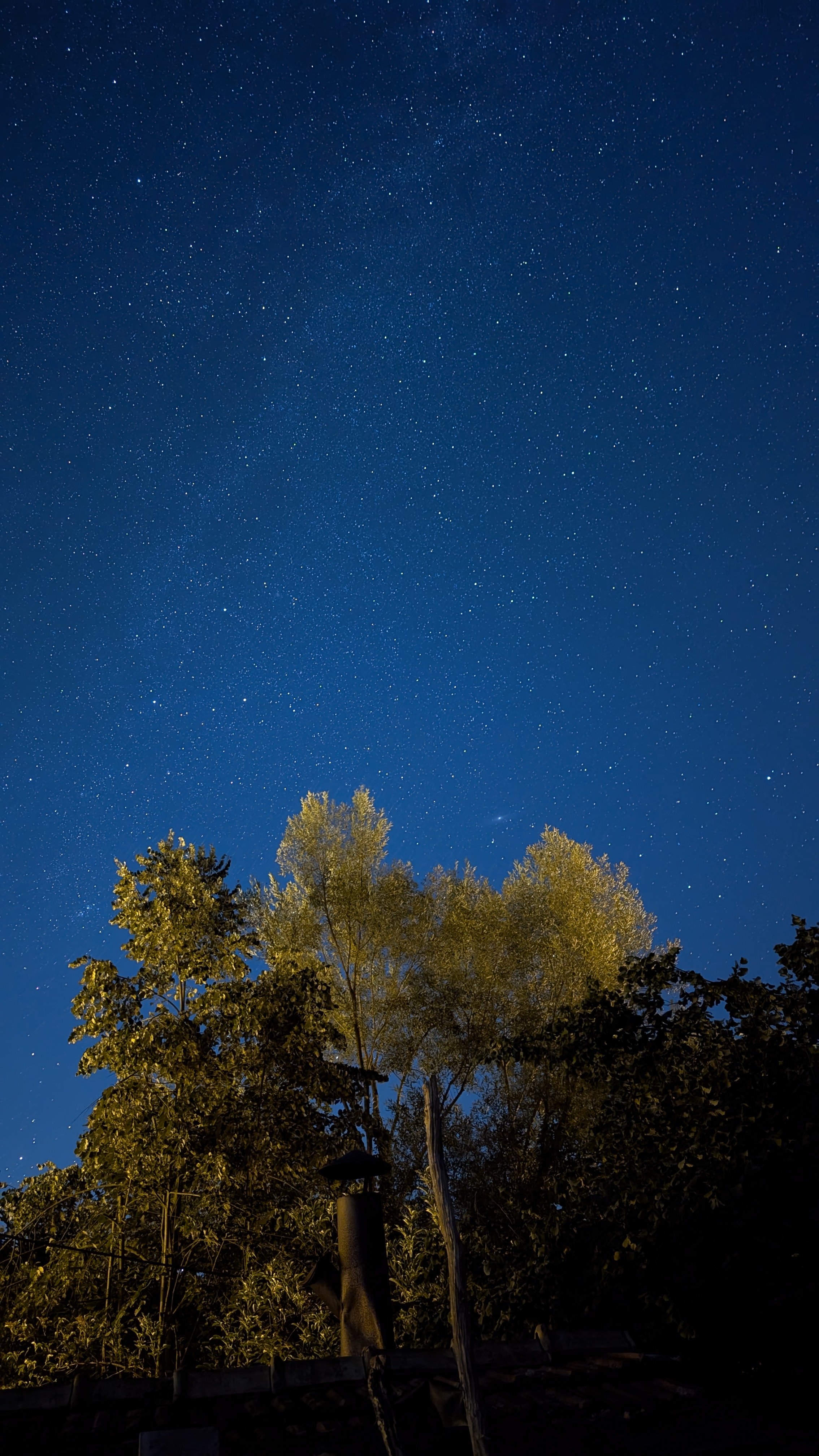
Image credit: MK (TRAC)
Above image: The summer night sky looking east. The bright patch of light just above the trees is the Andromeda Galaxy (M31). To its left are the bright white stars marking out the distinctive "W" shape of the constellation Cassiopeia. Photo taken on 01 Aug 2025 at 23:40.
SE Sky & Saturn
Saturn dominated the south-eastern summer night sky. The planet was positioned below the Circlet of Pisces and stood out clearly amongst the background stars.
Positioned slightly above Saturn is the planet Neptune. The two planets are 3 billion km (2 billion miles) apart. Neptune can be seen in the photo below – can you spot it?
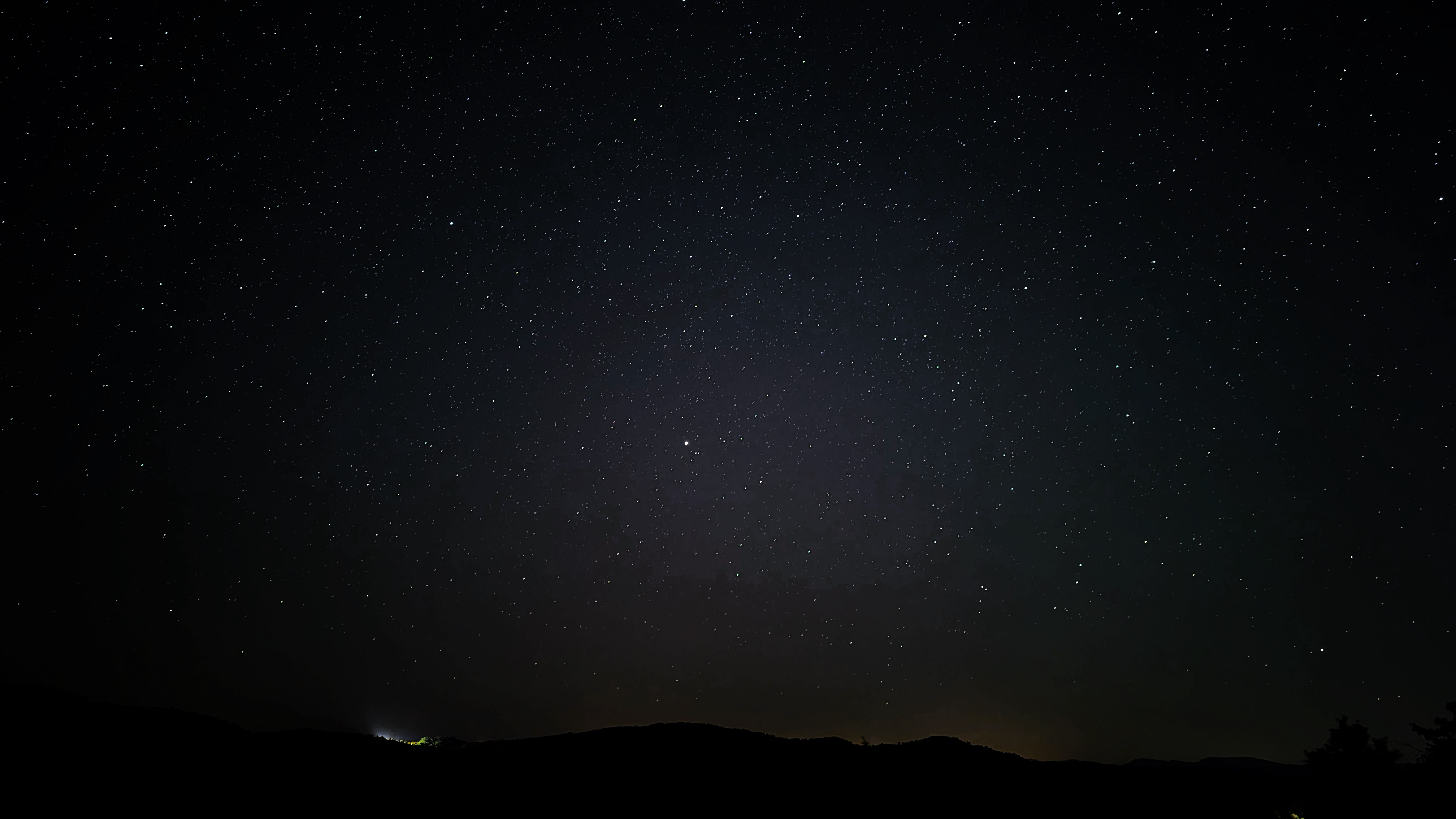
Image credit: MK (TRAC)
Above image: The bright object near the centre of the photo is the ringed planet Saturn. One of the white dots to its top left is the planet Neptune! Photo taken on 03 Aug 2025 at 00:30.
![2025 Summer Night Sky (South-East) [Annotated Version] - 03 Aug 2025](/static/images/photos/obs/2025/08/2025_08_03_PXL_20250802_212336366.NIGHT2_Saturn_ANNOTATED.jpg)
Image credit: MK/JM (TRAC)
Above image: An annotated version of the previous image showing the names of the constellations.
Time-lapse Videos
Matey K also captured two time-lapse videos of the night sky. In astronomy, time-lapse videos can be useful because they show the motion of stars and planets over several hours in a short video.
Video credit: MK (TRAC)
Above video: The bright moving object to the bottom left of the frame is almost certainly a plane. Technically, we can refer to it as a UFO because we haven't been able to positively identify it.
Video credit: MK (TRAC)
Above video: The rotation of the Earth can be appreciated in this time-lapse video showing the view towards the centre of our galaxy.
Lunar Observations
Full Moon (09 Aug 2025)
Clouds spoilt the view of this month's Full Moon. The position of the moonrise was checked from the park so we'll know the best vantage point to see it rise again next month for the lunar eclipse on 07 Sep 2025.
No other observations of the Moon were made.
Summary
Not Many Meteors
During the peak of this year's Perseid meteor shower, I saw a grand total of one meteor from Rainham on 04 Aug 2025. Matey saw 11 meteors during his time in Bulgaria – not quite matching his record of 23 meteors last year but still a good result compared to here in cloudy, light-polluted Rainham.
Solar Eclipse 2026
The next solar eclipse visible from Rainham will occur on 12 Aug 2026. It'll be another partial eclipse like we saw in March this year. The eclipse starts at 18:18 and ends at 20:06. The Sun will be 10 degrees above the horizon at the time of maximum eclipse.
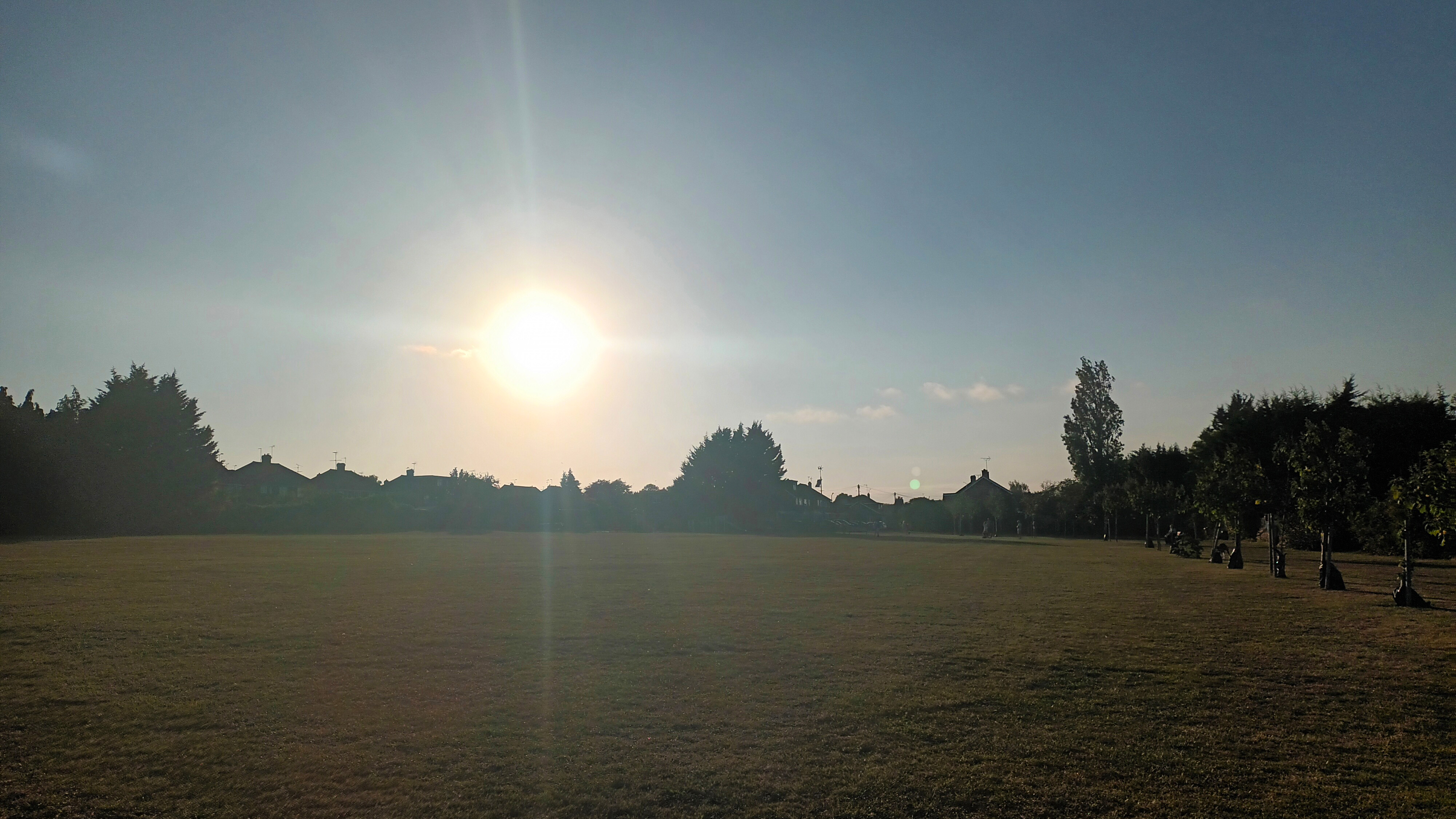
Image credit: JM (TRAC)
Above image: This photo shows the position and altitude of the Sun in the north-west at 19:00 on 16 Aug 2025. From the park, the Sun will be perfectly placed at the time of the eclipse next year.
But hopefully we won't have to wait till then to see our next eclipse. We have a total lunar eclipse to observe at the beginning of September.
James M
TRAC Team Leader
03 Sep 2025 – Rainham, Kent

TRAC is an amateur astronomy group based in Rainham (Kent) in the United Kingdom.
On clear nights, you'll find us outside, observing stars, planets, moons, galaxies, satellites, meteors, and comets.
This monthly report is intended to keep club members informed of our observational activities, track progress towards the club's long-term goals, celebrate successes, and record memorable moments.
Unless stated otherwise, magnitude values refer to apparent magnitude and have usually been rounded to one decimal place; photos of deep-sky objects credited to TRAC were taken using a Seestar S50 smart telescope; our observations were made from Rainham, Kent; and times and dates are in the UK's local time zone (GMT or BST, depending on the time of year).
We welcome any questions, feedback, or suggestions you may have. Please let us know if anything is unclear or if you notice an error, inaccuracy, or typo. Contact us via email.
© 2025 Taverners Road Astronomy Club