TRAC Action Plan: February 2025
- Category: Action Plans
- Author: JM
- Published: 31 Jan 2025
- Last updated: 31 Jan 2025
February 2025 Calendar
- Sat, 01 Feb Moon close to Venus and Saturn after 17:30
- Wed, 05 Feb First Quarter Moon
- Thu, 06 Feb Moon close to the Pleiades and Jupiter in Taurus all evening
- Sun, 09 Feb Moon very close to Mars at 19:30
- Wed, 12 Feb Full Moon
- Wed, 12 Feb Moon close to Regulus in Leo after 23:00
- Wed, 19 Feb Venus (mag. -4.9) reaches perihelion at 18:00
- Thu, 20 Feb Last Quarter Moon
- Fri, 28 Feb New Moon
Once again this month, we also have some more Moon Transit Events on Jupiter and Saturn. Check the timings in the documents below:
Winter Stargazing
We got a decent view of the winter night sky in January, but we were stargazing close to the date of the Full Moon. In February, we'll take a closer look at some of the brightest stars in the absence of the Moon's glare.
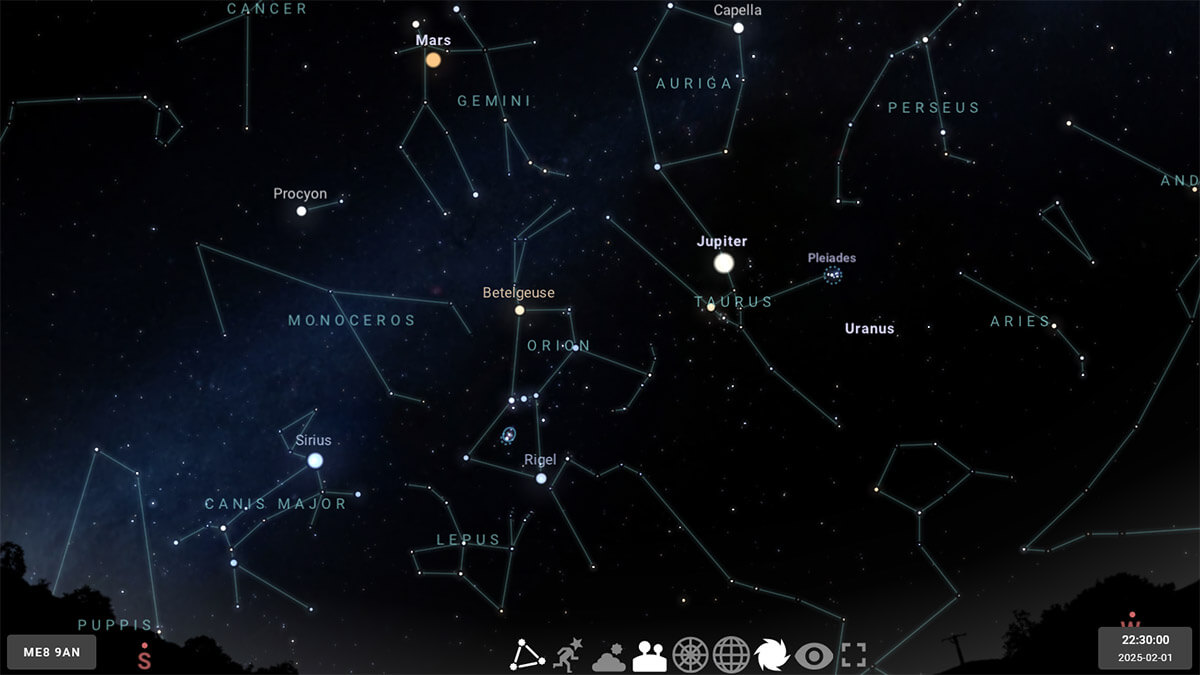
Image credit: Stellarium
Please refer back to the December 2024 Action Plan for the full details. See these links:
Open Star Clusters
Around the date of the New Moon, we'll look out for these open star clusters:
Solar Observations
The Sun Up Close
In 2024, we viewed the Sun through the eclipse glasses. We were able to observe a large cluster of sunspots on the Sun's photosphere.
Now, we'll use the telescope to take a much closer look at our nearest star.
The solar filter was fitted with new Baader AstroSolar Safety Film on 18 Oct 2024. It's ready to be tested on a sunny afternoon this month.

Image credit: JM (TRAC)
The Sun in February in the UK
Is February the best time to try to view the Sun? No, it isn't! But hopefully we'll get at least one afternoon where we can see the Sun in a cloudless sky.
We'll look out for sunspots, and we'll take a photo of the Sun at a magnification of around 60x. Then we can go online and compare our photos to the latest images of the Sun from NASA's Solar Dynamics Observatory.
Partial Solar Eclipse - 29 Mar 2025
Add it to your diary and calendar: Partial Solar Eclipse - 29 Mar 2025.
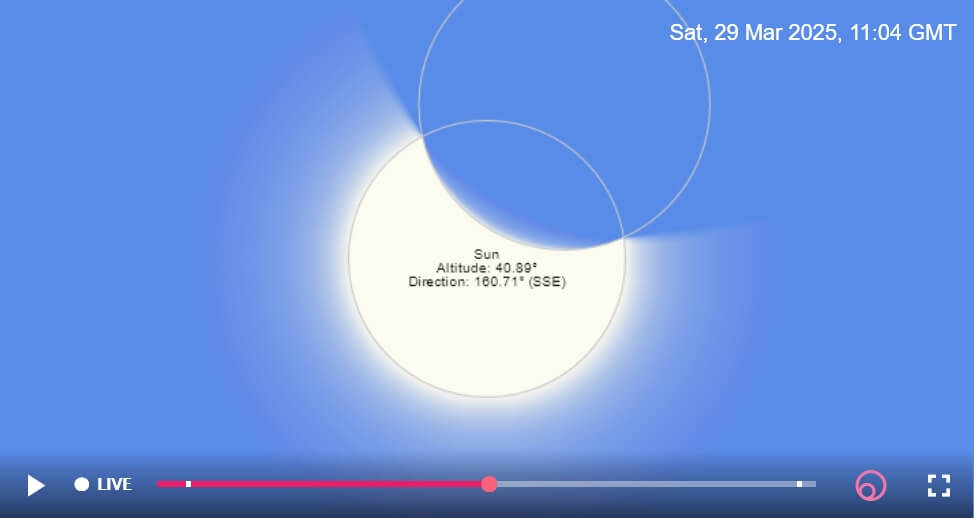
Image credit: Time and Date
It's important for us to gain some experience viewing the Sun using the telescope and solar filter in February and March. That way, we'll be ready in time for the partial solar eclipse at the end of March 2025.
Planets
The parade of planets continues!
Mercury
Mercury (mag. -1.2) will appear very low in the evening sky towards the end of February 2025. We can attempt to see Mercury, but it will not be easy. We'll stand a better chance in March.
Venus
Venus will reach perihelion and its maximum brightness (mag. -4.9) on 19 Feb 2025. The "Evening Star" sets at 21:00 and will now appear as a crescent through the telescope.
We'll aim to observe Venus shortly after the sun sets and take some photos so that we can compare them with ones we took last month to see how the phase of Venus has changed.
By the end of February 2025, the planet will appear as a very thin crescent.
01 Feb 2025: Venus will lie very close to the Moon between 17:00 and 20:00.
Mars
Mars (mag. -1.1) is now dimming after it reached opposition on 16 Jan 2025. By the end of the month, it'll fade to mag. -0.3. February will be the last chance to get a good view of Mars.
Opposition is the best time to observe Mars, so this month is an excellent time to view the Red Planet.
Under ideal conditions, the telescope should be capable of showing us:
- White polar ice cap at Mars' northern pole
- Dark markings on the Martian surface
- Perhaps even some white clouds in the atmosphere
09 Feb 2025: The Moon will lie very close to Mars at 19:30.
A huge model of Mars will be visiting Rochester Cathedral.
Jupiter
Jupiter (mag. -2.3) will be bright and visible all night.
We're still aiming to get a clear view of Jupiter's Great Red Spot (GRS). Check the transit times below to find out when the GRS will be visible from Earth.
Jupiter's four moons will also be positioned in interesting arrangements at the following times:
- 12 Feb 2025, 20:00 Moons Aligned
- 17 Feb 2025, 00:00 Three moons close to Jupiter
- 23 Feb 2025, 18:00 Two moons close together on either side of Jupiter
- 24 Feb 2025, 18:00 Four moons closely aligned on the western side of Jupiter
We'll also endeavour to observe a couple more Jovian moon shadow transits.
Transit timings for the GRS and moon events are listed here:
Saturn
Saturn (mag. +1.0) is losing altitude and getting harder to see. By the end of the month, it'll be lost in the twilight glow. It will reappear later in the year.
Saturn's rings are now almost edge-on. We're currently viewing them from above (northern side). When the planet reappears from behind the Sun in May, we'll be viewing its ring system from below.
Uranus
Uranus (mag. +5.8) is visible all night long just south-west of the Pleiades on the boundary between Taurus and Aries.
It should be possible for us to locate Uranus on a night with good seeing. Hopefully, it will appear with a slight greenish hue in the telescope.
Neptune
Neptune (mag. +7.9) will be low in the sky after dark. There will only be a short window of opportunity when the planet will be visible. For that reason, this month is not the right time to start thinking about viewing Neptune.
Moon Shadow Transits
Please refer to the November 2024 Action Plan for more information about moon shadow transits.
All transit timings are in UT and may vary by a few minutes.
Titan Shadow Transits
The only Titan shadow transit this month will be very difficult to see because it occurs early in the evening against a bright sky. Saturn will be too low in the sky by the time darkness falls.
Jupiter Moon Transits
We've seen a few Jovian shadow transits now, but we've never seen one of Jupiter's moons crossing the planet. We'll aim to see one of those this month.
Full listings of Jovian moon transits, shadow transits, occultations, and eclipses can be viewed here:
Some of the highlights are detailed below.
Io Transits of Jupiter
These three Io transits are highlighted because the times work out well for us:
- Io Tra start: 2025 Feb 03 18:08
- Io Sha start: 2025 Feb 03 19:19
- Io Tra end: 2025 Feb 03 20:20
- Io Sha end: 2025 Feb 03 21:32
- Io Tra start: 2025 Feb 10 20:00
- Io Sha start: 2025 Feb 10 21:15
- Io Tra end: 2025 Feb 10 22:12
- Io Sha end: 2025 Feb 10 23:28
- Io Tra start: 2025 Feb 26 18:16
- Io Sha start: 2025 Feb 26 19:35
- Io Tra end: 2025 Feb 26 20:28
- Io Sha end: 2025 Feb 26 21:48
Jupiter Moon Events: 25 Feb 2025
An interesting sequence of events will take place on 25 Feb 2025 involving three of Jupiter's moons (Io, Europa, Ganymede):
- II Tra start: 2025 Feb 25 18:27
- III Sha start: 2025 Feb 25 18:40
- II Tra end: 2025 Feb 25 21:01
- II Sha start: 2025 Feb 25 21:01
- I Occ start: 2025 Feb 25 21:04
- III Sha end: 2025 Feb 25 21:06
- II Sha end: 2025 Feb 25 23:38
- I Ecl end: 2025 Feb 26 00:34
I = Io
II = Europa
III = Ganymede
Mars at Rochester Cathedral
Mars: War & Peace
Mars: War & Peace is a touring artwork by UK artist Luke Jerram that follows on from his other astronomical artworks Museum of the Moon and Gaia.
Measuring seven metres in diameter, the artwork features 120 dpi detailed NASA imagery of the Martian surface. The artwork is made from images taken by NASA's Mars Reconnaissance Orbiter.
At an approximate scale of 1:1 million, each centimetre of the internally lit spherical sculpture represents 10 kilometres of the surface of Mars.
Mars is coming to Rochester Cathedral in February 2025.
How to See It
The Mars exhibition runs from 11 February until 8 March 2025. Check the links below for the latest information.
Mars is open free of charge during the day.
Lunar Observations
February 2025 Lunar Calendar
- First Quarter Wed 05
- Full Moon Wed 12
- Last Quarter Thu 20
- New Moon Fri 28
Note: We must remember to use the variable polarising filter to reduce the brightness when viewing the full moon.
Moon Conjunctions
Conjunctions involving the Moon and a planet or a bright star, though common, always provide good photo opportunities.
The first half of February 2025 offers a few celestial close encounters. Here's what we'll look out for:
| Date | Approx Time | Planet/Star | Moon Phase |
|---|---|---|---|
| Sat, 01 Feb | After Sunset | Venus & Saturn | 13% - Crescent |
| Thu, 06 Feb | All Evening | Jupiter & Pleiades | 66% - Waxing Gibbous |
| Sun, 09 Feb | Closest at 19:30 | Mars | 92% - Waxing Gibbous |
| Wed, 12 Feb | After 23:00 | Regulus (Leo) | 100% - Full Moon |
Admin Tasks
Telescope Maintenance
It's time the eyepieces were inspected and cleaned. In particular, I've noticed black spots on the Svbony zoom eyepiece, which are caused by dirt or dust on the glass.
The following cleaning tasks need to be completed:
- Clean every eyepiece carefully
- Clean the star diagonal mirror
- Blow dust off the telescope's outer glass surface
Great care must be taken when cleaning the lenses and mirrors. We don't want any glass surfaces to be scratched.
Website Content
- We'll review the photos and videos taken in January 2025 and add the best ones to the website.
- Krum is going to expand his page about Zak, our club mascot.
- We still need to create avatars to put alongside our names on the "Meet the Team" page.
TRAC Research
Topics we need to read up on include:
- Tips and techniques for improving our astrophotography skills
- Information about the upcoming partial solar eclipse on 29 Mar 2025
- How we can improve the view we get of Mars with the telescope
Guides for anyone wanting to get some good Moon photos:
TRAC members can earn bonus points for undertaking independent research.
Summary
Top Priorities for February 2025
In descending order of importance:
- Winter Night Sky & The Orion Nebula
- Mars (Ice caps and surface markings)
- Photographing the Phase of Venus
- The Sun (with the telescope)
- Jupiter's GRS
- Moon Shadow Transits
- Moon Conjunctions
- Uranus
February Astrophotography
Photography opportunities this month include:
- Various Moon Conjunctions
- Jupiter's GRS (if we get perfect conditions)
- The Sun (and any sunspots)
- The Orion Nebula (difficult)
- Surface Markings / Ice Caps on Mars (very difficult)
See You Out There
As always, there's lots to see this month. Clear skies for all in February 2025!
James M
TRAC Team Leader
31 Jan 2025 – Rainham, Kent

TRAC is an amateur astronomy group based in Rainham (Kent) in the United Kingdom.
On clear nights, you'll find us outside, observing stars, planets, moons, galaxies, satellites, meteors, and comets.
This action plan is specifically tailored for our location (Rainham, Kent), schedules, optical equipment, level of experience, personal interests, and local sky conditions.
Unless stated otherwise, magnitude values refer to apparent magnitude and have usually been rounded to one decimal place; photos of deep-sky objects credited to TRAC were taken using a Seestar S50 smart telescope; our observations were made from Rainham, Kent; and times and dates are in the UK's local time zone (GMT or BST, depending on the time of year).
We welcome any questions, feedback, or suggestions you may have. Please let us know if anything is unclear or if you notice an error, inaccuracy, or typo. Contact us via email.
© 2025 Taverners Road Astronomy Club