TRAC Monthly Report: September 2025
- Category: Monthly Reports
- Author: JM
- Published: 30 Sep 2025
- Last updated: 10 Nov 2025
Stargazing
Summer Constellations
We saw Lyra, Aquila, and Cygnus on 19/20 Sep 2025. Everyone should now be able to point out and name the three bright stars which make up the summer triangle.
Remember:
- The brightest star is Vega, part of Lyra.
- The star that's lowest in the sky is Altair, part of Aquila.
- And the remaining star is Deneb, part of Cygnus.
Lunar Observations
Total Lunar Eclipse (07 Sep 2025)
The timings of this lunar eclipse (early Sunday evening) were excellent, but we were let down by the British weather.
We were in the right place at the right time, but all we saw were thick, dark grey clouds low in the sky to the east – exactly what we didn't want.
Once again, the BBC and Met Office weather forecasts were not helpful.
I've been saying "the clouds make me sad" for over a year, and I think the feeling was shared by everyone in attendance.

Image credit: JM (TRAC)
Above image: We didn't take any photos on eclipse evening because we were too upset about the situation, but this photo was taken the following evening from the same spot where we'd set up camp. It's actually a decent place to view the Moon rising in the east. Maybe next time we'll have more luck.

Image credit: JM (TRAC)
Above image: September's Full Moon shining brightly ... a few hours after the lunar eclipse had finished.

Image credit: JM (TRAC)
Above image: The view of the Moon was fairly clear by 23:00. Unfortunately, the lunar eclipse was over by then.
Planets
Saturn
We observed Saturn on 20 Sep 2025. Its rings now appear edge-on from Earth, though they're still clearly visible. Its largest moon, Titan, was also easy to spot.
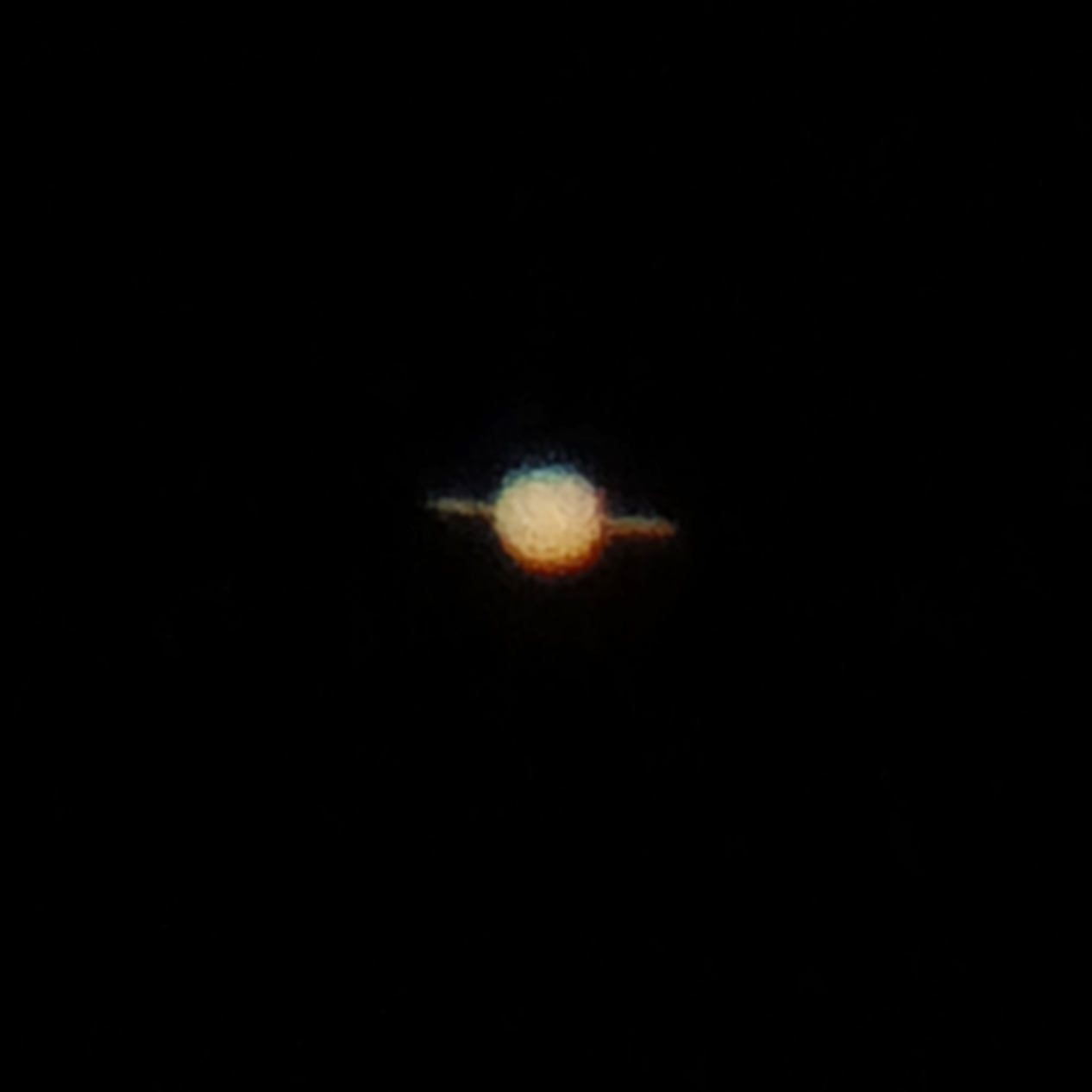
Image credit: JM (TRAC)
Above image: Saturn at ~150x magnification.
I was able to see three of Saturn's moons on the evening of 22 Sep 2025: Titan, Rhea, and Iapetus (the outermost large moon of Saturn).
There was no sign of Tethys (mag. +10.3) or Dione (mag. +10.5) – maybe because they were positioned closer to Saturn and thereby obscured by the planet's glow.
The light from each of these moons was too faint to be picked up by my phone camera.
Neptune
Success! I am very pleased to report that we had our first confirmed sighting of the planet Neptune on the evening of 21 Oct 2025.
After a couple of failed attempts, some of us are now able to say we've seen all of the planets in the solar system.
Seeing Neptune is a great result for everyone involved with TRAC. We've proven that it's possible to observe Neptune from our location. We've gained a lot of experience at hunting down faint targets like Neptune. If you missed out this time, don't worry; we now have the know-how to do it again over the winter.
On the very clear night of 21/22 Oct 2025, I was even able to find Neptune with binoculars – because I knew exactly how to star hop to it from Saturn!
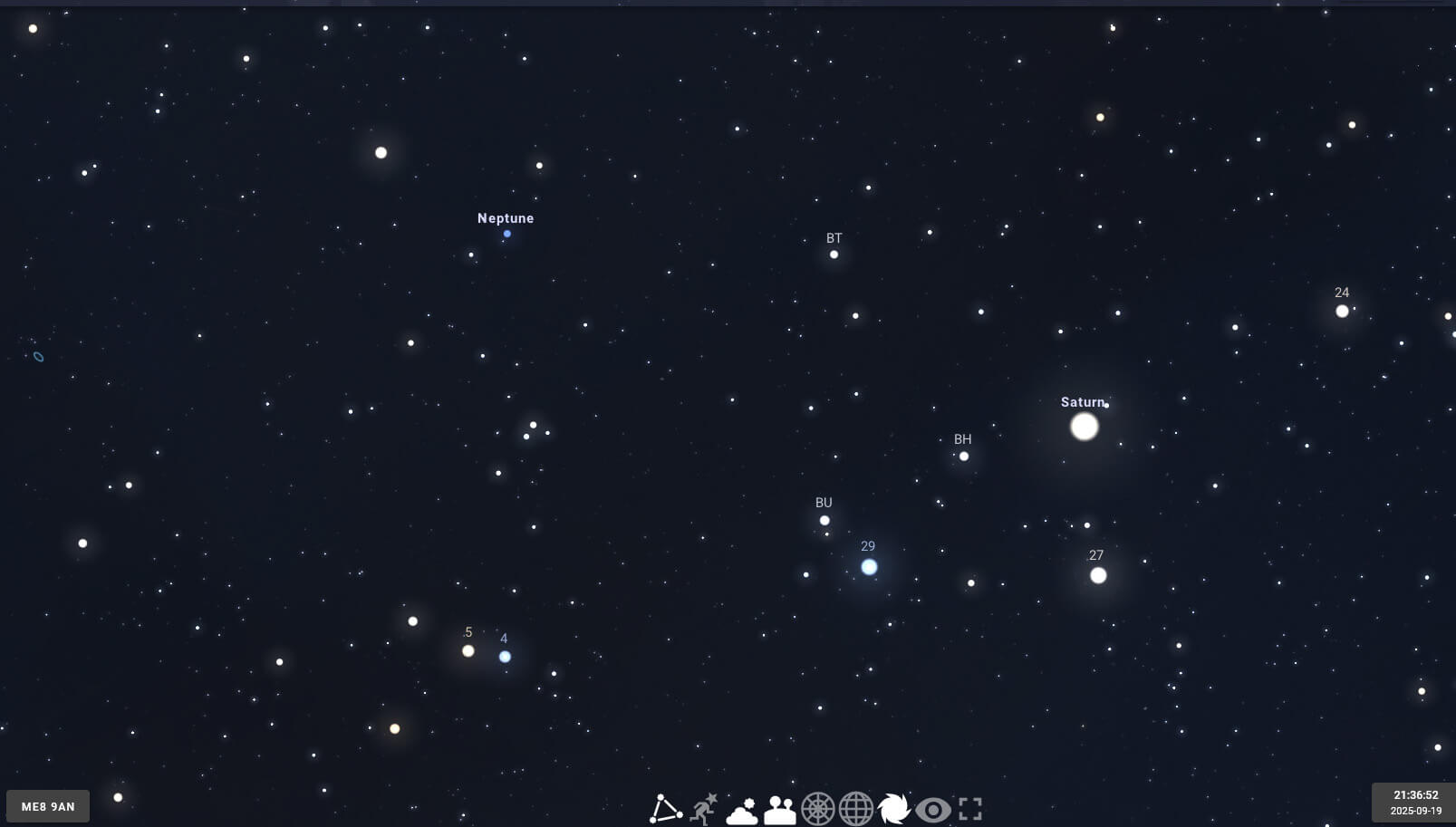
Image credit: JM (TRAC)
Above image: The position of Neptune in relation to Saturn.
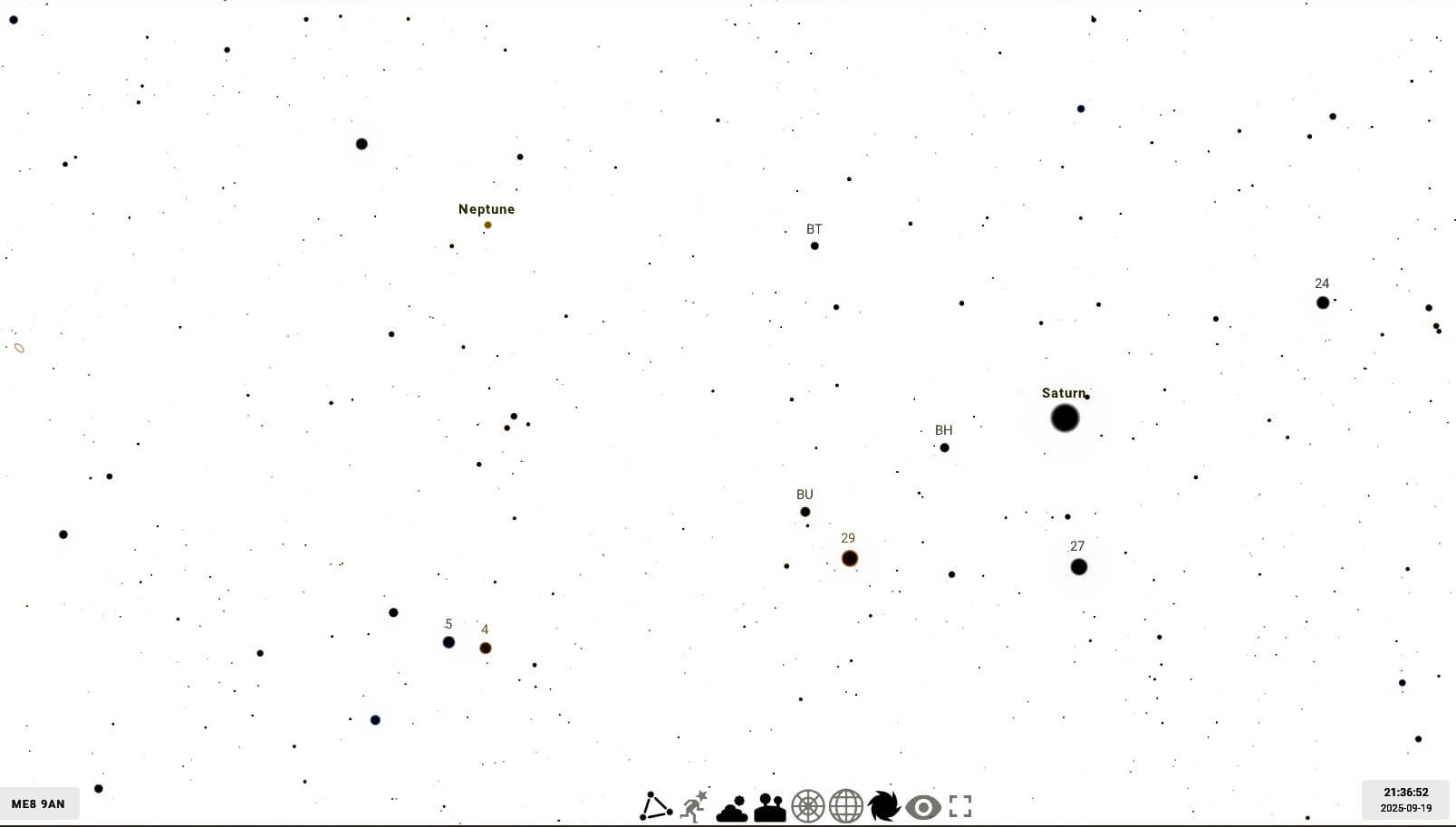
Image credit: JM (TRAC)
Above image: An inverted version of the previous image.
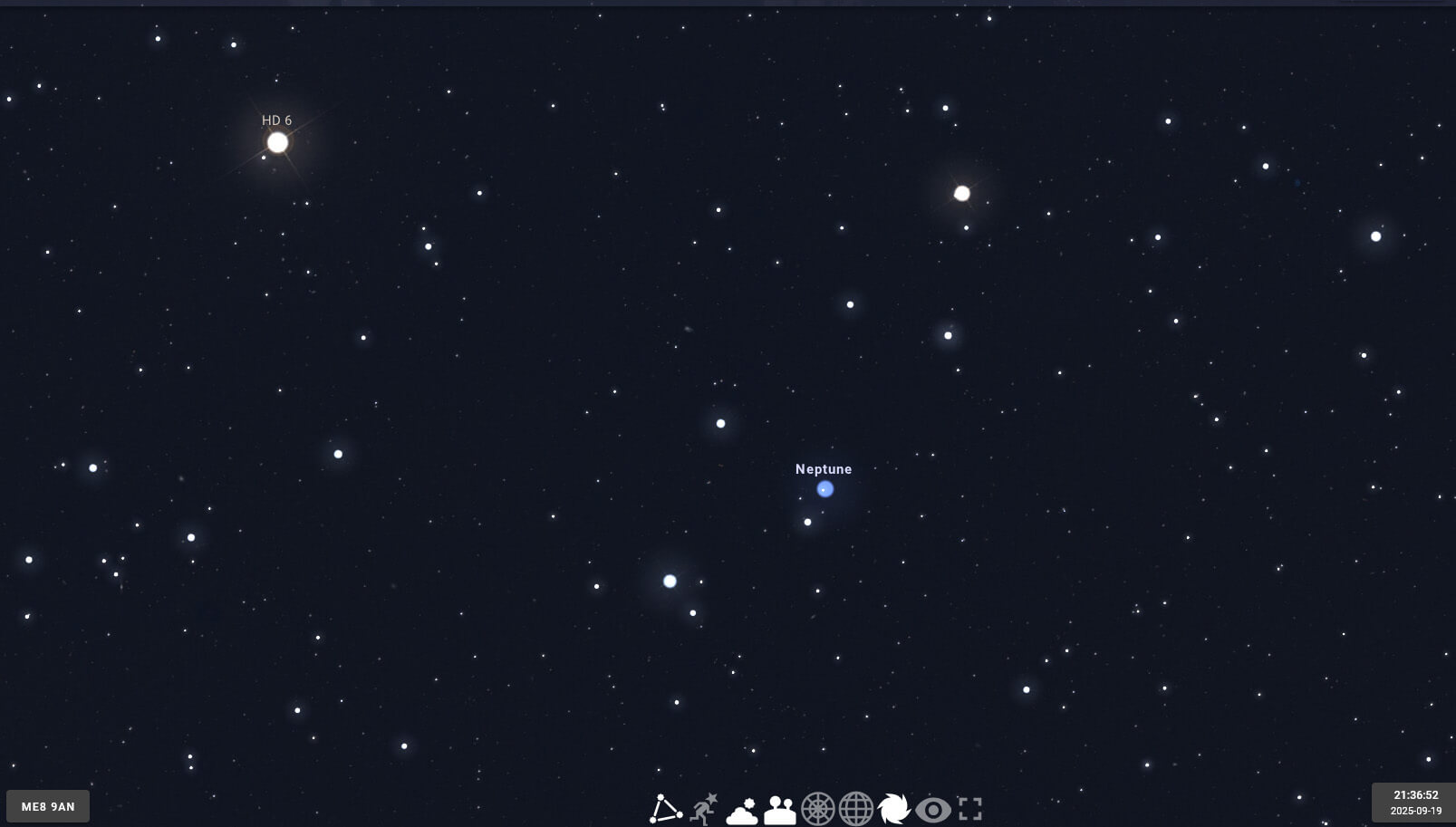
Image credit: JM (TRAC)
Above image: A magnified view of the area around Neptune, showing stars down to magnitude +13.
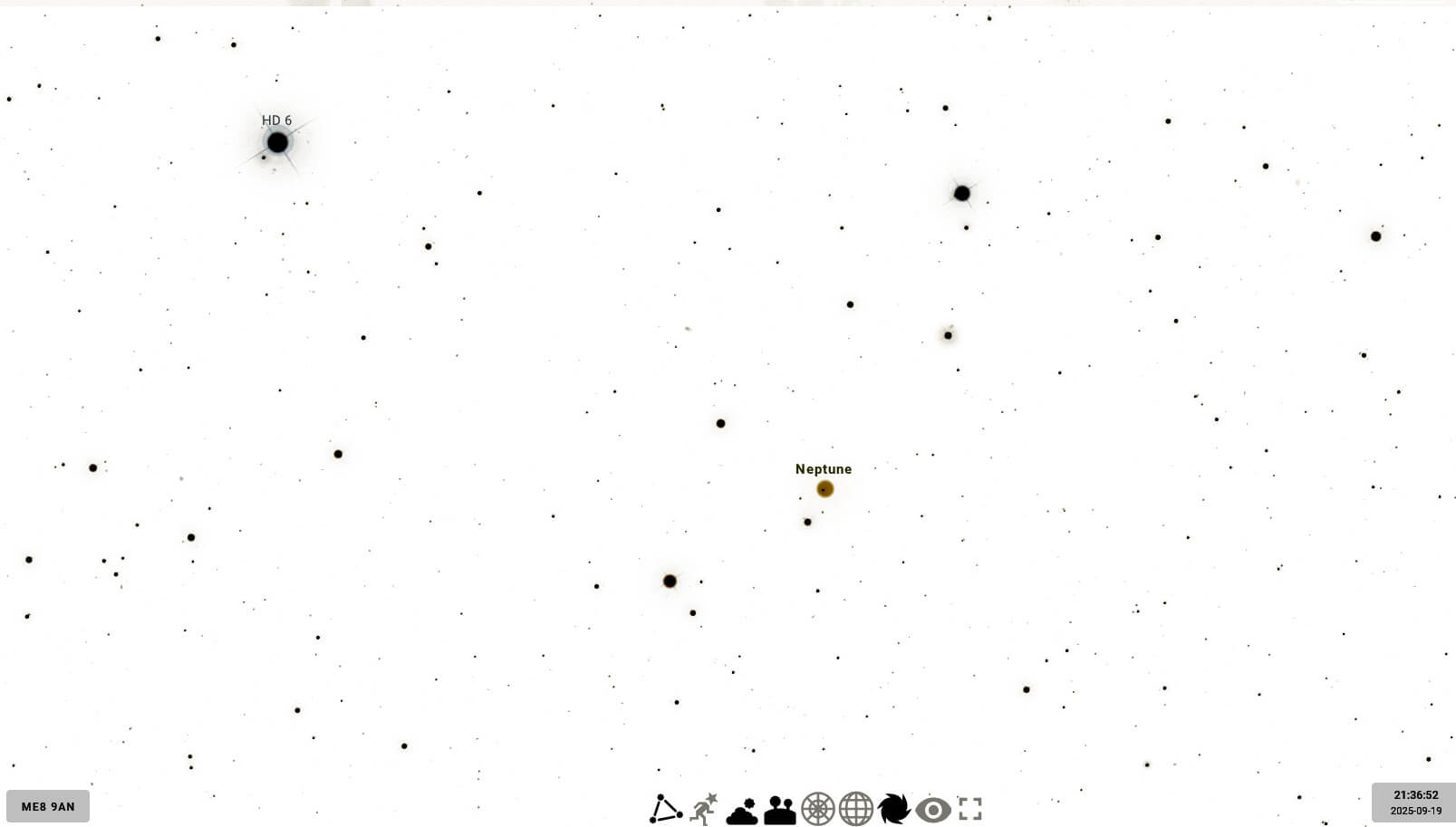
Image credit: JM (TRAC)
Above image: An inverted version of the previous image.
Hunting down Neptune was tricky; it required some detective work:
- The screenshots above show the night sky around Saturn and Neptune.
- We printed out these charts and used them to make our way from the bright planet Saturn to the much fainter planet Neptune.
- We were able to verify that we were looking at Neptune by comparing the view through the telescope to the positions and magnitudes of surrounding stars on our printed charts.
- We performed three checks to verify with 100% confidence that we had found Neptune. Everything matched up perfectly.
- This strategy can also be applied to other dim celestial objects such as Ceres, which we'll look for in October.
There are a few improvements we can make for next time:
- We'll horizontally flip the star chart images on the computer before printing them so that they match the view in the telescope eyepiece. That way, it'll be easier to navigate our way to Neptune. The credit for this idea goes to Matey K.
- New star charts are needed for different times due to Earth's rotation.
We have shown that it is possible to see Neptune from an urban area like Rainham. It just takes a small amount of planning before heading outside.
I'm confident that we'll be able to get a better view of Neptune over the winter. Our aim will be to see if we can resolve it as a small blue disc.
Summary
We came up against a lot of bad weather this month. The clouds ruined our view of the lunar eclipse and the lunar occultation of the Pleiades.
One silver lining to all the rain we had in September: there were more rainbows this month than I can ever remember, including a couple of double rainbows.
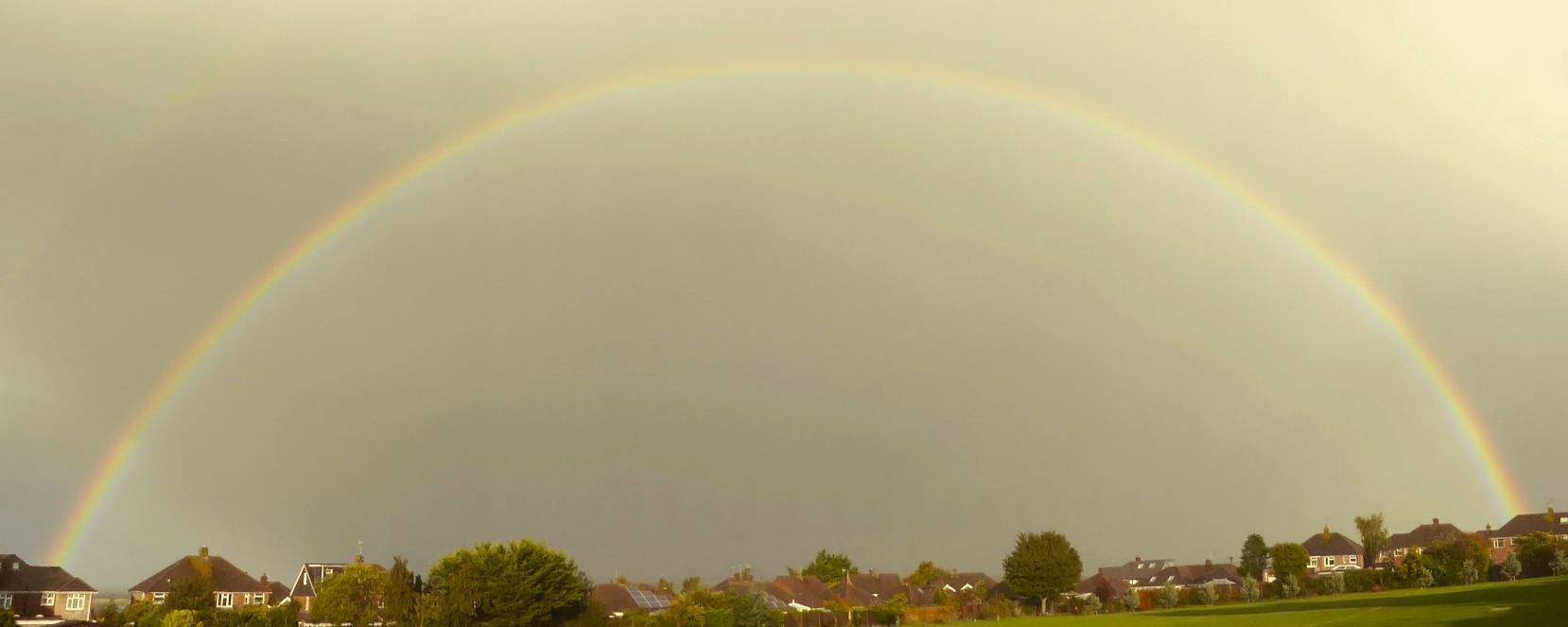
Image credit: JM (TRAC)
Above image: A stunning rainbow stretched across the sky on 13 Sep 2025.
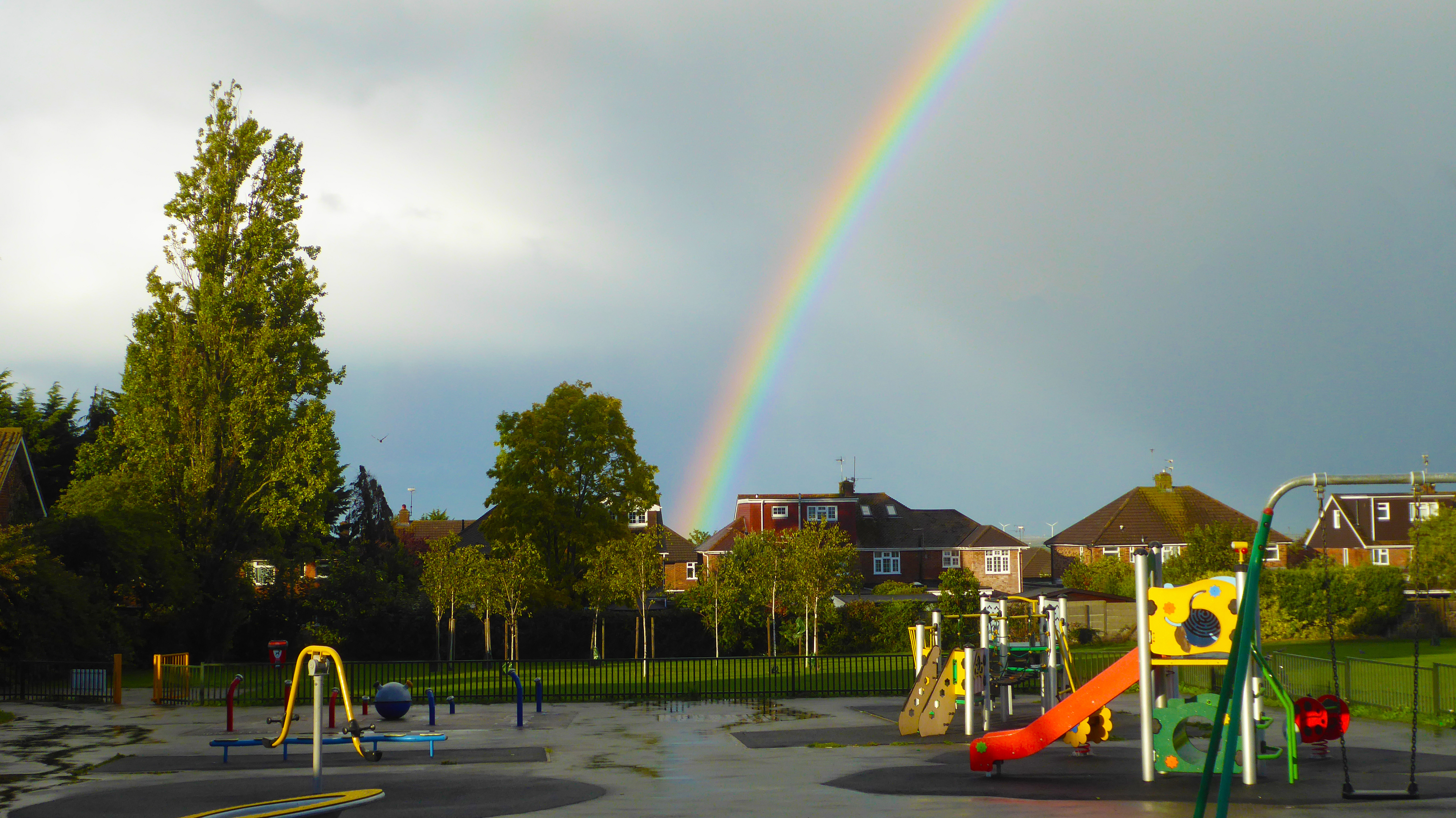
Image credit: JM (TRAC)
Above image: It looks like the end of the rainbow was in Cozenton Park. The pot of gold at the rainbow's end might be in Ryetop Park next time. Then it will be ours, and we can buy a bigger telescope.
Despite the frustrating setbacks, I think we did really well to carry on regardless and put in the extra effort required to finally locate Neptune. This is a huge success for us as an astronomy club, and it marks a major milestone in our progress towards intermediate-level status.
James M
TRAC Team Leader
30 Sep 2025 – Rainham, Kent

TRAC is an amateur astronomy group based in Rainham (Kent) in the United Kingdom.
On clear nights, you'll find us outside, observing stars, planets, moons, galaxies, satellites, meteors, and comets.
This monthly report is intended to keep club members informed of our observational activities, track progress towards the club's long-term goals, celebrate successes, and record memorable moments.
Unless stated otherwise, magnitude values refer to apparent magnitude and have usually been rounded to one decimal place; photos of deep-sky objects credited to TRAC were taken using a Seestar S50 smart telescope; our observations were made from Rainham, Kent; and times and dates are in the UK's local time zone (GMT or BST, depending on the time of year).
We welcome any questions, feedback, or suggestions you may have. Please let us know if anything is unclear or if you notice an error, inaccuracy, or typo. Contact us via email.
© 2025 Taverners Road Astronomy Club