TRAC Action Plan: April 2025
- Category: Action Plans
- Author: JM
- Published: 31 Mar 2025
- Last updated: 01 Apr 2025
April 2025 Calendar
- Tue, 01 Apr Moon close to the Pleiades after 21:30
- Sat, 05 Apr First Quarter Moon
- Sat, 05 Apr Moon close to Mars after 21:00
- Sat, 12 Apr Moon close to Spica after 21:00
- Sun, 13 Apr Full Moon
- Mon, 21 Apr Last Quarter Moon
- Tue, 22 Apr Lyrids peak
- Sun, 27 Apr New Moon
Spring Stargazing
Leo, Boötes, Corona Borealis, and Virgo
The brightest, most iconic spring constellations will be visible in the south-east by mid-April. We'll focus our attention on Leo, Cancer, Hydra, Virgo, and Boötes. Do you remember them from last spring?
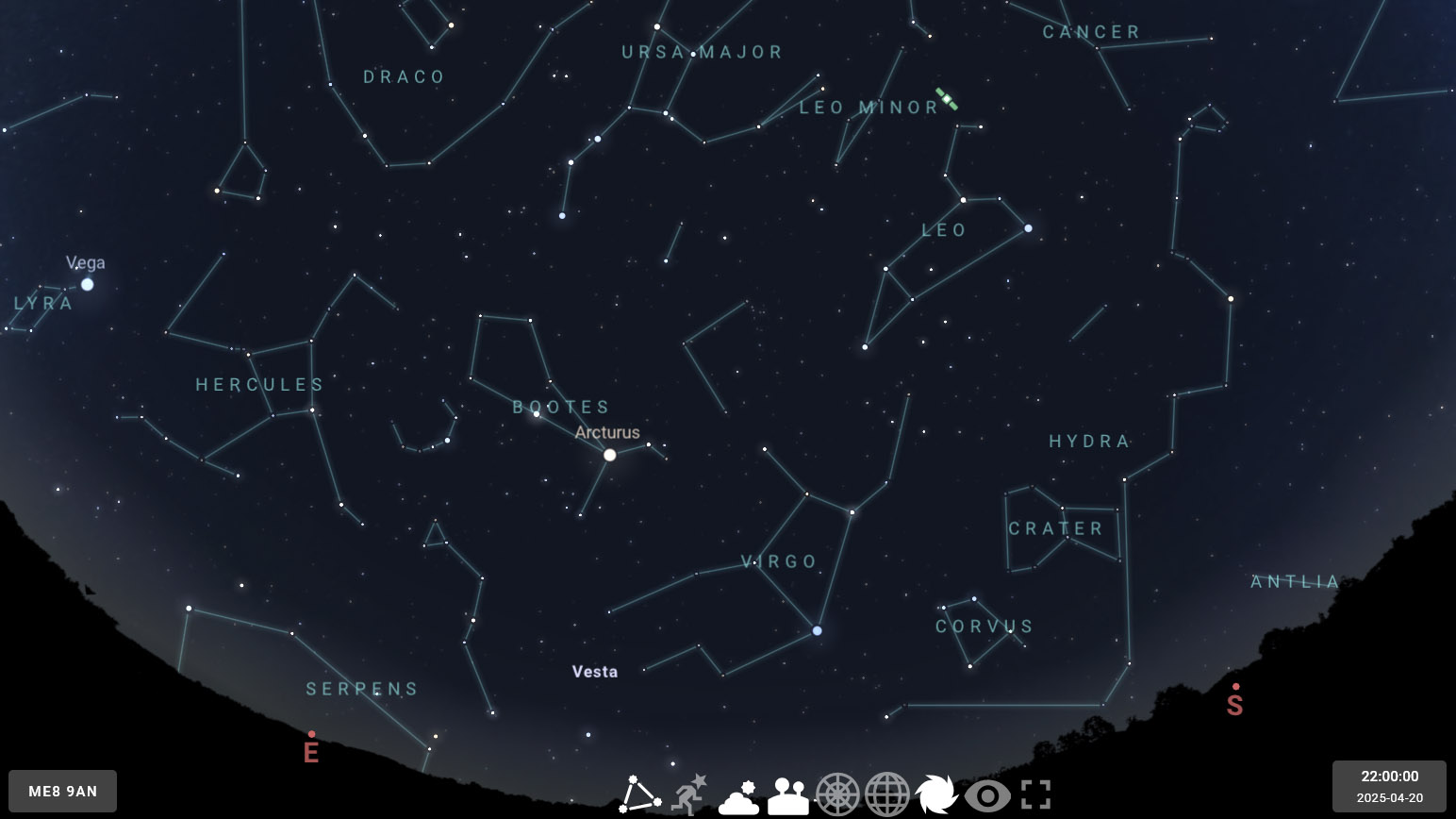
Image credit: Stellarium
One of our Astronomy Club's favourite stars, Vega, is also making its return to the night sky, now visible late in the evening in the north-east.
April Lyrids
The Lyrids ("April Lyrids") begins on 16 Apr 2025 and peaks on 22 Apr 2025.
The peak night for this moderate meteor shower occurs a day or so after the last quarter moon, so the Moon will be below the horizon until early in the morning, and the sky will be nice and dark.
Asteroid Vesta
Minor planet Vesta will appear brighter as we go through April. It will reach its peak brightness (mag. +5.6) on 02 May 2025. It will be about the same magnitude as Uranus and therefore quite tricky to observe. It will only appear as a faint dot through binoculars and the telescope.
We'll try to find Vesta in the second half of the month.
We didn't see an asteroid in 2024. Spotting an asteroid is one of our 2025 challenges. Vesta is our best candidate.
Open Star Clusters
Please refer back to our March 2025 Action Plan.
Solar Observations
Warning!
Looking at the Sun can cause serious eye damage or blindness.
The following methods are NOT safe:
- The naked eye
- Sunglasses
- Binoculars
- Smoked glass
- Cameras
- Telescopes
Safe ways to view the Sun:
- ISO-certified eclipse glasses from a reputable manufacturer
- Special solar filters and solar film for optical devices
- Pinhole cameras and other projection methods
Your eyesight is priceless. Do NOT take any risks.
NEVER allow children to view the Sun on their own.
Sunspots and Solar Photography
Our eclipse photos were not our best work. We need to figure out how to photograph the Sun in greater detail. All we need is more practice.
The telescope and solar film offer clears views of sunspots on the Sun's upper atmosphere. We can observe them over a few consecutive days, taking photos each time and tracking how they move or change on the Sun's surface over time. Then, we can use the photos to estimate the Sun's rate of rotation and compare our results to the actual value published by NASA.
Pinhole Camera Project
Our two "TRACOSCOPE" pinhole projectors worked brilliantly during the partial solar eclipse, providing a safe and enjoyable way for everyone to view the event.
Now that you've seen them in action, would you like to create one of your own?
Please refer all the way back to our May 2024 Action Plan for more information about pinhole cameras.
Planets
The planetary parade is now over.
Mercury, Saturn, and Neptune aren't visible this month, and Venus is now a morning planet rising at 05:00 for anyone who's up that early. On 25 Apr 2025, it may be possible to spot the Moon between Saturn and Venus in the east at 05:15.
Mars
Mars (mag. +0.5) starts the month in Gemini and gradually moves into Cancer while continuing to fade, reaching mag. +1.0 by the start of May.
The Red Planet is visible all evening, but it's moving away from us so its apparent diameter is shrinking.
Jupiter
Jupiter (mag. -2.0) is now much lower in the evening sky and will soon be gone.
We'll try again to see Jupiter's Great Red Spot (GRS) if we get a chance.
Transit timings for the GRS are listed here:
Uranus
Uranus (mag. +5.8) now sets at around 22:30 and will be lost in the twilight glow by the end of the month.
Lunar Observations
April 2025 Lunar Calendar
- First Quarter Sat 05
- Full Moon Sun 13
- Last Quarter Mon 21
- New Moon Sun 27
Note: In March, we used a variable polarizing filter to reduce the brightness of the Full Moon, and it worked really well. We'll use this technique for every Full Moon to improve the viewing experience.
One- or Two-Day-Old Moon
One of our challenges as a club is to see the Moon one day after the date of the new moon. In this phase, the moon appears as a very thin crescent.
I spotted the one-day-old 3%-lit crescent Moon at 20:30 on 30 Mar 2025.
Anyone who's interested in this challenge can look out for the one-day-old Moon on 28 Apr 2025 at around 21:00 from the park.
Refer back to the March 2025 Action Plan for more information.
Moon Conjunctions & Occultations
Conjunctions involving the Moon and a planet or a bright star, though common, always provide good photo opportunities.
Once again, the first half of the month offers a few celestial close encounters. Here's what we'll look out for:
| Date | Approx Time | Planet/Star | Moon Phase |
|---|---|---|---|
| Tue 01 Apr | After 21:30 | Pleiades | 16% Waxing Crescent |
| Sat 05 Apr | After 21:00 | Mars | 58% First Quarter |
| Sat 12 Apr | After 21:00 | Spica | 100% Full Moon |
Admin Tasks
New Designs
We will continue working on designing:
- Leaflets / business cards to give to passersby
- Certificates for children
- Limited edition TRAC 2025 bookmark
Website Content
- We'll review the photos and videos taken in March 2025 and add the best ones to the website.
- The website could do with a "Gallery" page to showcase our best photos.
- We still need to create avatars to put alongside our names on the "Meet the Team" page.
TRAC Research
Topics we need to read up on include:
- How to operate the Nikon D60 camera
- How a pinhole camera works
Summary
Top Priorities for April 2025
In descending order of importance:
- Sun Observations
- Pinhole Camera Project
- Vesta (Asteroid)
- Moon Conjunctions (Astrophotography)
- Spring Constellations
- One-day old Moon
- Jupiter's GRS
April Astrophotography
Photography opportunities this month include:
- The Sun (Sunspots and Limb Darkening)
- Various Moon Conjunctions
- Vesta (very difficult)
- Open Star Clusters (Pleiades/Hyades/Beehive)
- Jupiter's GRS (if we get perfect conditions)
See You Out There
Following on from our successful partial solar eclipse day, we'll focus on viewing the Sun if we get bright, sunny afternoons. It'll be interesting to see if we can calculate the rotation rate of the Sun. It'll almost be as much fun as Maths Club (but not quite as exhilarating).
It'd also be great if we could find Vesta because none of us have ever seen an asteroid before.
James M
TRAC Team Leader
31 Mar 2025 – Rainham, Kent

TRAC is an amateur astronomy group based in Rainham (Kent) in the United Kingdom.
On clear nights, you'll find us outside, observing stars, planets, moons, galaxies, satellites, meteors, and comets.
This action plan is specifically tailored for our location (Rainham, Kent), schedules, optical equipment, level of experience, personal interests, and local sky conditions.
Unless stated otherwise, magnitude values refer to apparent magnitude and have usually been rounded to one decimal place; photos of deep-sky objects credited to TRAC were taken using a Seestar S50 smart telescope; our observations were made from Rainham, Kent; and times and dates are in the UK's local time zone (GMT or BST, depending on the time of year).
We welcome any questions, feedback, or suggestions you may have. Please let us know if anything is unclear or if you notice an error, inaccuracy, or typo. Contact us via email.
© 2025 Taverners Road Astronomy Club