TRAC Monthly Report: May 2025
- Category: Monthly Reports
- Author: JM
- Published: 01 Jun 2025
- Last updated: 04 Jun 2025
Spring Night Sky
Spring Constellations
Despite the forecast, the night of 03 May 2025 offered excellent views of the spring night sky. The following constellations were easily seen: Virgo, Libra, Boötes, Corona Borealis, Hercules, Leo, Leo Minor, Corvus, Cancer, Auriga, and Ursa Major.
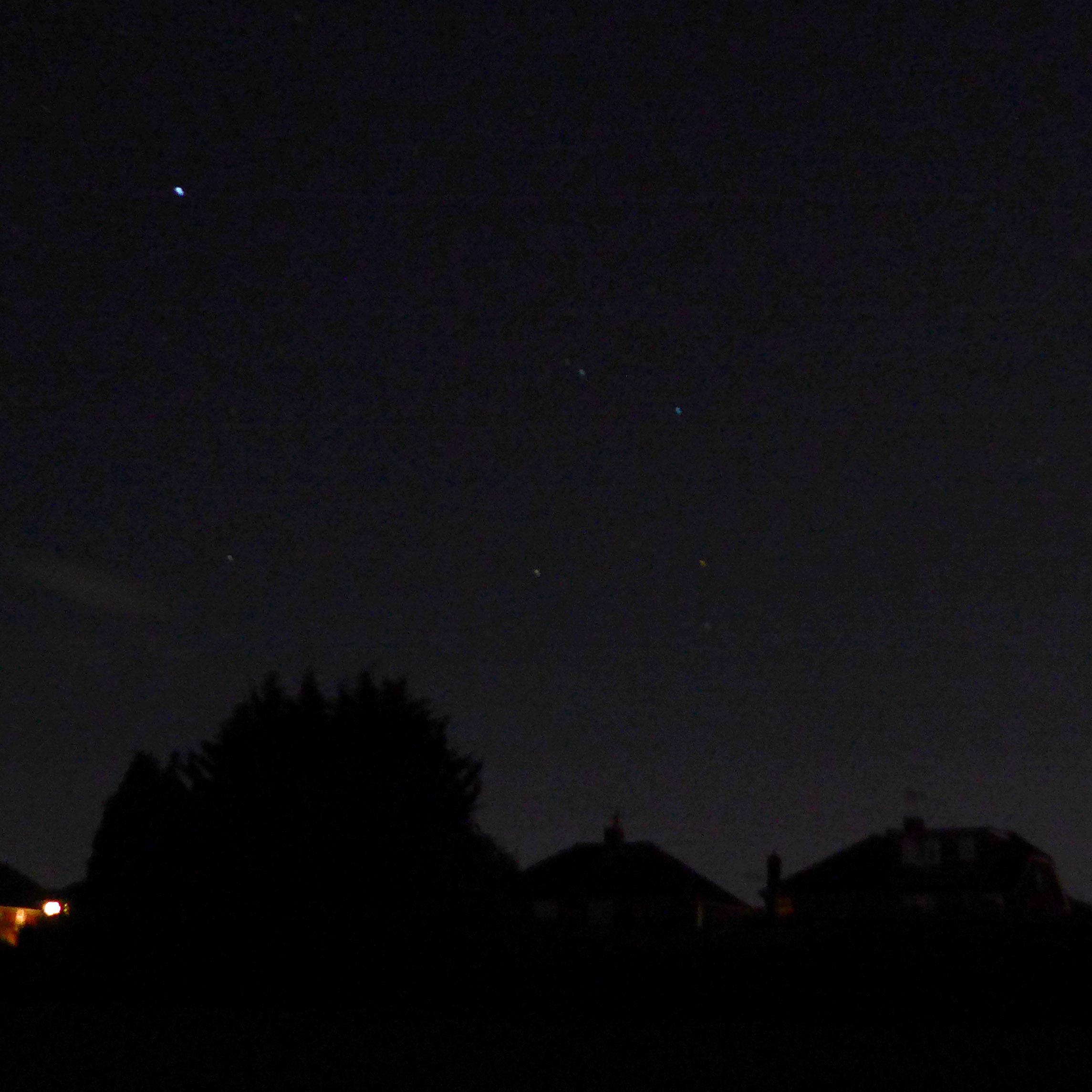
Image credit: JM (TRAC)
Above image: The bright star to the left is Spica (in Virgo) and to its lower left, the four main stars of the small constellation Corvus, the Crow, can be seen.
Satellite Spotting
On the same night, a very bright (mag. +1.6) satellite was spotted heading east. Using Stellarium, I was able to identify it as "NOSS 3-4r", a rocket used in the launch of satellites which are part of The Naval Ocean Surveillance System, operated by the US Navy.
This was a very bright satellite – the brightest I've seen.
Lunar Observations
Nikon Camera (10 May 2025)
We attched the DSLR camera to the telescope using the new T-ring adapter and took photos of the almost-full Moon. We had problems focusing the camera, and most of the photos were blurred.
We had better luck in shutter priority mode. We'll review the photos on the computer in June and have another go.
Cloud Obscures the Full Moon (11 May 2025)
May's Full Moon looked promising, but as soon as Charlie and Matey got the telescope set up, the clouds rolled in. We waited for 20 minutes, but the cloud only got worse.
We also discovered that the finderscope battery had died – probably because it was accidently left switched on from the previous night. Matey installed a new battery, and he recalibrated the finderscope using the bright star Arcturus, so it's all ready for next time.
The evening was not a total disappointment; Krum spotted the ISS at 21:17, and Charlie and Matey saw a bright meteor heading SW to SE at roughly 21:35.
Moon and Mars Near the Beehive Cluster (03 May 2025)
On 03 May 2025, the Beehive cluster was easily found in binoculars close to Mars and the Moon (1st quarter).
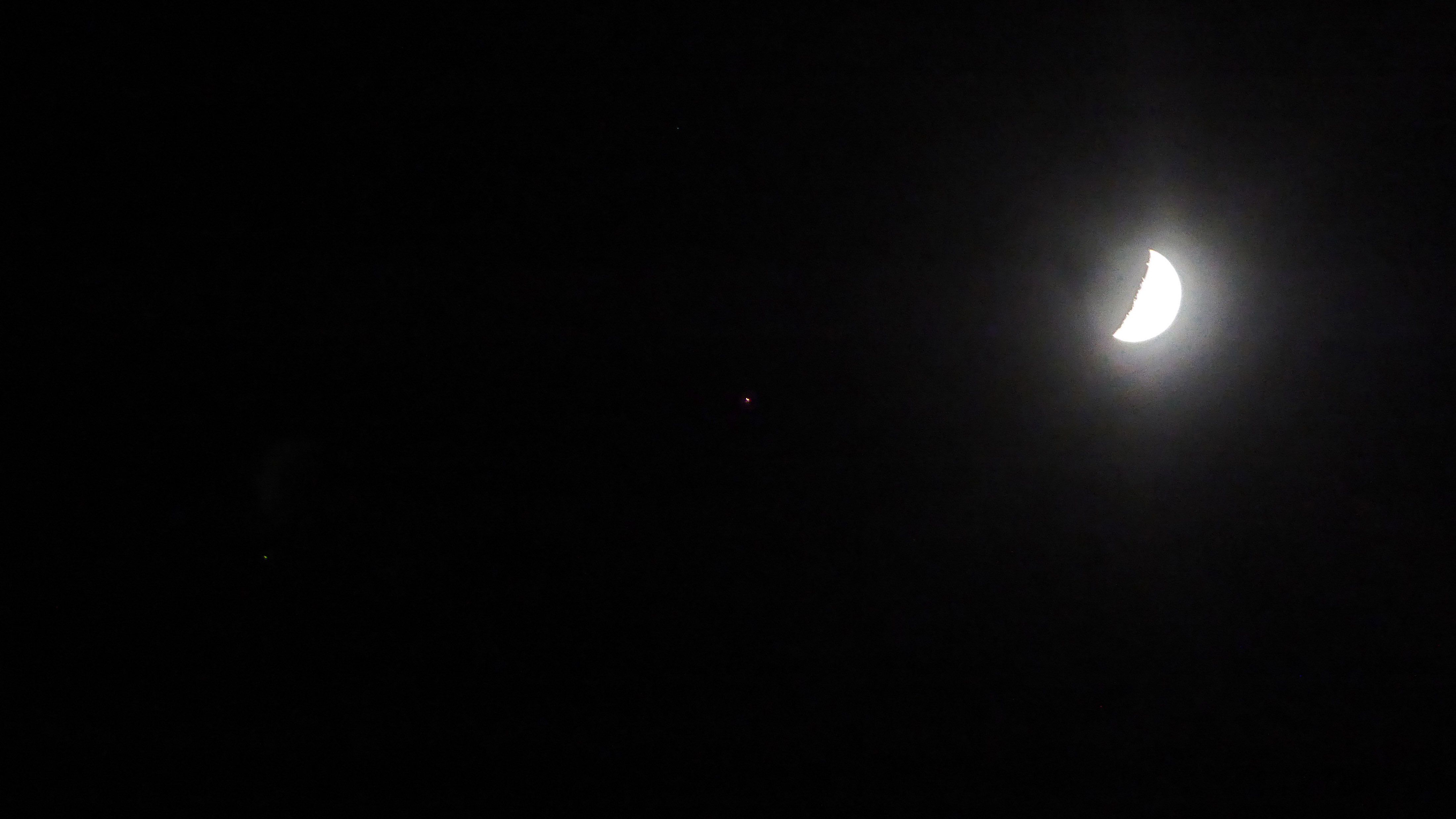
Image credit: JM (TRAC)
Above image: The central orange dot is Mars positioned between the Moon and Asellus Australis ("Delta Cancri"), a mag. +4.0 star about 140 light-years from the Sun in the constellation Cancer.
Asteroid Vesta
02 May 2025 – 22:15-22:35
Vesta was seen with binoculars, but conditions were poor. It's was quite difficult to find. I started at Spica and moved eastward, following the stars in Virgo until the triangle of stars was visible. Vesta was the faint dot in the middle of the triangle.
03 May 2025 – 22:25-22:45
Vesta was very easy to find at the right foot of Virgo in the middle of the triangle of stars. This was a 100%-confirmed sighting. Conditions were excellent, and the star at the right foot of Virgo was even visible to the naked eye, so finding it with binoculars was a piece of cake.
The aim is to track the movement of Vesta over the next week.
06 May 2025 – 22:25-22:30
Vesta was easy to locate again. Its movement west against the stars is evident.
The position of Vesta in the Stellarium app is not at all accurate! Repeated observations of Vesta confirms this to be the case.
Later in May
I looked for Vesta over a few nights near the end of May, but I was unable to locate it. It's faded slightly and moved away from the group of stars I had used to find it at the start of the month when it was at opposition.
ISS
The ISS was once again visible above the skies of Rainham during the middle of May 2025. The space station reflects light from the Sun and had an apparent magnitude of around -3.2, which is very bright.
When we've seen the ISS in the past, its appeared as a bright white disc. In May, it had a noticeably yellowish hue.
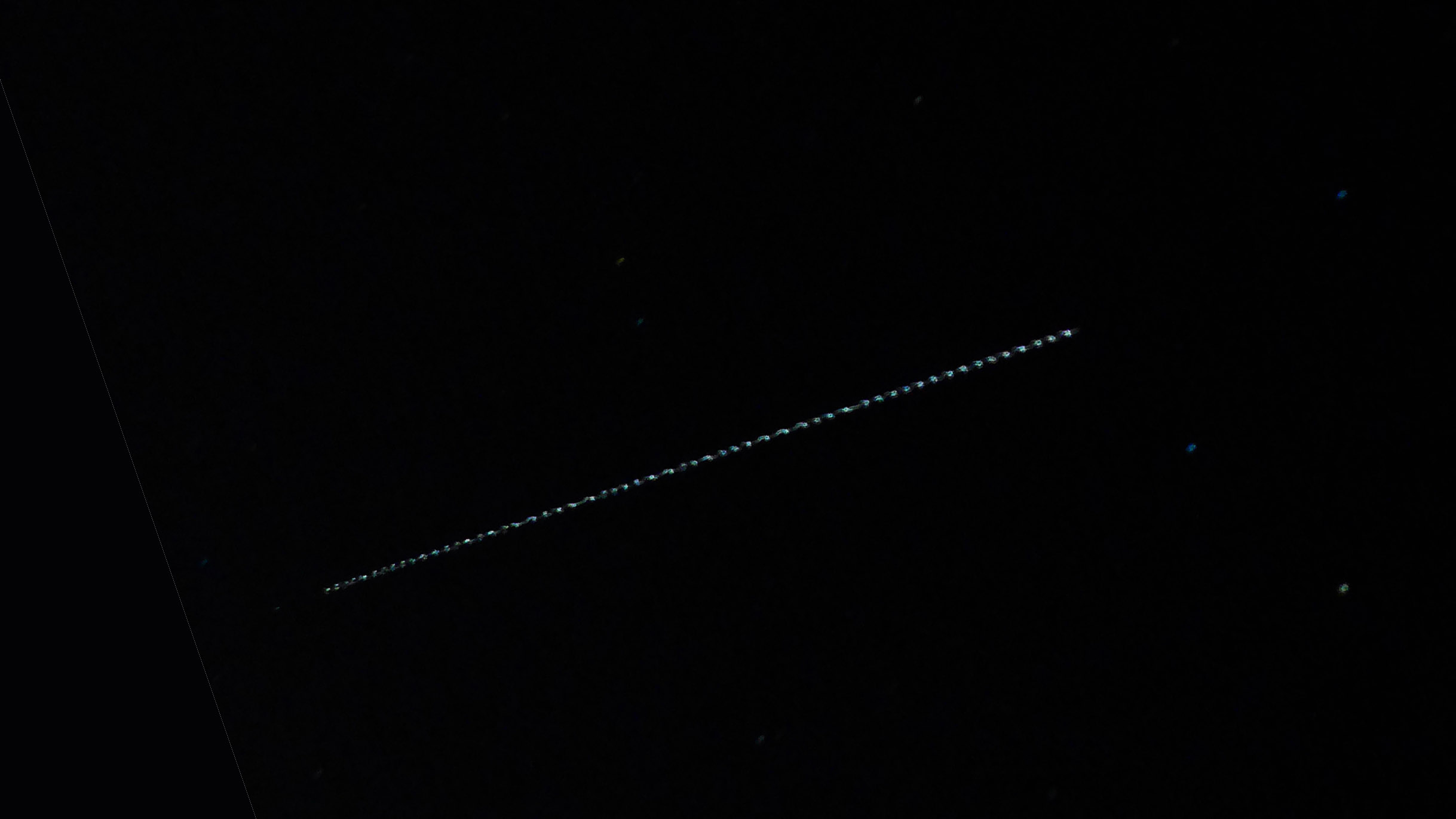
Image credit: JM (TRAC)
Above image: This 30-second exposure, taken on a point-and-shoot camera, shows the ISS as a bright dashed line across the field of view.
Summary
A Very Quiet Month
May was another quiet month at TRAC. The highlight was tracking Vesta's progress towards Spica in Virgo and seeing all the wonderful spring constellations on the exceptionally clear night of Saturday, 03 May 2025.
Our business cards were delivered on 23 May 2025. We can hand them out to curious passers by when we're doing astronomy activities in the park.

Image credit: JM (TRAC)
James M
TRAC Team Leader
01 Jun 2025 – Rainham, Kent

TRAC is an amateur astronomy group based in Rainham (Kent) in the United Kingdom.
On clear nights, you'll find us outside, observing stars, planets, moons, galaxies, satellites, meteors, and comets.
This monthly report is intended to keep club members informed of our observational activities, track progress towards the club's long-term goals, celebrate successes, and record memorable moments.
Unless stated otherwise, magnitude values refer to apparent magnitude and have usually been rounded to one decimal place; photos of deep-sky objects credited to TRAC were taken using a Seestar S50 smart telescope; our observations were made from Rainham, Kent; and times and dates are in the UK's local time zone (GMT or BST, depending on the time of year).
We welcome any questions, feedback, or suggestions you may have. Please let us know if anything is unclear or if you notice an error, inaccuracy, or typo. Contact us via email.
© 2025 Taverners Road Astronomy Club